


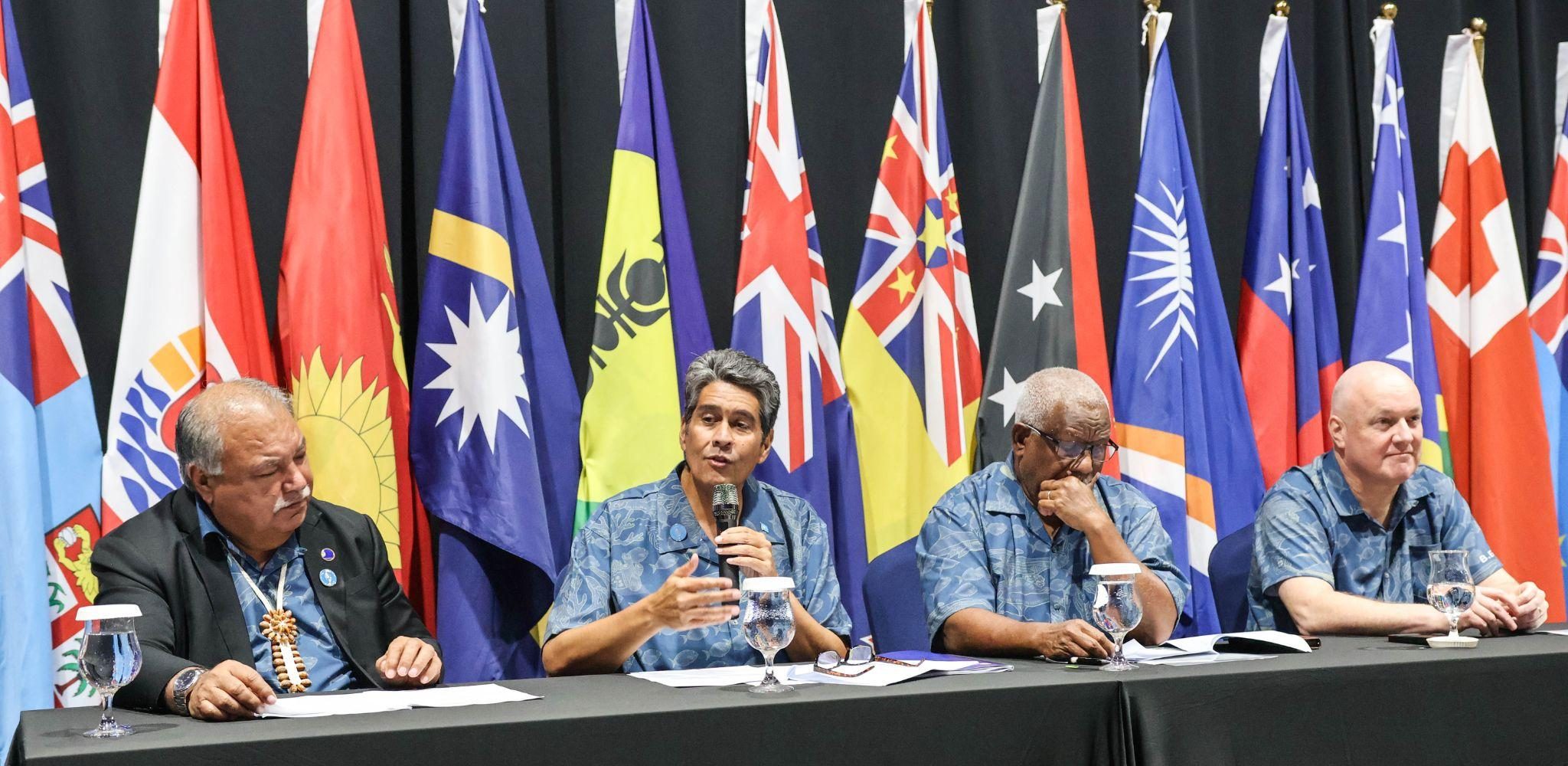
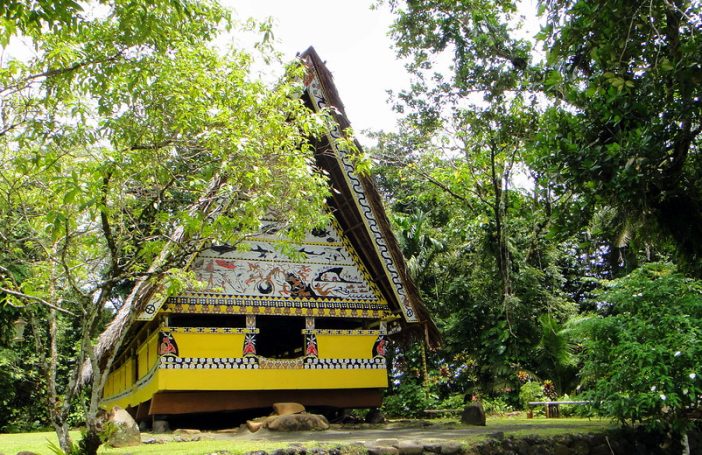
With a Chinese ballistic missile test in July as prelude, the familiar China-Taiwan tensions and preparations for the Pacific pre-COP in October and COP31 the following month, the annual Pacific Islands Forum Leaders Meeting (PIFLM) returned to Palau for the first time in 12 years, and north of the equator for the first time since Pohnpei in 2016.
Preparations for the 55th PIFLM were still underway as delegates arrived in Koror. An expected 2,000 people soon choked the town as motorcades shuttled VIPs between hotels and venues.
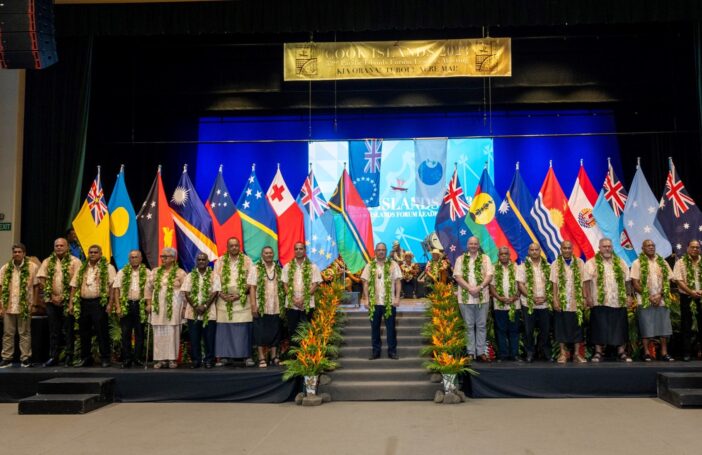
Attendance speculation dominated the early part of the week. The leaders of Fiji, Kiribati, New Caledonia, Samoa and Vanuatu were absent, and barely anyone mentioned that New Zealand’s Christopher Luxon, chair from 2027, only planned to attend the retreat. Kiribati, close to Beijing, sent the Director of Foreign Service and former ambassador to China, David Teaabo, but he was not in the room for the retreat, where the missile response was thrashed out, and Kiribati was initially omitted from acknowledgements at the closing session, which Teaabo called “protocol-wise … not good”. Matthew Wale, Prime Minister of Solomon Islands and outgoing PIF chair, added to the drama: met on arrival on the evening of Saturday 29 August by journalists asking about a no-confidence motion lodged in Honiara that day, he flew home in the early hours of Sunday. (The motion was withdrawn on 7 September.)
Invited back were the Forum’s 21 dialogue partners, excluded from last year’s meeting in Honiara over China-Taiwan tensions, along with the sole “development partner”, Taiwan. At the opening ceremony, China’s envoy Qian Bo and Taiwan’s foreign minister Lin Chia-lung were seated in the same room.
The week culminated in the communiqué, 76 paragraphs under headings tracking the thematic areas of the 2050 Strategy for the Blue Pacific Continent. Leaders endorsed “revised Communiqué drafting procedures”, but the document is increasingly flabby and lacks forward momentum: “reaffirmed” appears 38 times and “endorsed” 20; “agreed” 14 times, twice only in principle; “tasked” once.
Leaders agreed on the placement of partners in the two “partnership streams” created by last year’s Leaders Policy on Partnerships, the communiqué’s only words on the subject. As the Secretariat explains it, Tier 1 “strategic partners” keep leader-level access, while Tier 2 “sectoral partners” engage only at ministerial level on specific issues, with placements reviewed after a year. Secretary General Baron Waqa will now write to the countries concerned. The communiqué does not name them, but the ABC and SBS report that the 13 strategic partners are China, the United States, Japan, France, India, Indonesia, Germany, the United Kingdom, the European Union, Canada, Singapore, South Korea and the United Arab Emirates. That leaves in the second stream Türkiye, the host of COP31, and Thailand, whose prime minister is coming to the pre-COP, and six others. Their reactions will be watched closely.
The Belau Declaration for Urgent and Inclusive Climate Action to Keep 1.5°C Within Reach was issued the day after a sobering UNEP report confirmed that the target will be overshot, as the declaration itself concedes. It restates the Pacific position more strongly for the pre-COP and COP31 but sets out no pathway for returning the issue to centre stage globally; that job is deferred to the leaders’ meeting in Tuvalu that sits alongside the pre-COP proper, which Fiji co-hosts.
After Australia failed to secure a Pacific COP31, the consolation prize of a pre-meeting had been sold as a chance for world leaders to see Pacific climate impacts firsthand. Fiji’s foreign minister, Sakiasi Ditoka, revealed that the leaders of Antigua and Barbuda, Cabo Verde, Thailand, Maldives and Timor-Leste would come, along with a handful of ministers. Leaders do not usually attend pre-COPs, but the media presented the low turnout as a major embarrassment.
For some, Australia’s own contribution remains the sticking point. Vanuatu’s Climate Change Minister, Ralph Regenvanu, was typically forthright, telling the media that Australia was “not doing enough” and must end fossil fuel expansion. He spoke on the day Australia’s new environmental regulator approved an extension of the BHP Mitsubishi Alliance’s Saraji coal mine to 2055, its first coal approval since it began operating on 1 July, and by the Climate Council’s count the 37th fossil fuel project approved since Labor took office in 2022.
The Chinese missile, fired from a submarine, crossed the exclusive economic zones of several Forum members, including the Federated States of Micronesia, Naoero (formerly Nauru) and Kiribati, before coming down near the Kiribati-Tuvalu boundary. Leaders “registered concern” and called for at least 24 hours’ notice of future tests from all states, presumably including the United States, though neither China nor the US is named. But with Kiribati absent from the retreat and Naoero’s president, David Adeang, dissociating his country from the paragraph in a footnote, the consensus was undermined. Naoero, which switched recognition to Beijing in 2024, was the sole formal dissenter among the 18 members.
There was some movement on West Papua. Prodded by the Melanesian Spearhead Group (MSG), the PIF agreed to facilitate a dialogue with Indonesia and a mission of “interested Leaders”, destination unstated, in consultation with the MSG Secretariat, reporting back in 2027. The Forum’s envoys, appointed in 2023, Fiji’s Sitiveni Rabuka and PNG’s James Marape, are to press Indonesia on the long-sought visit by the UN High Commissioner for Human Rights, the invitation for which was originally extended by Indonesia in 2018 but still not granted. The MSG wants the visit by 31 December 2026, when Indonesia’s presidency of the UN Human Rights Council ends, or it will review Indonesia’s associate member status at its 2027 summit.
Leaders also approved terms of reference for a Renewable Energy Commissioner, first agreed in 2023, to sit within the Pacific Community (SPC) with dual reporting to SPC and the Forum Secretariat, funded by an initial A$1.89 million from Australia. Once appointed, the commissioner is to advocate for investment in renewables and coordinate the push towards 100% renewables, cutting dependence on imported diesel.
AI and digital sovereignty formally joined the regional agenda with the endorsement of the Pacific Digital and Artificial Intelligence Technology Principles, “the Pacific’s first collective regional position on artificial intelligence”, which will inform a governance framework in 2027.
The Pacific Pact on Gender and Climate Action is also new, committing governments to strengthen women’s representation in climate delegations, ministerial portfolios and governance bodies. Asked at the final press conference how that would happen with only one female leader among the Forum’s 18 members (Marshall Islands President Hilda Heine), after some confused looks, PIF chair Surangel Whipps said Palau is traditionally a matrilineal society where the women “decide who’s chief”, and predicted that “a new woman president is not far away”. (When Whipps invoked the influence of leaders’ wives, Luxon said, “That’s not the same, mate”.)
The closing press conference also exposed issues yet to reach the leaders’ agenda, none of them in the communiqué: a growing HIV crisis, which civil society groups complained was left off the health agenda; the future of Bougainville as it moves towards independence from Papua New Guinea; and the ambitions of Guam and American Samoa, associate members since 2024, for full membership despite their status as US territories.
The next PIFLM will be held in New Zealand in 2027, and the one after that in Naoero, the missile-testing dissenter, followed by Marshall Islands in 2029, Vanuatu in 2030 and French Polynesia in 2031. Whether the intervening 12 months produce action on the commitments made in Koror, or another communiqué heavy on reaffirming and light on tasking, remains to be seen.




Thanks very much Tess and Stefan for a helpful summary of the recent leaders’ meeting. Thanks also for including so many helpful hyperlinks.
Amanda