


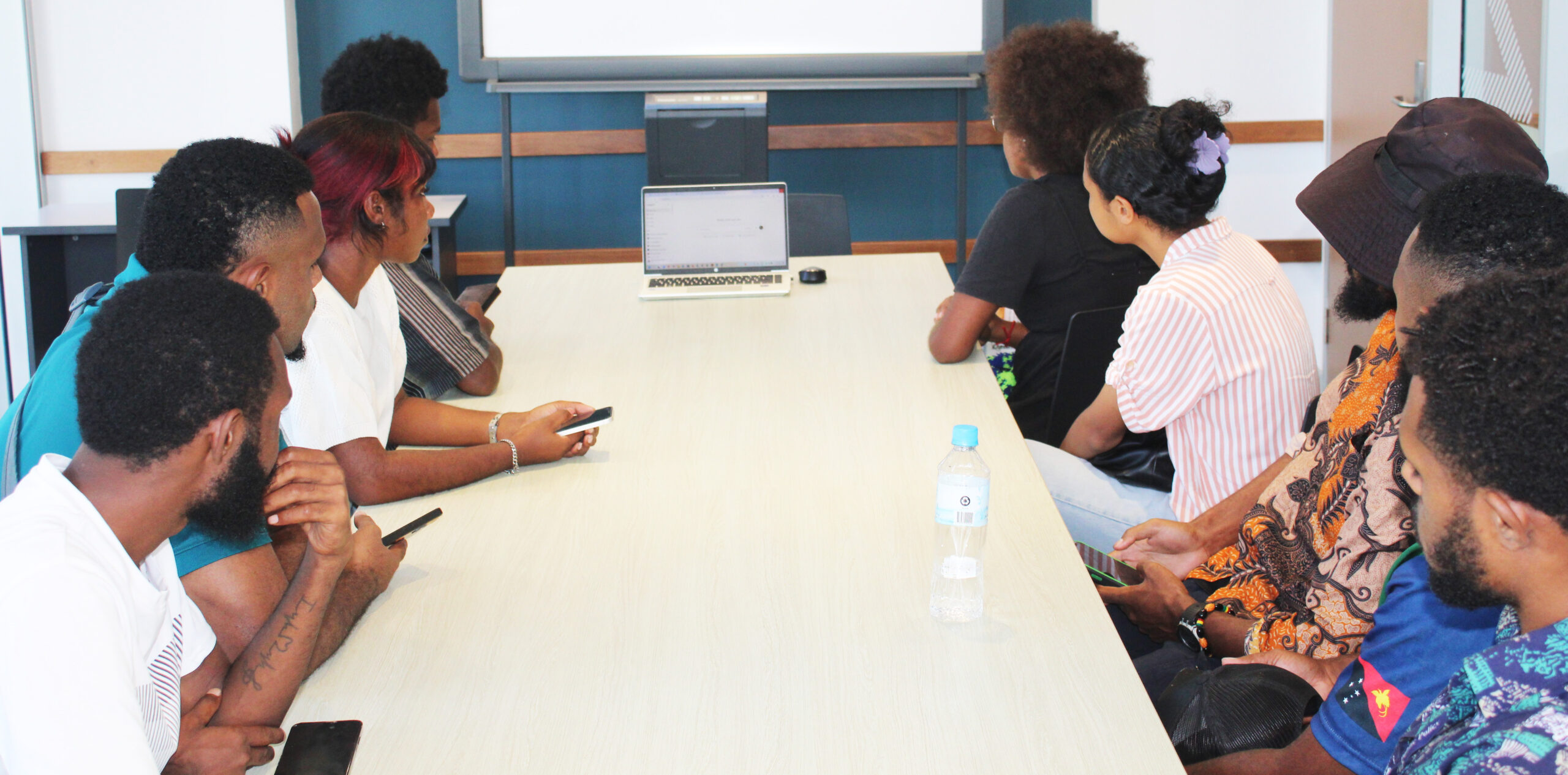
Artificial intelligence (AI) is often discussed as something that will reshape higher education in the future. But for many students, that future has already arrived.
At the University of Papua New Guinea (UPNG), students are already using AI tools to search for information, summarise readings, draft ideas, improve their writing and prepare job applications. This does not mean that AI has transformed learning overnight. Nor does it mean that students are all using it in the same way or always using it well. But it does suggest that AI is no longer outside the university. It is already part of student life.
A preliminary survey of 77 students at UPNG gives us an early indication of how students are engaging with AI. The survey included undergraduate and postgraduate students from the School of Business and Public Policy, including Executive MBA students and Bachelor of Business and Management students. Seven questions about AI were asked of the students.
The sample is limited, so the findings should be read with caution. They are not representative of all UPNG students or of higher education students in Papua New Guinea more broadly. A larger follow-up study is planned, which will include more students and academics.
Even so, the findings are useful because they point to an issue universities can no longer ignore.
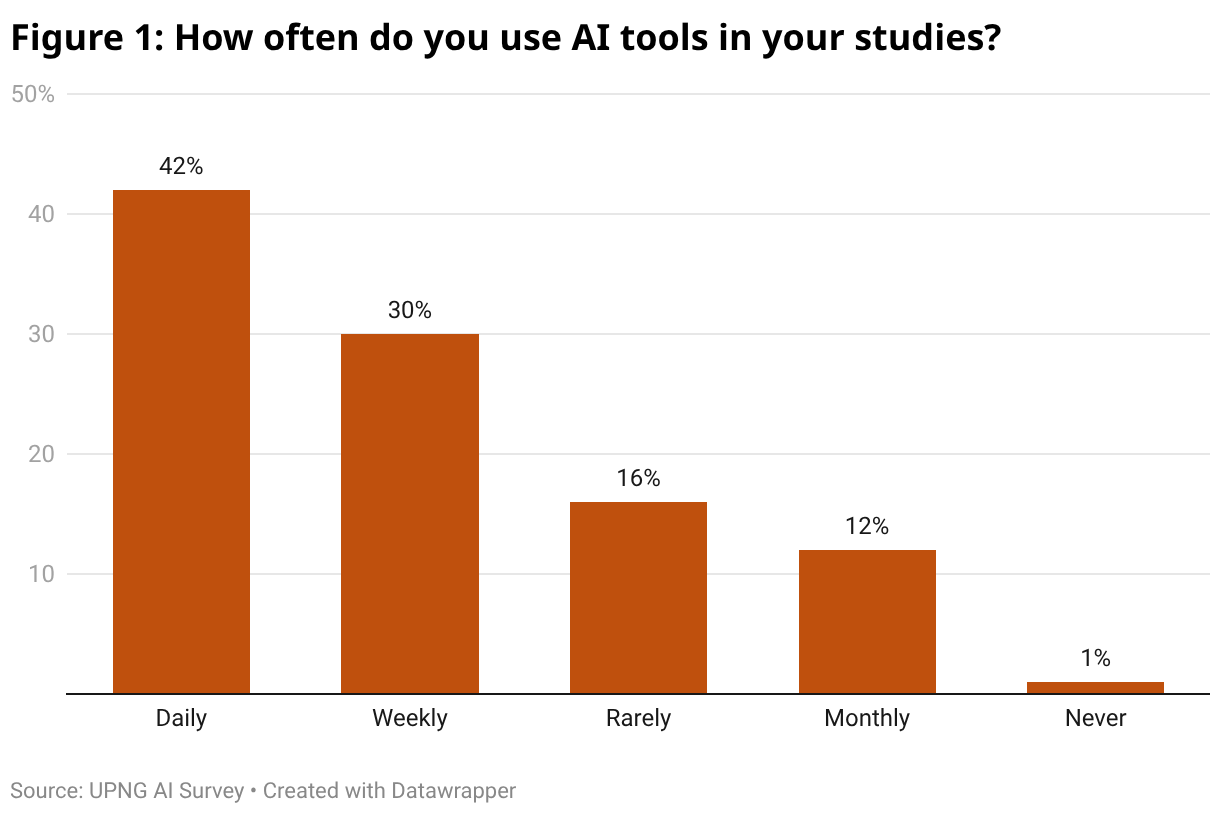
Of the 77 students surveyed, 42% said they use AI tools daily. Another 30% said they use AI weekly. In other words, more than seven in ten students reported using AI at least once a week. Only one student said they never use AI.
The most commonly used tool was ChatGPT. 66 students, or 85%, said they had used it. Microsoft Copilot was also widely used, by 34 students or 44%, followed by Google Gemini, used by 18 students or 23.4%. Smaller numbers reported using Grammarly, Claude or other tools.
These figures suggest that AI use among these students is not marginal. It is already common. But the data also raise questions about access and equity. Most students reported using free AI tools. Free versions may be useful, but they often have fewer features and capabilities than paid versions. Students with better internet access, better devices or the ability to pay for more advanced tools may have an advantage over others. In a country where digital access is uneven, this matters.
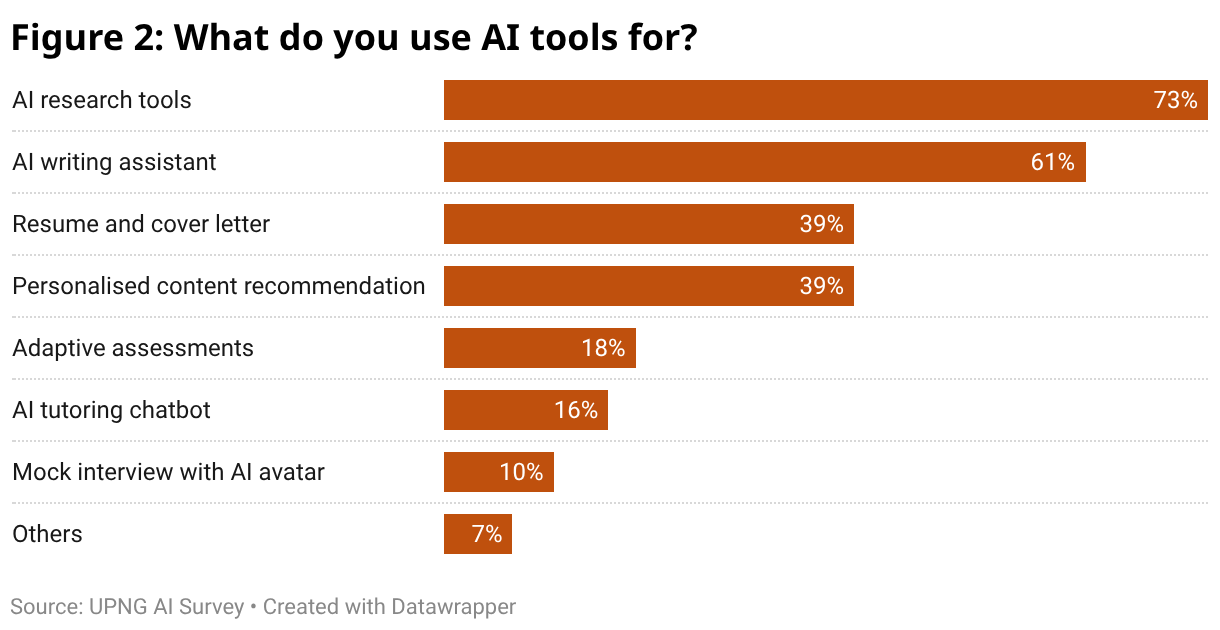
The survey also asked students which AI uses were most beneficial for their learning. As shown in Figure 2, students most often selected AI research tools, at about 73%, followed by AI writing assistants, at around 62%. A substantial share also saw value in AI for resume and cover letter support and personalised content recommendations, both at about 40%. Fewer students selected adaptive assessments (personalized tests that adjust in real time to a learner’s responses) at around 18%, AI tutoring chatbots at about 15% and mock interviews with an AI avatar at around 10%. Only a small proportion selected other uses.
This is an important point. Public discussions about AI in education often focus on cheating. That concern is real and should not be dismissed. But the survey suggests that students are also using AI in more ordinary and practical ways: to understand material, organise ideas, improve written expression and manage study tasks. For students working in a second or third language, or balancing study with work and family responsibilities, these tools can be attractive and useful to enhance learning.
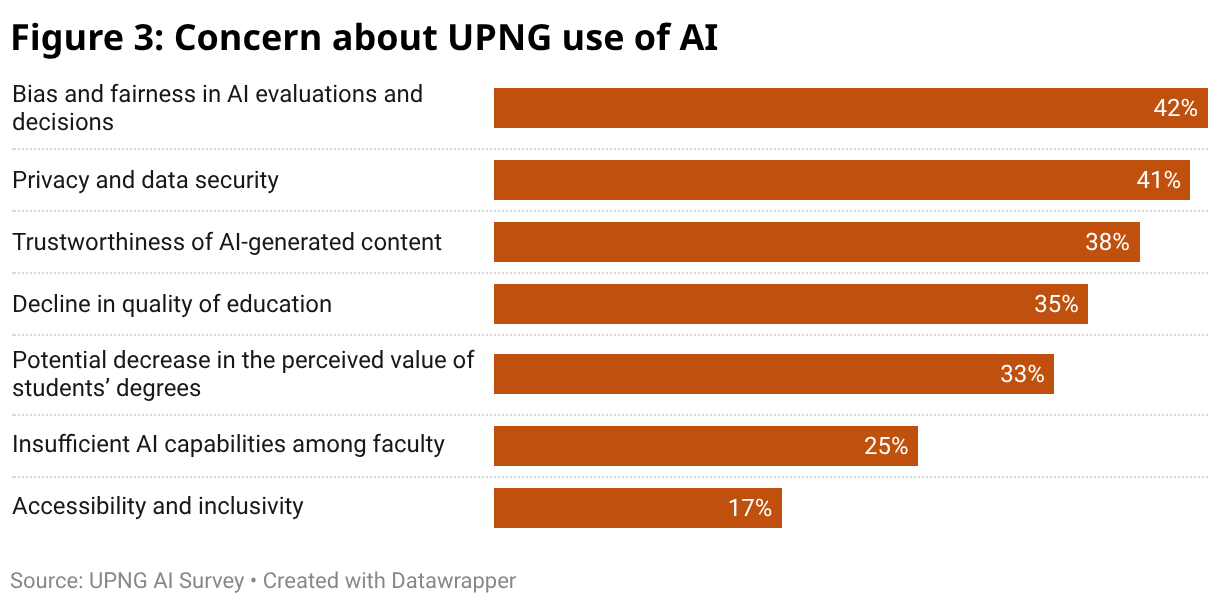
Students also raised concerns about the risks of AI use at UPNG, particularly around fairness, privacy, trustworthiness and educational quality. These concerns suggest that students are not simply asking for more AI use, but for clear guidance on how AI can be used responsibly, fairly, ethically and without weakening educational standards.
For universities, the challenge is not simply to catch misuse of AI. It is to help students understand both the value and the limits of these tools.
When asked what they expected from UPNG in relation to AI, the most common answer was better guidelines and communication about AI use. This was selected by 74% of respondents. Students also wanted greater use of AI in teaching and learning, selected by 61%, and more AI literacy courses, selected by 48%. A smaller but still important group wanted more student involvement in AI-related decisions.
This is a constructive message. They want to know how AI can be used appropriately, what is allowed in assessments, what needs to be acknowledged and where the boundaries are.
We suggest four practical strategies.
First, universities need clear and practical AI guidelines. These guidelines should not be written only as rules against cheating. They should explain how AI can support learning, when its use is acceptable, when it must be acknowledged and when it is not allowed. Students and staff both need shared expectations. (The Australian National University has published a guide on best practice when using generative AI.)
Second, universities should invest in AI literacy. Students need to learn how to use AI critically, responsibly and ethically: how to ask better questions, check the accuracy of responses, protect personal data, avoid plagiarism and use AI to strengthen rather than replace their own thinking. Academics also need support. They are being asked to teach, assess and supervise in an environment that is changing quickly. Without training and institutional support, the burden will fall on individual lecturers.
Third, AI should be integrated into teaching and curriculum in a careful way. This does not mean every course should become a course about AI. Rather, each discipline should ask what AI means for its field. How will AI change business, public policy, law, accounting, health, education or human resources? What skills will graduates need? How can assessment be redesigned so that students can develop their own knowledge and judgement while learning how to use AI responsibly?
Finally, this is not only an institutional issue. PNG’s higher education sector would benefit from broader policy guidance. National guidelines could help universities respond consistently while still allowing flexibility across different institutions and disciplines. They could also help address questions of access, equity, academic integrity and workforce readiness.
The findings from this small survey should not be overstated. They are preliminary and limited to a small group of students at one school within UPNG. But they are still informing us. They show that students are already experimenting with AI, often for practical learning purposes, and that they want clearer guidance from the university.
The next stage of this research will involve a larger study of students and academics. That broader evidence will be important for understanding how AI is being used across the university, how staff are responding, and what policies and support systems are most needed.
For now, one lesson is clear: AI is already part of student learning. The task for universities is not to pretend otherwise. It is to guide its use in ways that protect academic standards, support genuine learning and prepare students for a world in which AI will increasingly be part of professional life.




This is interesting research based on current changing technological world. AI is taking over, with people either using it academically or personally. Most students and non-students used it for study purposes as well as to answer their daily problems, for example, they use it to ask about relationships issues, family issues etc. Apart from using it only on academic AI is their friend leading to lesser number visiting student counsellors. Further research should also look at the non academic usage of AI to see if it helps students.
Given the epistemic centrality of generative AI, the sociology of knowledge provides a useful standpoint or lens to understand the societal implications (especially for education). Digital infrastructures are already deeply entangled in the production and legitimation of knowledge. AI brings opaqueness and automation to the party. One can understand AI as a step intensification of “deep mediatisation” (see Couldry & Hepp, 2016). I believe that we need to look at AI in education policy making not only as operational guidance but in a deeper way, understanding it’s potential role in not only representing but in shaping and constituting our reality (and what education means to us). Conducting research into the current situation as you have done is the obvious step towards a properly grounded approach to establishing a common set of rules for teachers and students, and so on. This should be within a broader collaboration to decolonise AI ( for instance, develop sovereign or regional genAI trained with our own data. (I am commenting as a Solomon Islands citizen and PhD student researching knowledge, discourse and digitalisation.)
David, you have worked in the communication technology space for years. I would love read and see your work out there. Please email me and let’s talk.