


It is well known that the people of Bougainville want independence. In the 2019 referendum, 98.3% of them voted for it. And in 2025, Ishmael Toroama, a strong advocate of independence, was re-elected to the position of President of the Autonomous Region of Bougainville, further confirmation of the widespread support for independence among the people of Bougainville.
But what do the people of PNG think about Bougainville independence? Much less is known about this. As a start, we included a question about Bougainville independence in the 2025 annual survey of UPNG students.
When asking the question, we reminded the students we surveyed of the strong support in Bougainville for independence, and told them that, as mentioned above, “in a recent referendum, an overwhelming majority (98.31%) of voters in Bougainville chose to have full independence from PNG over greater autonomy.” We then asked the students to consider this outcome when selecting from one of four options that we presented to them. They could say that Bougainville should be granted full independence, that it should remain in PNG with greater autonomy, that they oppose any changes in Bougainville’s current status, or that they were unsure.
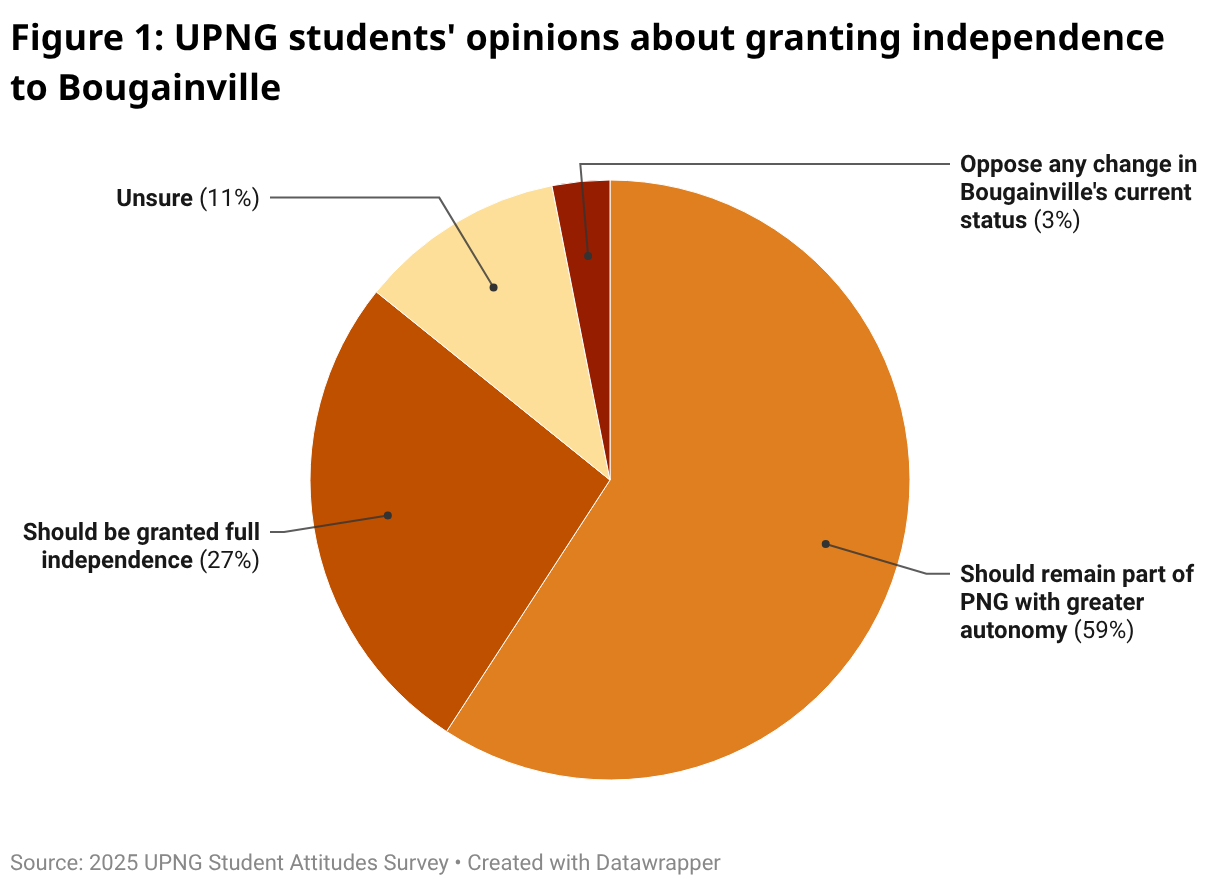
Only 27% of the 389 School of Business and Public Policy students who took the survey supported full independence. 59% said that Bougainville should remain part of PNG but with greater autonomy. 11% said they were unsure and 3% said that they supported no change in the current status.
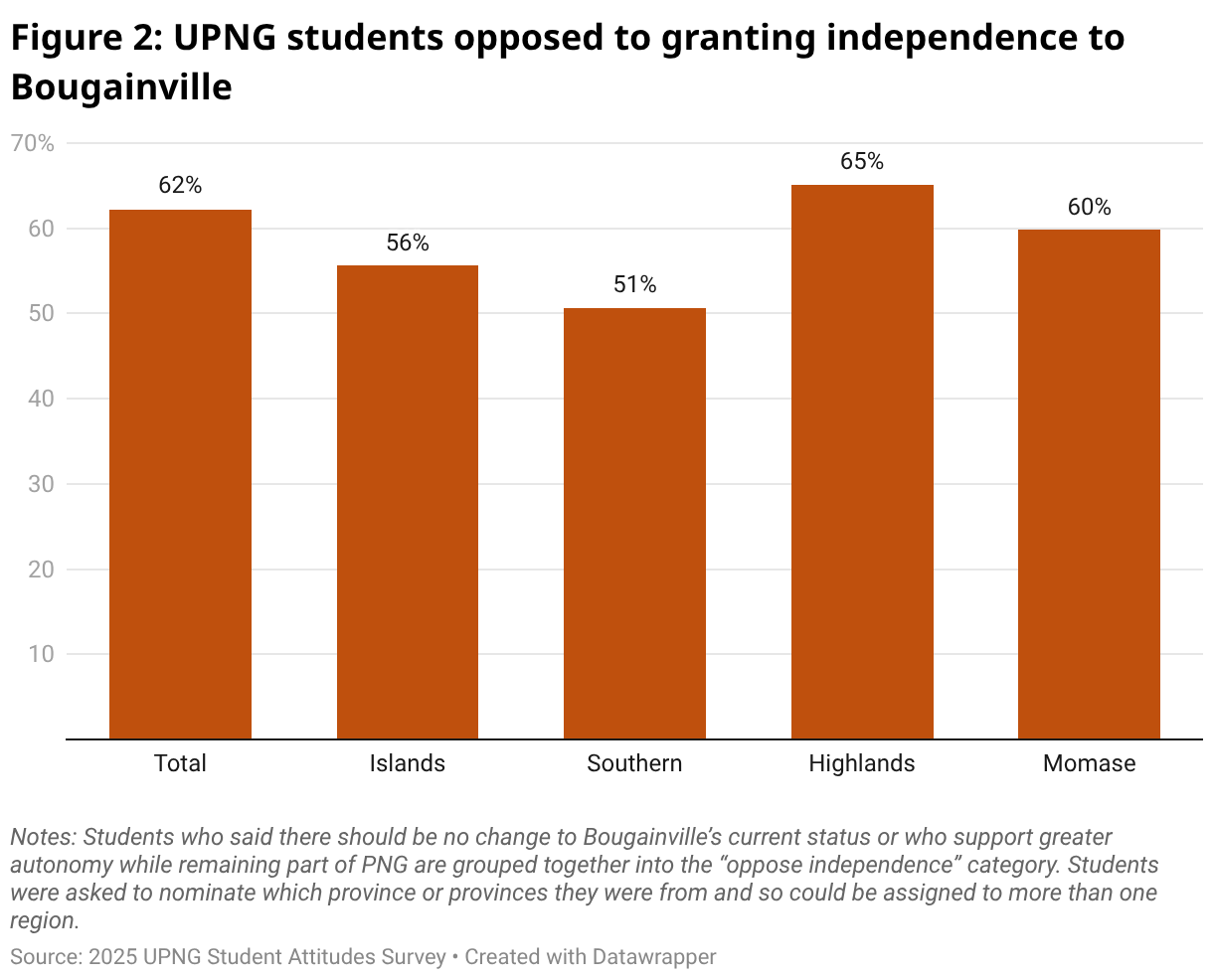
Opposition to independence was widespread across all four regions of PNG, but was slightly stronger among students from the Momase and Highlands regions, and lower among students from the Islands and Southern regions. However, these differences are not statistically significant. Even in the Islands region, which might be expected to be more sympathetic to Bougainville independence, a majority of students were in fact opposed. The most supportive was the Southern region, but even there 51% of students were opposed to independence.
Female students were slightly more supportive of independence (25% male vs 30% female). Male students were more likely to support greater autonomy (62% vs 52%) and women were more likely to be unsure (15% vs 9%). Again these differences were not statistically significant.
In summary, this survey of some almost 400 UPNG students found widespread opposition to Bougainville independence. We want to stress that we are not endorsing these views, nor criticising them. We are just reporting them.
The opposition we find among students is probably reflective of views more generally in PNG, at least among the elite, and might help explain why PNG’s political leaders are dragging their feet on the issue if not “fundamentally opposed” to independence. Few, such as the former prime minister Peter O’Neill, have come out openly to express their opposition to independence. But few, such as the late Morobe Premier Luther Wenge, have been openly supportive either.
There seems to be a general reluctance among PNG’s political leadership to respond to the 2019 referendum result, much to the frustration of Bougainville’s political leadership. On the one hand, it seems that no-one wants a confrontation. On the other, PNG’s political leadership, like UPNG’s student body, doesn’t seem to find the 2019 referendum result a convincing reason to support the cause of Bougainville independence.
If our survey is anything to go by, the PNG elite is willing to compromise (to allow Bougainville greater autonomy) but not to support its break away from the nation. If Bougainville wants independence, it will have to do more to win hearts and minds in the rest of PNG. Our survey shows that it is not enough to simply reiterate the overwhelming support that independence has within Bougainville. The students were explicitly reminded of this and still only one-quarter supported independence. If Bougainville is to succeed in its independence aspirations, it will need to do more to convince PNG’s elite, or at least its future elite, why it should be allowed to break away.
For other findings from the 2025 survey, see this article series and the 2025 PNG Update presentation. The results of the first survey, conducted in 2024, are reported here. Statistical significance was judged using the Chi-square test.




This article of a very sensitive ongoing issue, aspires to represent the “PNG elite” (whatever that is) from the basis of a survey of uninformed UPNG students. C’mon Devpolicy Blog. Do Better.
Thank you all for your comments and interest in this piece of our blog series.
With due respect to the sensitivity of the topic, this is just one of the topic amongst others of which we thought are of concern and wanted to gauge students opinions on in this annual survey.
We acknowledge not much context about the topic was given to the students, apart from the referendum voting results. Majority of the student group were also born after the civil war ended and may have little knowledge of the severity of the civil war.
Again, it is merely a students opinion survey covering several topics or issues and therefore we did not have enough time to cover any single topic such as Bougainville independence extensively.
The findings of the survey were first presented on the 2025 PNG Update which can be found at the link under this blog if you wish to see the results of other topics covered in the survey.
Regards,
Anna.
Dear Editors and Authors – Anna Kapil and Stephen Howes,
I am writing in response to your recent article, “Most UPNG students oppose Bougainville independence,” and to raise serious concerns about both the framing of the survey and the manner in which it has been conducted and publicised.
First, the title itself is misleading and politically loaded. A limited survey of students from a single school at UPNG cannot credibly be presented as representing “UPNG students” as a whole, let alone broader PNG sentiment. When such findings are amplified nationally and internationally, particularly by an Australian institution, they risk distorting public understanding of a highly sensitive and legally grounded political process.
Second, it is deeply troubling that an Australian university (ANU) has taken such a prominent role in surveying and interpreting PNG student opinion on Bougainville’s political future. This inevitably raises questions:
Why is ANU involving itself in PNG’s internal political discourse on an unresolved self-determination process?
Is UPNG not sufficiently equipped with qualified academics and researchers to design, run, and interpret its own surveys?
Given our shared colonial history, this involvement understandably revives concerns about external influence, agenda-setting, and extractive research practices—particularly on an issue as sensitive as Bougainville independence.
Third, if this survey is to be published and cited nationally, then full transparency is essential.
What were the exact questions asked?
How were they framed?
What legal, historical, or constitutional context was provided to respondents?
Without this information being made public, it is impossible to assess whether the results reflect informed opinion or surface-level reactions to a complex issue.
By contrast, I would draw your attention to recent UPNG coursework and bipartisan public forums, including assignments undertaken by international law students, where students were required to conduct proper legal and historical research into Bougainville’s case—examining international law, decolonisation precedents, the Bougainville Peace Agreement, and comparative independence movements globally.
When students engage with the full factual and legal record, their views have often shifted markedly, in many cases toward recognising Bougainville’s right to independence under both domestic and international law.
This raises a fundamental question:
What exactly was your survey measuring—uninformed opinion, or informed analysis?
Finally, Bougainville’s future is not an abstract academic exercise. It is a matter grounded in decades of conflict, negotiated peace, constitutional law, and an internationally observed referendum. Research on this topic must be conducted within appropriate ethical, legal, and political parameters, and with a level of care that reflects the gravity of the issue.
I strongly urge you to reflect on the role external institutions play in shaping narratives around Bougainville, and to ensure that any future research prioritises transparency, local leadership, and contextual integrity.
Sincerely,
Charleen Morris
Ethical consideration is very important in a sensitive research like this and should be explained well as part of the methodology, even if you are only presenting part of your findings for public consumption. Is the research ethically sound?
Hi Peter, Ethical clearance for the survey was obtained from UPNG. It is very important to give students and young people and people in general voice. Other countries have much more elaborate programs to survey the opinions of students and young people. See for example in the US, the Harvard Public Opinion Project (https://iop.harvard.edu/programs/harvard-public-opinion-project-hpop). Regards, Stephen.
Stephen Howes and Anna Kapil, you both seem to be avoiding replying to my Comment below. Is there a reason for
Interesting finding. Suggest amending the title to proper context i.e “Most students at the School of Business…” and not “UPNG” given the sample.
Baseless. Not a valid conclusion and titles.
No proper sampling
You don’t seem to have the remotest knowledge of the legal and political basis behind Bougainville’s Independence process.
1. Have you even read the Bougainville Peace Agreement (BPA)?
2. Do you even know the the 3 greatest pillars of the BPA are Weapons Disposal, Autonomy and a Referendum on Independence?
3. Do have the faintest idea at all that when the BPA was being negotiated, it was agreed by both the GoPNG and the ABG that there could be any number of agreed options on the Referendum ballot paper but only one at to be compulsory…….INDEPENDENCE?
4. Do you know that the definition of Independence that 97.7% of Bougainvilleans voted for was defined and provided by the PNG government, not the ABG? The definition in essence, was for Bougainville to be a separate Independent sovereign State Independent from PNG and with full legal and international personality. You don’t seem to have knowledge of this.
5. Do you know that Part XIV of the PNG Constitution was inserted in 2002 by the PNG parliament by way of a constitutional amendment to cater for Bougainville only, no other province? The Bougainville Independence process is based on Part XIV of the PNG Constitution and is a legal process so the Referendum being a constitutionally-guaranteed vote.
Your obvious ignorance of the whole Bougainville issue, legally, politically and historically, is delinquent at the very least and dangerous at best because it would appear you’re developing a narrative that makes Bougainville out to be rogue province running a secessionist movement that has no legal basis.
Before running such mischievous scholarly and academic surveys, it would be advisable that you provide as much context and perspective on the issue at hand to your subjects. It is just not good enough putting up such polls for ignorant or unknowledgable people to pass views on and in the process coming up with an outcome that seriously lacks cognitive and intuitive understanding of the bottom-line.
Your survey result though is inconsequential to the 97.7% vote by Bougainvilleans for Independence so it’s of no concern at all. What’s of concern though is your obvious spin on the issue without giving your subjects the benefit of context and perspective. These are so-called university students you surveyed and their apparent and obvious lack of appreciation and understanding of the Bougainville issue is a clear indictment on the people who mentor them.
Being an ANU/DFAT sponsored survey, there are no surprises with the outcome.
Either way, it does not affect Bougainville’s core Agenda
The BPA as it was and as it is stands, no dubdt about it. Part of it or all part of it is being fullfilled. The peoples aspiration to Independence was a resounding YES. However, the simple things have not been adhered to. I see you pointed out in your rebutal that it was ANU/DFAT sponsored survey. Yes it was. Australian National University and the Department of Foreign Affairs have a big say in the giving of Independence. The local administrations challenges are too much. The little things like mismanagement of funds and resources given to the region has seen alot of misuse, and other things like the existence of Factions in Bougainville does not give the assurance that the Independence once given will be received smootly and lived with. The nation building elements and instutions of good governance are still not matured. The fact that there are still high powered riffles and guns in the hands of so called factions (still in existence). The Independence will be given once everything outlined above is addressed. The Australian Government, the New Zealand Government and those others including the GoPNG will not agree easily on giving Independence. It will come but things have to be set right. AUSTAID/ NZAID and other funds and resources pumped into ABG needs to be properlu accounted for , the high powered guns in the hands of people need to be returned and destroyed and the so called factions need to be desolved to make one Bougainville- True Bougainville and things will go right. If not adequately addressed- The Australian Government and the New Zealand Government will tell you that ” We dont want to see a zone of instability in the region” (no hutsis and tutsis type civil war to break out)). Such will create conditions for external elements to get in and create more havoc… just my view.
Seriously? Do you even understand the way international politics works and how international law is prescribed? Bougainville does not need Australia or NZs permission to attain Independence. Bougainville is following a lawful and constitutional process in its pursuit of Independence from PNG and Australia and New Zealand would do well to respect this process. Other governance issues that you’ve raised are being meaningfully addressed, let that be clear
Agree with you. Furthermore it questions the qualifications of these two people.
In the survey, what were the reasons given for the different responses to Bouganville aspiration for Independence? I can not find that in your research report.
Hi Moses, The survey covered several issues, so unfortunately we didn’t have the space to ask students for their reasons. Regards, Stephen