Australian aid
The 2025 Australian aid attitudes survey commissioned by the Development Policy Centre shows a large drop (-11%) in the proportion of people who think the government gives too much foreign aid compared to 2024. The survey results also show that when given information about the predicted impacts of US aid cuts, the proportion of people who think Australia doesn’t provide enough aid rises significantly (+8%).
As Israel’s military campaign expands, famine has now been officially declared in Gaza, with more than half a million people affected. Australia has allocated a further $20 million in assistance and has joined another call from European nations, the EU, Canada and Japan for Israel “to provide authorisation for all international NGO aid shipments and to unblock essential humanitarian actors from operating”. Médecins Sans Frontières has released a new report accusing the US and Israel-backed Gaza Humanitarian Foundation (GHF) of “orchestrated killing” of civilians and calling for GHF food distribution sites to be shut down.
The government has announced $266 million in funding for the next three-year replenishment (2026-28) of the Global Fund to Fight Aids, Tuberculosis and Malaria. This is the same in the nominal terms as the amount that Australia committed in 2022 for the previous replenishment and represents a 9% funding reduction once adjusted for inflation.
While details are yet to be released, the Albanese government has signed a new bilateral agreement with Vanuatu which will involve the allocation of $500 million in bilateral funding over the next decade. This funding will reportedly encompass assistance in a range of areas, including “climate resilience, key infrastructure, security support, labour mobility, and budget support.”
Australia’s Minister for Pacific Island Affairs Pat Conroy has said the government is looking into the details of a proposed $1 billion deal between a mysterious Chinese company and the Nauru government to help the latter develop “key sectors”. Nauru has also reportedly contracted Australian companies allegedly linked to outlaw motorcycle gangs to help provide security on the island. In 2024, Australia and Nauru signed a new treaty which included Australian budget support and security assistance in return for mutual agreement on any future security and critical infrastructure arrangements that Nauru makes that involve “other states or entities”.
The government has announced Michelle O’Byrne, a former member of the Tasmanian parliament and federal Labor MP, as its new Ambassador for Gender Equality, and Will Nankervis, a senior DFAT official, as its new Climate Change Ambassador.
A progress report from the Development Intelligence Lab marking the two-year anniversary of the government’s 2023 International Development Policy finds that two out of the policy’s 18 commitments have been “fully delivered”, with “substantial progress” made against 11 others, “partial progress” made against four and “little progress/no public information” on one. DFAT is undertaking another round of consultations on the Civil Society Partnerships Fund announced in the policy.
Separately, the Development Policy Centre has found substantial progress in its latest audit of Australian aid transparency, with the government promising further improvement in this area.
Regional/global aid
Kiribati has seen a dramatic fall in its reported poverty rates (-75%), largely because of increased revenues from the sale of fishing rights which have been used to fund social protection programs.
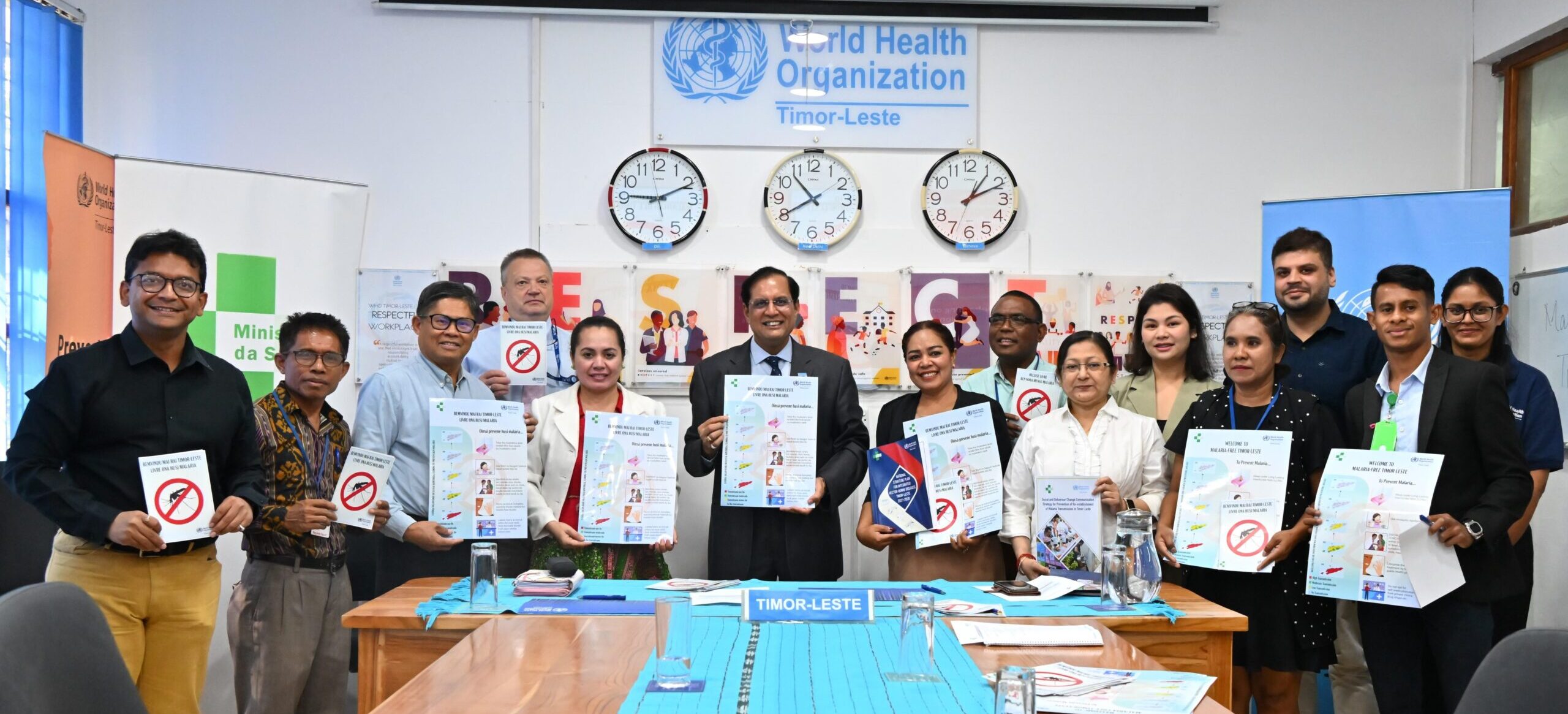
The World Health Organization has certified that Timor-Leste is now officially malaria free, “having reduc[ed] cases from a peak of more than 223,000 clinically diagnosed cases in 2006 to zero indigenous cases from 2021 onwards”.
Proposed cuts by the Trump administration would see aid and reform programs delivered by the US Millennium Challenge Corporation (MCC) in Timor-Leste, Indonesia and the Philippines eliminated. Programs in Solomon Islands and Kiribati would be retained under the proposal. The MCC is also seeking to establish programs in Fiji and Tonga.
Global aid cuts have raised fears of a “full blown” starvation crisis in Rohingya refugee camps in southern Bangladesh and in Myanmar’s Rakhine State, as well as dire shortages of medicines and food in refugee camps along the Thai-Myanmar border.
People in northeast Nigeria are also facing starvation due to the funding cuts, with the World Food Programme estimating that at least 630,000 children in this region are at risk of acute malnutrition and a further 280,000 suffering from wasting.
The Starmer government has published more detail on its 2025-26 aid cuts, which will see the UK’s bilateral aid to Africa drop by 12% and aid to the Middle East and North Africa cut by 21%. Global health spending will fall by nearly 46% and global education, gender and equality spending will be reduced by 42%.
Gavi, the Vaccine Alliance, has stated that a US$3 billion shortfall in its latest five-year replenishment means it will need to slow down some of its immunisation programs, sharpen its focus on children living in fragile and crisis-affected settings, and revise its approach to eligibility and transition support in middle-income countries.
The Gates Foundation has announced US$2.5 billion over the next five years in funding for research and development activities focused on advancing women’s health in low and middle income countries.
Books, reports, articles, podcasts etc.
Jeremy Lewin, a former Department of Government Efficiency (DOGE) official installed to oversee the dismantling of USAID who is now head of foreign assistance at the State Department, joins the New York Times’ Interesting Times podcast. Notwithstanding repeated claims of widespread fraud in the agency by President Donald Trump and Elon Musk in early 2025, Lewin says that “DOGE didn’t find that much fraud at USAID” (and then redefines “fraud” to include programs with which the Trump administration disagrees). He also maintains that the Trump administration is not cutting lifesaving programs, despite clear evidence to the contrary.
A more factual and nuanced discussion of the successes and failures of US foreign aid — and how it could be made more effective — is provided by former USAID chief economist Dean Karlan on the Statecraft podcast.
Adam Tooze discusses the future of global development, including the elusive promise of private development finance, on the Ones and Tooze podcast.
A new World Bank study of aid fragmentation finds that the number of donor agencies has increased over the last two decades — up from 227 in 2004-08 to 608 in 2019-23 — whilst the average size of individual aid projects has decreased — down from US$1.6 million in 2000-02 to US$0.9 million in 2021-23. It also finds that despite multiple donor declarations on the importance aligning aid with country priorities and systems, the share of development finance delivered through recipient governments has almost halved since 2007-09 (Figure 1).
Figure 1: Share of aid by delivery channel (number of transactions basis)
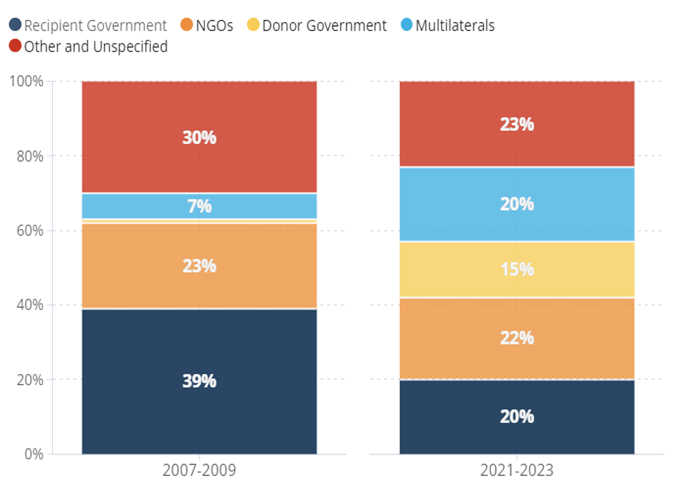
Source: World Bank, Defragmenting the global aid architecture: a new playbook for development impact, July 2025.
Ahead of the Global Fund’s upcoming replenishment meeting in November, the UK-based One Campaign have launched new analysis of the return on investment from the fund, highlighting dramatic progress in the reduction of deaths from malaria, tuberculosis and HIV/AIDS (Figure 2) over the last two decades.
Figure 2: Global HIV/AIDS-related deaths vs. cumulative Global Fund HIV/AIDS funding, 2002-2024
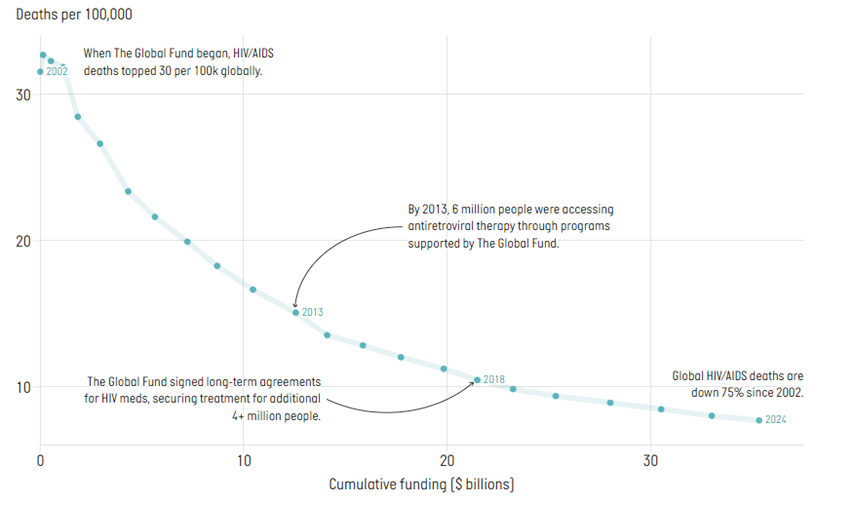
Source: One Campaign, The Global Fund’s high return on investment, 7 August 2025.