


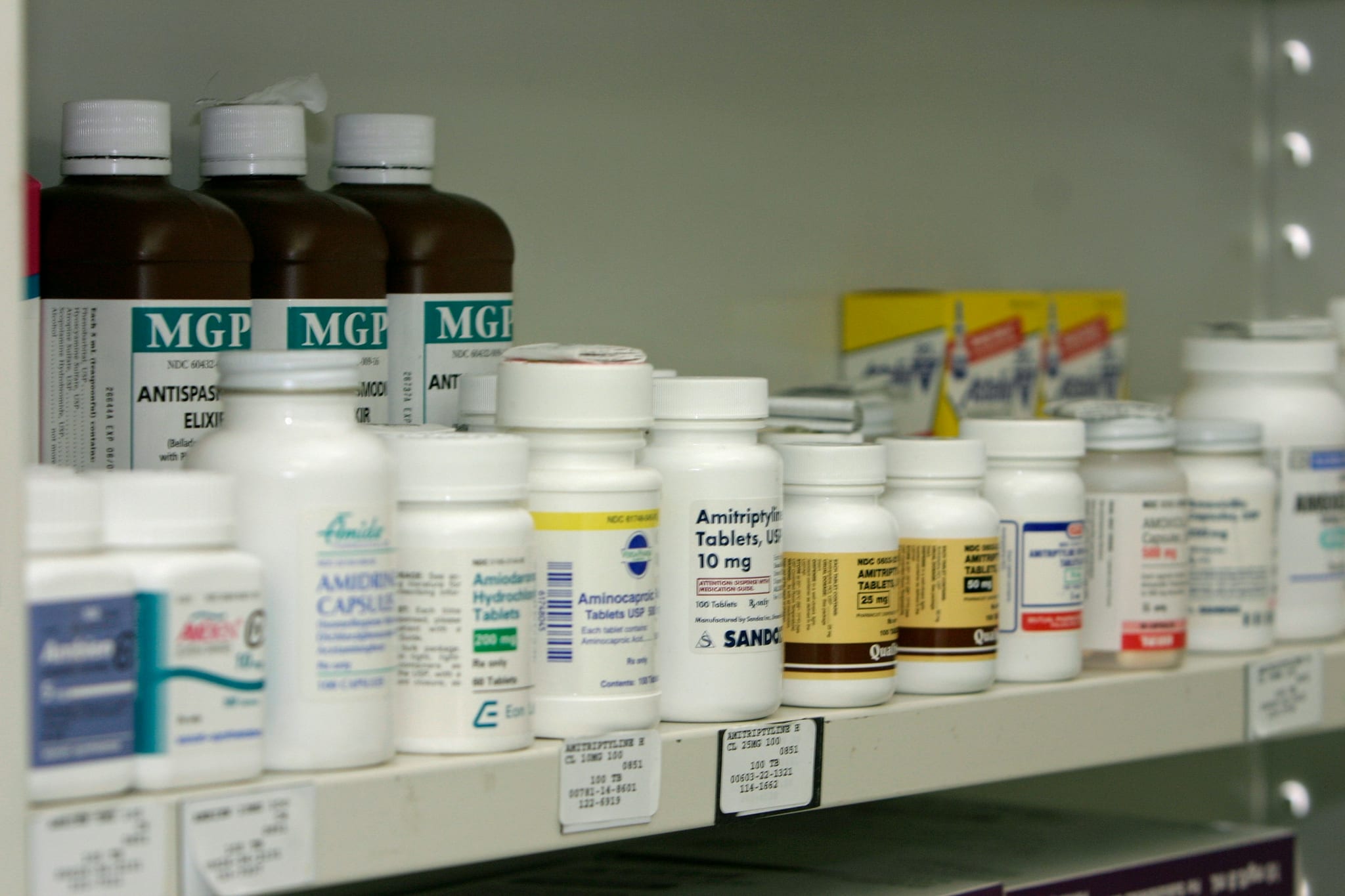
A budget allocation is often treated as evidence of government commitment. For a nurse, community health worker or patient waiting for basic medicines, that is beside the point. What matters is whether the money arrives on time, can be spent, and results in medicines on the shelf when patients need them.
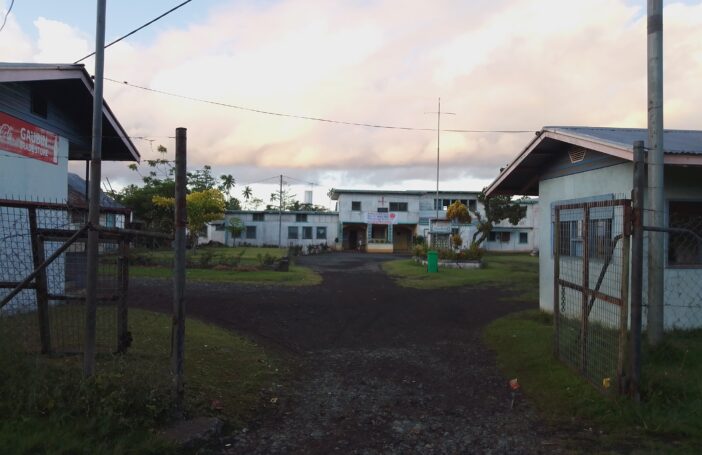
The point bites hardest in remote provinces such as the island province of Manus, where geography makes service delivery difficult at the best of times. Manus has one provincial hospital which together with urban clinics, rural health centres and aid posts serves communities scattered across islands. When funding is delayed, the consequences are felt at the pharmacy counter, in the outpatient ward and in aid posts with thin buffer stocks.
Our recent research examined the link between delayed budget release and execution, healthcare delivery and medicine availability in Manus province. The study drew on a structured survey conducted from August to December 2025. It involved 172 health workers and stakeholders: nurses, community health workers, pharmacy staff, administrators and others with direct experience of the health system.
The findings should be interpreted with care. The study is descriptive and is based on reported experience and perception. It does not prove that budget delays cause medicine shortages. It does provide frontline evidence that budget execution problems are widely seen as a major contributor to shortages in Manus’s health facilities. A lack of antibiotics, in particular, can be fatal.
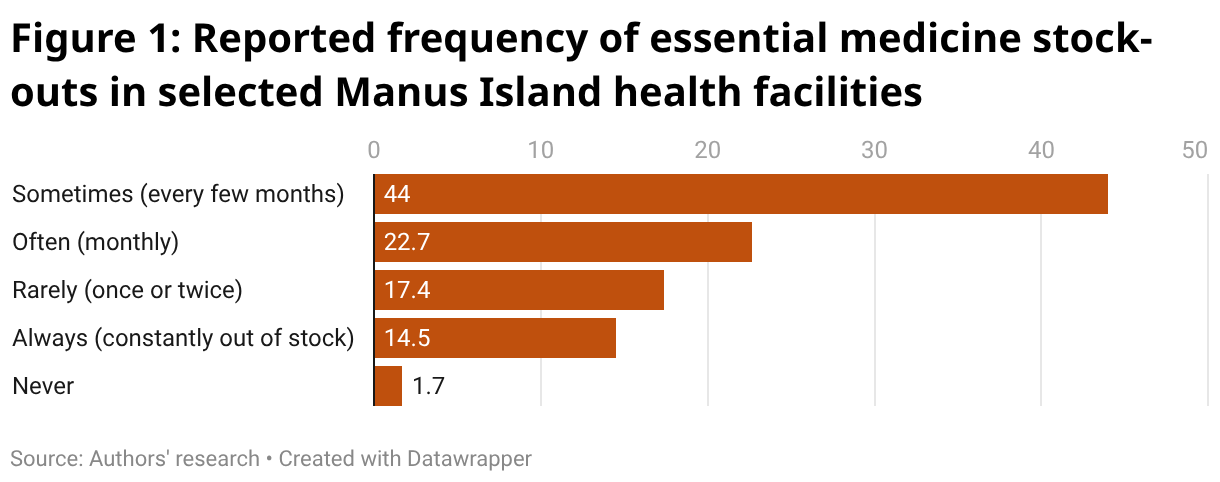
Shortages are not rare. 44% of respondents said essential medicine stock-outs occurred “sometimes”, or every few months. A further 22.7% said they happened “often”, or monthly, and 14.5% said medicines were “always” or constantly out of stock. Only 1.7% reported never experiencing shortages.
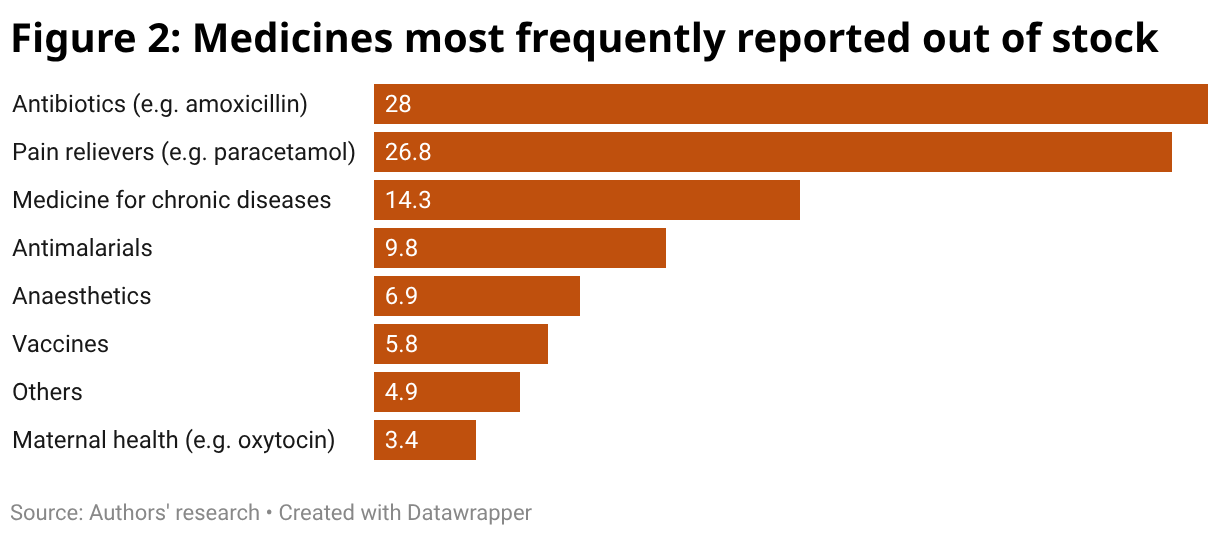
The drugs most often reported missing were not specialised. They were the basic medicines that make everyday primary healthcare possible. Antibiotics, particularly amoxicillin, accounted for 28% of reported stock-outs. Pain relievers such as paracetamol accounted for 26.8%. Medicines for chronic diseases and antimalarials were also commonly named.
Respondents said patients were often told to buy medicines privately, that treatment was delayed, that the patient’s health worsened and that some patients were referred elsewhere. When public facilities have no medicines, the cost shifts to patients and families. Those with money buy elsewhere. Those without go without.
Asked whether delays in government funding contributed to shortages, a majority (53%) named delayed funding as a major cause, and many others as one of several. That finding shifts attention from the size of the health budget to the reliability and timing with which it is executed.
The question is not only “how much is allocated?” It is “when is it released?”, “how quickly can it be used?” and “does it reach the systems responsible for procurement and delivery before medicines run out?”
If funding is approved but released late, procurement is delayed. If procurement is delayed, supply schedules break. In a remote island province, that means medicines may not reach rural health centres and aid posts for weeks or months.
Technical reforms alone will not solve this. Systems such as mSupply can improve visibility over stock levels. In principle they can also order medicines, but not if the money has not arrived. Stock data is useful only when it is connected to timely financing, access to supply and logistics.
Several policy priorities follow from the research.
First, health funding releases need to be predictable. Provincial health authorities need reliable cash flow to plan procurement, pay suppliers and avoid emergency purchasing. A fixed quarterly release schedule, with real accountability for delays, would reduce uncertainty.
Second, pharmaceutical funding should be better protected. A ring-fenced allocation for essential medicines would reduce the risk that funds are delayed, diverted or absorbed by other pressures. In a province like Manus, that should include safeguards for rural and island facilities.
Third, health facilities need stronger buffer stocks for high-priority medicines. Buffer stocks will not substitute for national procurement reform, but they would give the provincial system more resilience when funding, shipping or procurement slip. They should be managed transparently and prioritise the facilities most exposed to stock-outs.
Fourth, financial and medicine supply systems should be joined up. Monitoring should show not only whether medicines are out of stock, but whether funds have been released, whether procurement has started, whether orders have been paid for and where the delays sit.
Finally, reforms must fit the realities of remote service delivery.
An island province with high freight costs, irregular transport and limited facility-level autonomy cannot rely on systems designed for urban settings. Rural health centres have the least capacity to absorb delays and need the most attention.
Medicine availability depends not only on health policy but on the quality of public financial management. For Manus and other provinces, improving access to essential medicines requires approved funds moving predictably from the budget system into procurement, and from procurement into the clinics.
For patients, the test of the health budget is not whether funding appears in a budget document. It is whether the medicine is on the shelf when they need it. A minor administrative delay can cost Papua New Guinean lives, particularly among those who cannot pay for private care. Politicians and bureaucrats should act accordingly.





Thanks Dr Bizhan and Clement for this timely piece. Just yesterday (13/08/26) Madang provincial hospital announced that they are scaling down their services due to critical drug shortages; heres the link; https://www.nbc.com.pg/post/38772/madang-provincial-hospital-scales-down-services
Medical supplies for GoPNG health facilities are largely procured by NDOH and supply gaps covered by PHAs if it has been budgeted by the Provincial Pharmacist. Delay of fund releases to NDOH and also Budget cuts are two of many factors in the PNG Pharmaceutical supply chain that contribute to shortages and stock outs of essential medicines. Hope these two factors can be addressed by Treasury, appropriations are as per medical supplies budget and ensuring warrants are released on time.
My sincere thanks to the two authors for raising this important issue. As the authors and many others would know, the problem of medicine stock-outs is not unique to Manus Province. I have known of many occasions in Madang Province when people were not able to receive, or even purchase, the medicine they needed. A friend of mine who lives near Angoram in East Sepik Province recently travelled to Madang to purchase medicine she could not secure in Angoram.
Dr Colin Wiltshire has conducted research on public financial management. He explored this issue in a research report on the health sector in Papua New Guinea that was published in 2020 and is available at: https://openresearch-repository.anu.edu.au/items/b3d0a1d0-087b-4495-8be0-a8f7faa130f9
I was happy to assist with preparation of this report and I recommend it to anyone who wants to look into these issues in further depth.
Thanks again to the two authors of this valuable blog post.
Amanda