The 31st Conference of the Parties (COP31) has ended without an overarching political agreement. Decisions were adopted under existing climate work programs, but no cover decision was secured.
When Australia withdrew its bid to host COP31 in November 2025, the Albanese government presented its appointment as President of Negotiations as a diplomatic achievement. It promised unprecedented influence over international climate negotiations and an opportunity to advance the interests of its Pacific neighbours. Twelve months later, Australia and Türkiye presented a proposed agreement that did not explicitly mention fossil fuels.
The proposed Antalya Pact failed to reaffirm the commitment made at COP28 to transition away from fossil fuels in energy systems. Instead, it proposed scaling up carbon capture, utilisation and storage to gigatonne levels globally by 2035.
The final text also dropped a reference to the International Court of Justice’s advisory opinion on climate change, achieved through years of Pacific-led advocacy, that earlier drafts had contained. The first draft, circulated on 16 November, welcomed the advisory opinion of 23 July 2025. The revision of 19 November weakened that language. The text put to parties on 22 November, and rejected, left it out altogether. The reference was removed under the successive drafts of the Türkiye–Australia presidency itself.
Decisions were adopted on adaptation, just transition, climate finance and other established work programs, but COP31 did not deliver the greater political ambition that vulnerable nations urgently require. For Australia, the outcome exposes a contradiction between its international climate diplomacy and its domestic economic policies.
Australia is already the world’s largest exporter of metallurgical coal and its second-largest coal exporter overall by volume. The International Energy Agency’s latest World Energy Outlook projects that Australia could overtake Indonesia as the world’s largest coal exporter, measured in energy-equivalent terms, under its Current Policies Scenario.
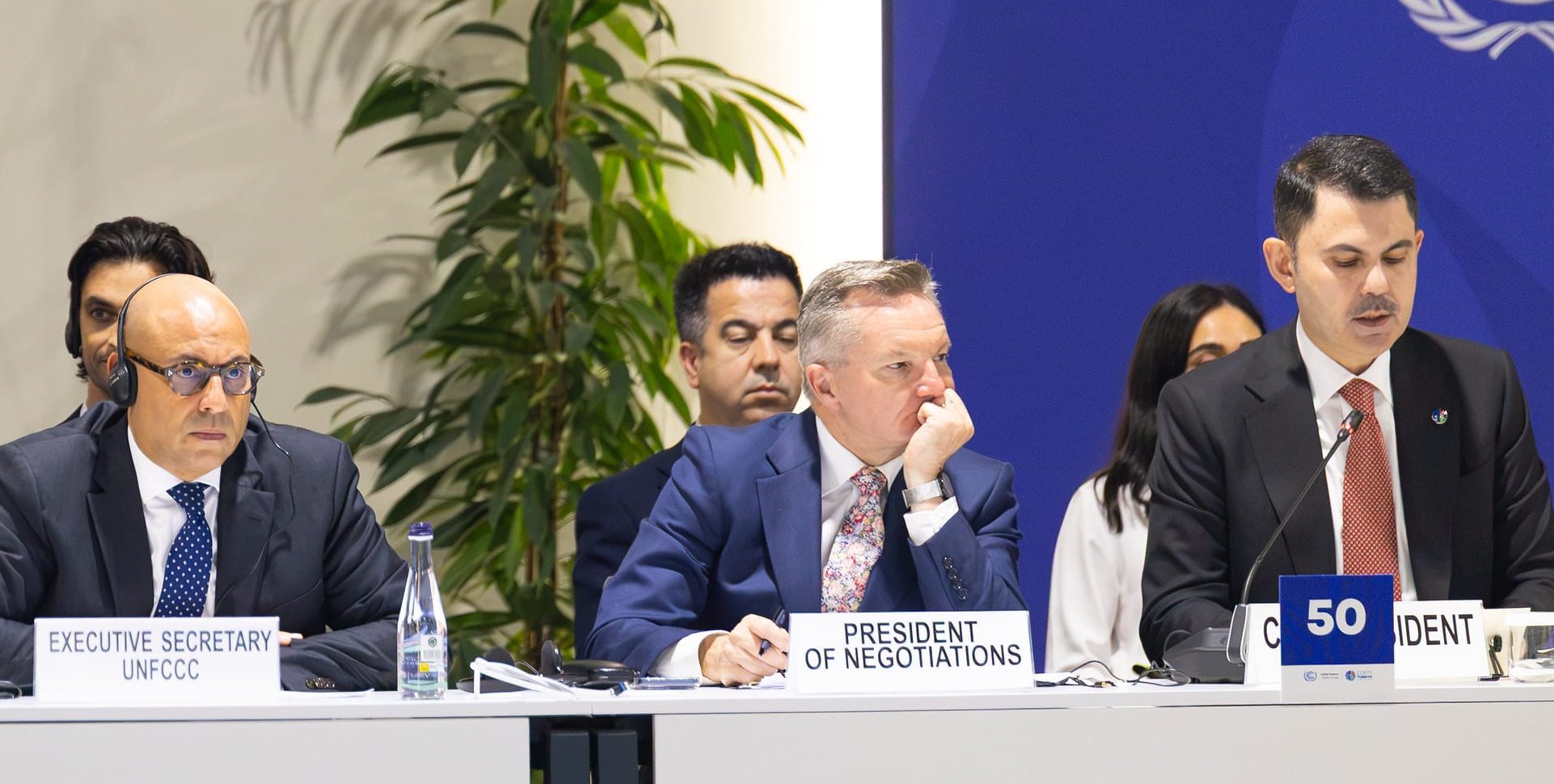
As Australia’s Minister for Climate Change and Energy and COP31 President of Negotiations, Chris Bowen was entrusted with advancing global climate action while representing a government that continues to approve new and expanded coal and gas developments. Some Australian fossil fuel approvals extend coal mining into the 2060s, and the approved extension of Woodside’s North West Shelf gas facility runs to 2070. Gas approvals run later still: in March 2026 the government approved Australia Pacific LNG’s Gas Supply Security Project in the Surat and Bowen basins (EPBC 2020/8856), an approval that has effect until 22 February 2081. The government’s own Future Gas Strategy supports new gas development and envisages a continuing role for gas beyond 2050.
These decisions have consequences beyond Australia’s borders, particularly for Pacific countries already dealing with rising adaptation costs, threats to food and water security, displacement and damage to critical infrastructure. Australia cannot credibly advocate for the survival of Pacific nations while expanding industries that contribute to the threats they face. Bowen said disagreements between countries prevented consensus on the transition away from fossil fuels. Australia’s own capacity to act, however, does not depend on resolving those disagreements.
International consensus is not a prerequisite for national climate action, and its absence must never become an excuse for inaction. If the Albanese government is disappointed by the outcome of COP31, it should demonstrate that disappointment through domestic action. Australia could end approvals for new and expanded fossil fuel projects, establish a managed transition strategy and support affected workers and communities. It could also strengthen its support for Pacific-led climate initiatives and join the emerging international efforts to govern fossil fuel production. Australia’s climate leadership should be measured by what it does between COP meetings, not by what its ministers promise during them.
Meanwhile, Pacific nations are demonstrating that international leadership does not require the wealth or influence of the world’s largest economies. At COP31, Vanuatu rejected the proposed cover decision, making clear that consensus could not come at the expense of its people’s survival, sovereignty and future generations.
Vanuatu led the campaign that secured the International Court of Justice advisory opinion in July 2025. The Court clarified that failures by states to take appropriate measures to protect the climate system, including in relation to fossil fuel production, exploration licences and subsidies, may constitute internationally wrongful acts. That provides a foundation for strengthening accountability independently of the outcomes of annual climate conferences.
Outside the formal negotiations at COP31, the coalition of Global South nations developing the proposed Fossil Fuel Non-Proliferation Treaty grew to 30 countries. Championed by Pacific nations, the proposed treaty seeks to end fossil fuel expansion, equitably phase out existing production and mobilise the finance and cooperation necessary for a just transition. It would complement the Paris Agreement by addressing a gap in international climate governance: the absence of a framework governing fossil fuel production and supply.
The Santa Marta Process, launched in Colombia in April 2026, offers another pathway for countries willing to advance climate action beyond the consensus requirements of the UN negotiations. In July 2027, Tuvalu and Ireland will co-host the second international conference on transitioning away from fossil fuels, an opportunity to strengthen international cooperation and advance the proposed treaty.
Having failed to secure a Pacific COP through Australia, the Pacific may now deliver something far more consequential. These developments also challenge conventional approaches to international development. Pacific nations should not be viewed simply as vulnerable recipients of climate finance and development assistance. They are increasingly shaping international law, diplomatic cooperation and alternative approaches to climate governance.
Australia frequently refers to its Pacific family. But within Pacific understandings of relationality, family carries responsibilities and reciprocal obligations. The prosperity of one member of that family cannot legitimately be built on the destruction of another’s homeland. Climate finance and adaptation assistance remain essential, but they cannot substitute for addressing the underlying causes of climate change.
The challenge for Australia following COP31 is to reconsider its relationship with the Pacific, align its domestic policies with its international commitments and support the leadership already emerging across the region. Perhaps the most important lesson from COP31 is that Pacific nations should no longer look to Australia for climate leadership.
Instead, Australia should look to the Pacific.
This article is a shortened version of a paper available on the Uncharted Collective website.