Australian aid
Australian and international aid agencies have launched emergency appeals in response to the Venezuela earthquake. So far, the disaster has resulted in over 1,400 deaths, with tens of thousands of people still unaccounted for, and almost two million people requiring humanitarian assistance. The Australian government is yet to announce whether it will contribute to the international relief effort.
Asked about her views on Australian aid to the Pacific at the National Press Club, One Nation leader Senator Pauline Hanson said that this aid “should be spent well” and, subject to meeting the party’s domestic spending priorities, “we might be able to increase [aid] and help others”. She also suggested that Australia’s aid should be conditional on whether Pacific countries also receive funding from China and, citing PNG, on their levels of corruption. One Nation’s current party platform says that Australia should “redirect and reduce” 60% of its aid spending, “saving up to $3 billion annually”.
PNG’s Foreign Minister, Justin Tkatchenko, has hit back at Hanson’s corruption comments, describing them as “not only defaming, but totally unnecessary”. Australia’s opposition spokesperson for foreign affairs, Ted O’Brien, has also rejected Hanson’s characterisation of PNG and said that issuing ultimatums to Pacific countries regarding funding from China would “not [be] in our national interest”.
Australia and Vanuatu have signed the Nakamal Agreement, a “landmark treaty” covering security cooperation, climate change and “economic transformation”. With regard to the latter, the treaty says that Australia will provide budget support to Vanuatu, develop a new traineeship and skills program, and support Vanuatu’s transition “to a cloud-based digital economy”. Vanuatu rejected an earlier version of the treaty that would have restricted its ability to access Chinese infrastructure funding and is currently negotiating a separate bilateral agreement with Beijing.
Australia will provide $35 million in budget support to support Solomon Islands’ response to recent natural disasters and the energy and economic shocks associated with the US-Israel war with Iran. The Albanese government will also double the number of training and vocational scholarships and Pacific Engagement Visa places available to Solomon Islanders in 2027.
Australia is among several countries, including China, assisting authorities in Port Moresby to avert a major disruption to the city’s water supply arising from degraded public infrastructure, inadequate funding and poor oversight of PNG’s state-owned water utility.
Members of the Quad grouping — Australia, Japan, India and the US — have announced that they will cooperate on the development of port infrastructure in Fiji to “boost trade and economic prosperity …”. While no individual projects or specific financial commitments were included in the joint statement, the head of Fiji Ports Corporation said, “If it’s a Quad project, it’s going to be a mega-project, which is Suva Port most likely”. The joint statement contained no updates on the status of previously announced Quad initiatives to tackle cervical cancer (2024) and increase immunisation rates (2022) in the region.
Australia, the UK and Canada have agreed to establish a new International Peace Fund for Israel and Palestine, “a multi-donor initiative to support peacebuilding efforts to establish the conditions for a lasting peace”. The three countries will each contribute £1 million (A$1.9 million) over three years. The UK has declined to join the US-led Board of Peace — which includes a putative focus on the Israel-Palestine conflict and rebuilding Gaza — and Canada has been disinvited. The Australian government is yet to declare whether it will join.
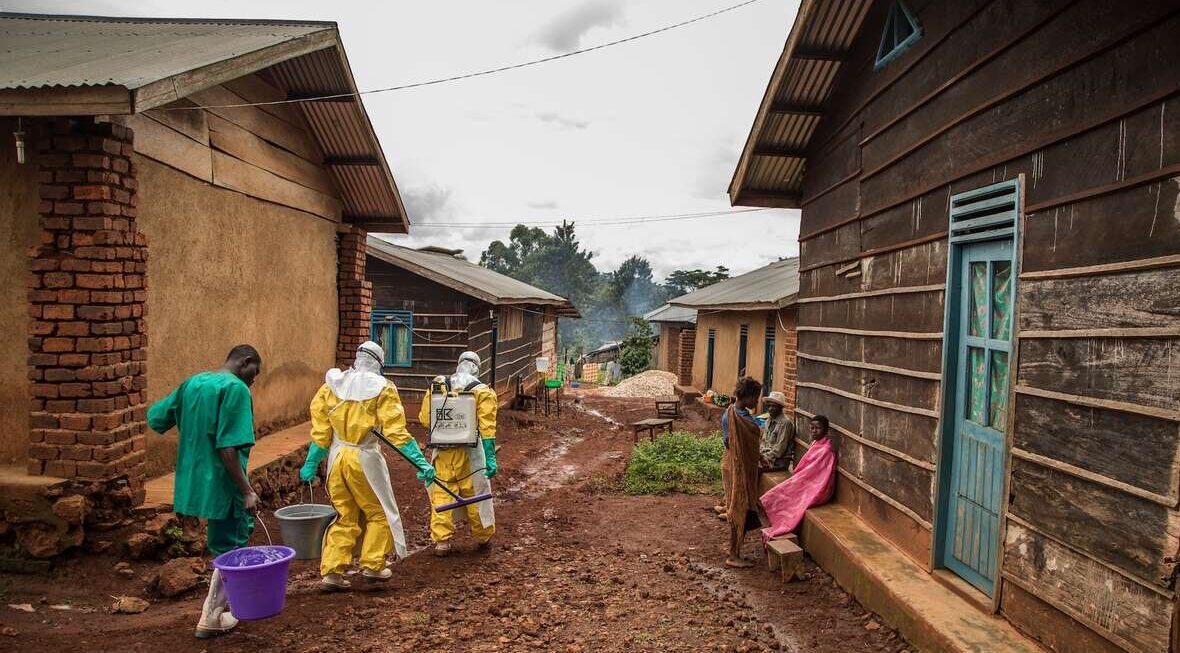
The Australian government has announced that it will provide $5 million to support the response to the Ebola outbreak in the Democratic Republic of Congo and Uganda. Regional and global health experts have described the outbreak as “one of the most consequential epidemic emergencies in Africa due to its epidemiological and operational complexities …”, resulting in over 1,000 confirmed cases and almost 300 confirmed deaths so far.
Speaking at Senate Estimates hearings about the 2025 OECD Development Assistance Committee (DAC) peer review of Australia’s development program, DFAT officials said that while the government “broadly accepted most recommendations and will look at how we take them on board …“, it will not publish a formal management response despite this being “a highly encouraged and central part of the peer review process” under the current guidance endorsed by DAC members.
Australia has joined several other DAC donors in launching new guidance for supporting “locally led development”. A recent assessment has concluded that — ten years after the adoption of the “grand bargain” on locally led humanitarian action — “we are still having the same foundational argument about who leads, who decides, and who gets resourced. The sector has changed at the margins. Its architecture has not.”
Regional and global aid
The government of Tuvalu has said it is reviewing investments by its national sovereign wealth fund, to which Australia and New Zealand are longstanding contributors and board members, in the wake of reporting that the fund is invested in fossil fuel companies in India, the US and Australia (Woodside’s North West shelf gas project). Tuvalu was highly critical of the Albanese government’s decision in 2025 to approve the latter project, stating that it “would lock in [carbon] emissions until 2070, threatening our survival and violating the spirit of the Pacific-Australia climate partnership”.
Following a deeply flawed national election and amid a deepening economic crisis and a brutal, five-year civil war, Myanmar’s leader, Min Aung Hlaing, has visited China to affirm cooperation on several high-profile but troubled mega-projects under the “China Myanmar Economic Corridor”.
Bangladesh has requested a new loan and a restructuring of its existing US$5.5 billion support program from the International Monetary Fund, citing changing domestic and global economic conditions and its political transition.
Appearing before Congress, US Secretary of State Marco Rubio has disputed findings by multiple academic studies that the Trump administration’s cuts to health and humanitarian aid have resulted in hundreds of thousands of preventable deaths. Rubio described the administration’s new government-to-government approach to health assistance as “promising and exciting”.
The latest OECD reporting on public and private climate finance shows that this finance reached a combined US$133 billion in 2023 and US$137 billion in 2024, with most public finance delivered through multilateral development banks and climate funds (56% in 2024) and in the form of loans (67%).
The OECD DAC is forecasting a further 7% fall in total ODA provided by its members in 2026, on top of the combined fall of 32% in 2024 and 2025. This estimate sits slightly above their previous one, from April 2026, but slightly below our own. Bilateral aid to sub-Saharan Africa (-12%) and the least-developed countries (-11%) will likely experience the sharpest cuts, along with health aid, which could fall back to 2008 levels. Strikingly, in contrast to previous global shocks, the DAC observes that despite the massive disruptions caused by the US-Israel war with Iran “none [of the DAC members] reported new measures to address the economic fallout of the crisis in developing countries”.
Alongside a wider review of its role and functions, the DAC is also undertaking a review of the criteria governing countries’ “graduation” from ODA and a potential shift away from a sole reliance on income per capita thresholds.
Books, reports, articles and podcasts
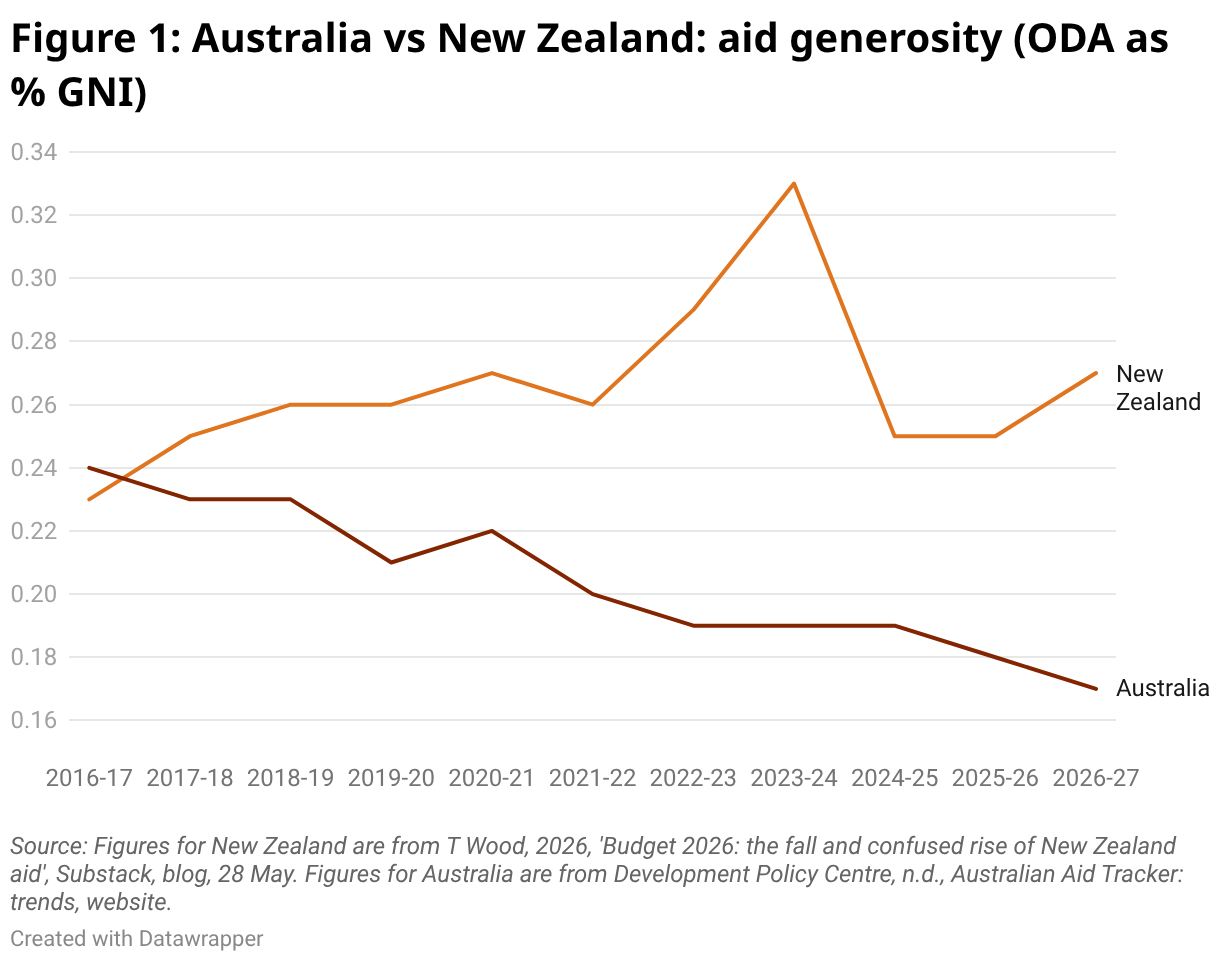
Writing on his Substack, Devpolicy’s Terence Wood examines a surprise increase to aid by New Zealand’s governing conservative coalition in its recent budget. New Zealand will again pull away from its trans-Tasman neighbour on aid generosity — ODA as share of gross national income — as Australia’s performance on this measure tumbles to new record lows (Figure 1).
Writing for Foreign Affairs, Mark Suzman from the Gates Foundation argues that in a world of shrinking budgets ODA must become more tightly focused on development need and impact.
New analysis from the Center for Global Development looks at philanthropy’s place in a changing development finance landscape and India’s role as a finance provider.
The China in the Global South team unpack China’s new White Paper on its global governance initiative, a weakened UN and Beijing’s influence in the developing world.
And in a new book, Worse than war; the global costs of violence, Anke Hoeffler and James Fearon examine the scale and consequences of various, underreported forms of interpersonal violence and show how these are more widespread and impose greater societal costs than collective violence like interstate wars, terrorism and ethnic conflicts.