I left it too long but finally made it back to Lesotho. Sadly, most of my Basotho colleagues had passed on, but District Rural Water Supply was still operating, as were most of the gravity water supply systems that I helped build. So too was the volunteer agency that I first went with, which had morphed into a local non-government organisation called Skillshare Lesotho.
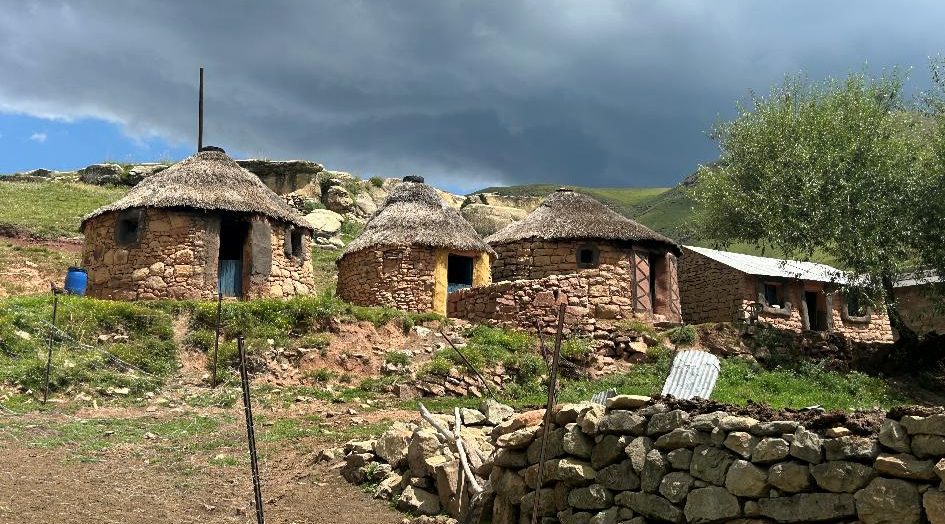
It used to be a long day’s drive on a rough gravel road around the mountains, but now there was a sealed highway from Maseru, straight over the top. After five hours of tight curves and brake-squealing descents, I joined the old road. And there Qacha’s Nek was: the sandstone cliffs, aloe trees, villages nestled in ravines and dongas, and rondavels built of stone, earth and grass.
I was last here in 1990. While travelling through London, I stumbled upon a Times newspaper advertisement: “District Engineer, Qacha’s Nek District, Village Water Supply”. Getting the job included a multi-stage interview, technical training, a country briefing and Sesotho language training. I was then embedded into a Government of Lesotho role for two years. I was 23 years old.
The office was much as I left it, the old project files and ink drawings I helped pen, still in the same filing cabinet. The current District Engineer, Ntate Lerotholi Rabukana, described the new projects and rehabilitations. I requested to visit the Ha Phatela project, the largest and most difficult system during my time. Getting there was the same adventure, by rowboat across the Senqu (Orange) River. The stone tanks were still there, carefully crafted by masons, shaping and placing sandstone blocks with artistic flair.
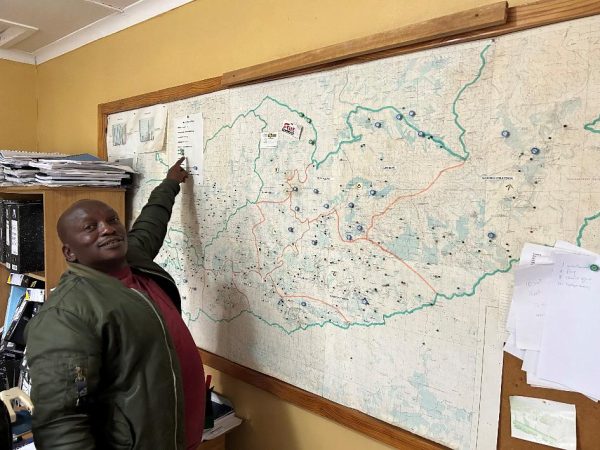
Ntate Lerotholi Rabukana, current District Engineer (Mark Moran)
I was genuinely surprised to see the systems still working, thanks to the local staff who were still maintaining, rehabilitating and building them. Seven projects were underway and another seven were waiting on funding.
We, the expatriate district engineers who worked in Lesotho from the 1980s into the 2000s, worked mostly as volunteers, via English, American and Irish volunteer agencies. We were given public service houses and paid the equivalent of local wages. We organised around position descriptions within a Lesotho Government Department with centralised policies and technical standards from the capital Maseru. I’m not entirely sure why we stopped coming, but I’d like to think it was when we were no longer needed.
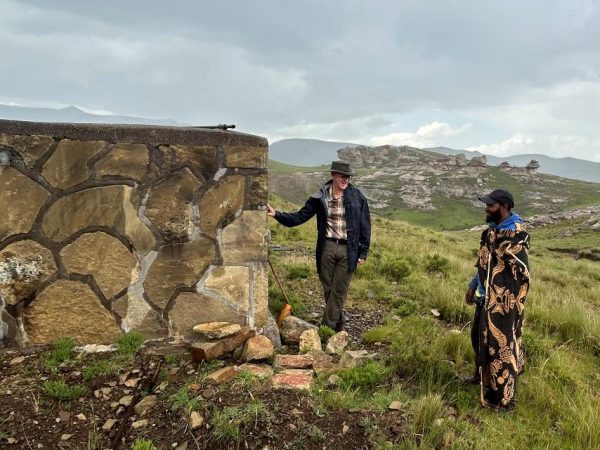
Sandstone masonry water tank (Mark Moran)
This sure got me thinking. How can something as simple as turning up as a young man, with little else than an engineering degree, being embedded into a government department, operating to their mandates, be the time when I felt most connected and effective?
And how do I reconcile my experience with the critique of technical assistance, which began in Africa in the 1990s before playing out in the Australian aid program, notably via a 2009 Australian National Audit Office audit then a 2010–11 AusAID Joint Advisor Review. The critique found problems with targeting, host organisation ownership and, significantly, capacity substitution.
Reading through this, I learnt that few technical advisors occupied in-line positions as I had in Lesotho. According to a small survey reported in a 2014 Australian Volunteers for International Development Evaluation, only a third of volunteers were placed into in-line positions (33%), followed by technical advisor (29%), team mentor (27%) or counterpart (9%). A 2010 Independent Review of the Papua New Guinea (PNG)–Australia Development Cooperation Treaty noted how few positions were still held in-line, and recommended trialling an “in-line approach” instead, whereby:
… aid-funded personnel would operate with and under whatever authority and reporting lines normally go with the position they are hired into. This would promote both accountability and effectiveness, and through the training of junior staff would make an important contribution to capacity building. There would be less risk of displacement of local effort, since the in-line model would do away with the practice under the current advisory approach in which the adviser is there only to help, which means that the more the adviser does, the less work there is for the person or team s/he is helping.
This resonated with my experience. My job description was to fill an established government position. It did not use the language of capacity development but rather human resource management.
You couldn’t get the job without the approval of the organisation, and you were then accountable to the organisation. I managed my subordinates and my superiors managed me. Training courses were centralised, and support was provided for technical officers to study engineering overseas.
Being an outsider, I also brought influence and brokered resources. I gained the knowledge to better target support programs, building enough trust to myself be an agent of reform. And I had my capacity built in the process.
Regardless of education and experience, placements like mine require intensive pre-departure training and mentoring. International volunteer agencies have invested considerable resources into developing training programs and still run them. Much still rests on the personality and fortitude of the individual, their ability to learn on the job, and the luck of the draw with the placement and colleagues. It didn’t always work out, but mostly it did.
More than a decade after this critique and reform, Australian assistance has shifted substantially from directly placed technical advisers towards “partnerships” operationalised through contractor-managed “facilities”. These facilities contain many long-term advisors, but very few are embedded or accountable through the normal management structures within national agencies. The shift has not resolved the underlying problem of governance capacity. A substantial literature argues that public sector capability is politically and organisationally embedded and cannot be reformed simply through external programs, or worse, efforts may be redirected through clientelism and political networks. These dynamics are largely invisible unless you work in-line.
In PNG, I have completed governance and political economy assessments to help facilities understand the internal dynamics of their partners, and entry points for their assistance. In the process, I have interviewed experienced advisors who once held in-line positions, or advisory positions where they sat inside PNG agencies. They are bemused by my questions, and indeed the need for my services, as this was something that they once did without naming it. They lament the loss of inside knowledge and relationships they once held.
I’ve written for this blog on the political economy of PNG agencies, and their patronage networks, gendered power dynamics and de facto decision makers, and how these maintain the status quo and resist reform. When embedded, these internal dynamics and politics are “so in your face” you can’t ignore them. To get things done, you must find effective officers and avoid those who are otherwise beholden to deals.
Some national agencies in PNG will have no interest in having an outsider in their ranks. Some have a distaste for past colonialism, fear ceding sovereignty, or are suspicious of advisors reporting back to their donor agency. Others though are independently employing outsiders using their own internal resources. Who the paymaster is and how high the salary surely blurs reporting lines, raising doubts about who the outsider works for. Looking back, it helped that I was a volunteer, on commensurate conditions, placed by an agency that remained remarkably hands-off for the duration of my placement.
Some of the most effective facilities that I have worked with have good inside knowledge of their partner agencies. Often, this is held by their national staff, through the relationships they hold with staff in the partner agencies. I have also interviewed and worked with serving public servants, and am struck, for the most part, how deficits are not in their capability, but rather the institutions they work for. They exude a welcoming enthusiasm to work and share with me.
And when I do and we get talking, I’m reminded of how things worked when I was in Lesotho.