

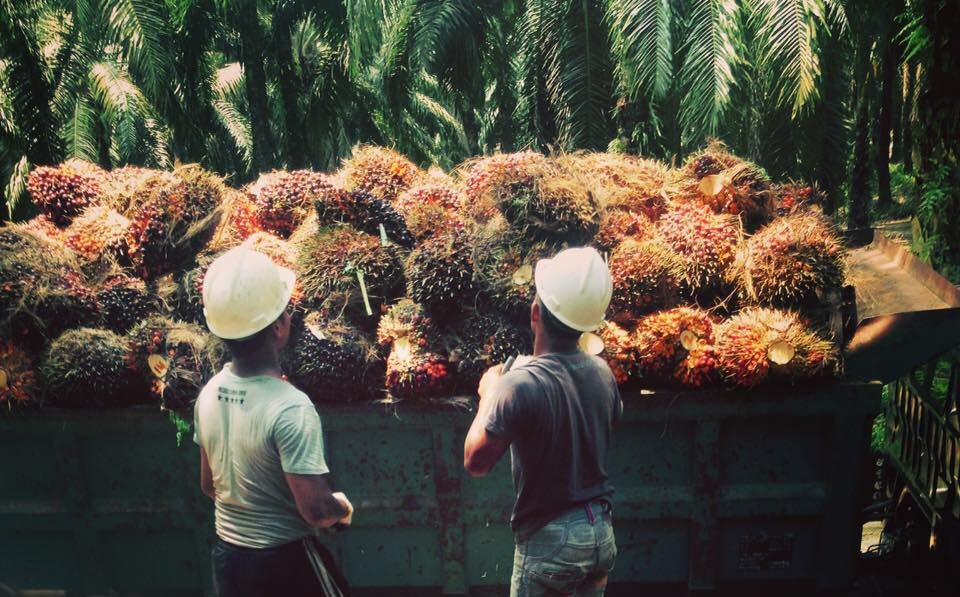
Palm oil is in around half the products on your supermarket shelf. It is also one of the world’s most socially contested industries. Coalitions of activists and consumers are mobilised around the view that palm oil is environmentally and socially damaging and should be limited, through boycotts or through policy. The environmental concerns are well-founded. When I started this research over a decade ago, which was recently published in the Journal of International Economics (open access), I was struck by how little systematic evidence existed on what the world’s largest modern agricultural expansion had actually done to the communities where it came from.
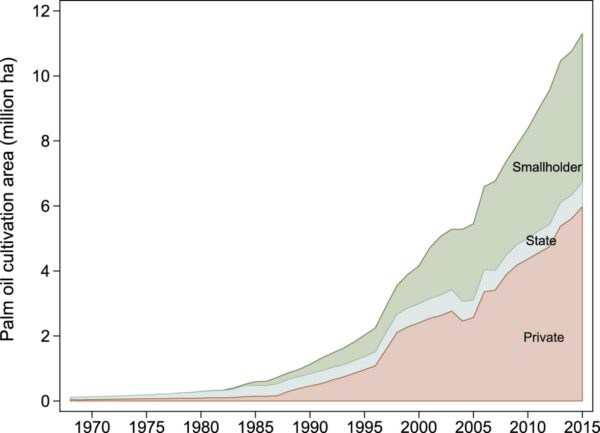
My research question is straightforward: did Indonesia’s palm oil export boom help or hurt the poor? Indonesia is the world’s largest palm oil producer, accounting for over half of global output. Production quadrupled from 2000 to 2015, almost entirely through planting more land rather than increasing per-hectare productivity. About 85% is exported. The expansion was triggered by surging global demand for oilseeds, primarily from India and China, and Indonesia’s post-Suharto decentralisation, which gave local governments new powers over land use and allowed smallholder farmers to plant oil palms with little more than a nod from the village head. Smallholder area tripled and these family farms quickly grew to account for over 40% of the total (Figure 1).
Figure 1: Indonesian palm oil acreage over time
Source: Export agriculture and rural poverty: Evidence from Indonesian palm oil.
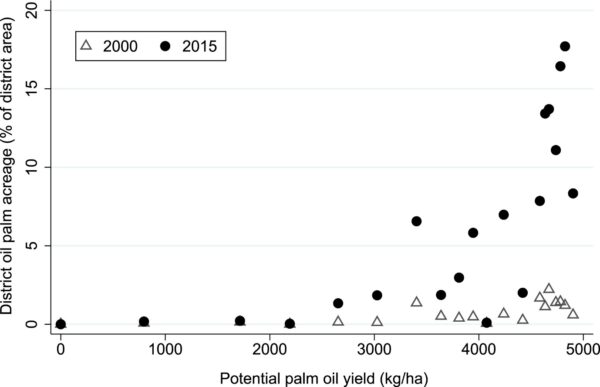
Simply comparing districts that grew more palm oil with those that didn’t would be misleading, because the two groups may differ in other ways that also affect poverty. To separate out a causal effect, I exploit the fact that not all land is equally suitable for growing oil palms. Districts with higher potential yields planted substantially more oil palm after decentralisation (Figure 2). Because these districts’ natural characteristics are essentially fixed and unrelated to other drivers of development, I can use them to estimate the portion of each district’s palm oil expansion attributable purely to its agronomic potential — and then ask what that agronomically driven expansion did to poverty.
Figure 2: Potential yields and district areal expansion
Source: Export agriculture and rural poverty: Evidence from Indonesian palm oil.
The main finding is that the expansion delivered faster poverty reduction and expenditure growth for producing communities. A 10-percentage-point increase in the share of district land under oil palm from 2000 to 2015 corresponds to around six percentage points of additional poverty reduction and 9% faster household expenditure growth from 2002-15. With national poverty declining from 18% to 11% over this period, palm oil appears to account for a non-trivial share of Indonesia’s development performance, especially across the outer islands.
Why? The answer is surprisingly simple: rising returns to agricultural labour. Agricultural wages and output per worker grew faster in expansion districts. Importantly, the increase in total farmland, not just switching existing farms (for example, rubber and rice) to oil palm, is what drives this. Oil palm is less labour-intensive per hectare than many alternatives but the massive expansion of new farmland more than offset the labour saved from switching crops, thus increasing net demand for agricultural workers. I find no evidence of workers shifting out of agriculture into other sectors: people stayed in farming but earned more. Factor immobility — the main mechanism behind the negative effects of Indian trade liberalisation — appears to have concentrated the gains among incumbent populations, as palm-producing districts actually receive fewer migrants than similar rural areas, despite the local demand booms.
Beyond direct income effects, the expansion boosted local government revenues and spending, and led to more marketplaces, mini-marts, schools, health clinics and places of worship in expansion districts.
Now on to the costs: there was no free lunch here. Each percentage point increase in district oil palm area corresponded to roughly 26% more tree cover loss and 8% more fire detections, with serious health consequences. A 10-percentage-point increase in oil palm area led to around an 11-percentage-point increase in villages experiencing malaria outbreaks, and a seven-percentage-point increase in respiratory infections. Social conflicts also became more common. Clearly, not trivial trade-offs.
Yet, one may be cautiously optimistic. National deforestation rates in Indonesia have declined since 2015, even as palm oil expansion continues, suggesting a potential decoupling may be possible. And it is not clear that the Indonesian experience will translate elsewhere, as the expansion took place in communities with a nascent but well-established agro-industrial sector, exceptionally decentralised governance and a hunger for local resource-led development, and voracious global demand. How the story is playing out in PNG’s East New Britain, or just outside of Honiara in Solomon Islands, or across West Africa and the rest of the developing tropics, where smallholder oil palm is either not a big part of the picture or expanding under very different conditions, remains an open question.
The bottom line is that income effects, especially for middle-aged farmers with relatively lower education levels and few other options for good local jobs, have been the first-order issue in the communities where palm oil comes from. Environmental concerns are real and urgent, but policies that restrict palm oil production without understanding these income effects risk hurting the rural poor who have benefited most from the expansion. Getting the balance right — maximising the benefits while minimising harmful externalities — has been the central policy challenge since I started looking into this topic and will continue to be going forward.
The paper is open access and the replication data are on Mendeley.





Thank you, Ryan for making a well-crafted paper. I would like too raise two comments. One is about valuation of environmental benefits or costs under the crop. Specifically, palm oil simulates forest like conditions and of course far from a forest and has it increased soil and moisture loss, reduced fuelwood availability to community? How does it compare with rubber for instance? When intensive animal husbandry is introduced under palm oil like practised in PNG’s New Britain Island, the situation could be more favorable to the crop. Second, is there any evidence on how the communities are spending their enhanced earnings apart from increased consumption? Are people investing on enterprises that generate other benefits? Kind regards.
Fascinating paper – thanks Ryan. I remember reading about sunflower, rapseed and soybean oils in the US and Europe and their efforts to keep Indonesian palm oil out of those markets. Aside from not appreciating how interesting cooking oils were(!) I wondered how much those trade and geopolitical dynamics influence how we’ve come to see palm oil, while recognising some real environmental and human rights concerns?
Hi Anura, thanks for your kind words and the comments. On one, I’m careful not to do any valuation of environmental benefits or cost, rather just focusing on comparing measurable outcomes (not converted to money values, or indicies, etc.). There is a lot of variability in the conditions though, in terms of both agricultural practices (principally fertilizer and pest control methods, which have environmental implications), intercropping, and animals roaming around. I haven’t seen any particularly rigorous research that works through how these different conditions relate to either development or environmental outcomes. On two, the district and village expenditure and “public good” estimates in the paper (Table 8) speak to this. In an earlier version of the paper, I did break down the main household expenditure impacts by types of expenditure (see Figure 10 here: https://static1.squarespace.com/static/57d5edcf197aea51693538dc/t/5c98e6b4a4222ff822715558/1553524407756/eard_v9_1903_JIE-merged.pdf). In relative (%) terms, education and health spending are responsive and there is movement in durables and assets. I have a companion paper to this one which speaks to your last questions (https://doi.org/10.31235/osf.io/uvjef). This paper is focused on what happens to the very local economy around mills where adoption is strongest, and looks at the business data. The figures to most of the talking in that one, so you can skip straight to the end of the PDF. All my best, Ryan