As cities expand across low- and middle-income countries, access to safe and inclusive public spaces is increasingly recognised as a core component of sustainable urban development. Sustainable Development Goal (SDG) 11 commits governments to making cities “inclusive, safe, resilient and sustainable”, yet for millions of urban children, this promise remains unfulfilled. From South Asia to sub-Saharan Africa and Southeast Asia, rapid and often unplanned urbanisation is shrinking children’s opportunities to play, socialise and move freely in their neighbourhoods.
Dhaka — one of the world’s most densely populated megacities — offers an instructive case. Our recent study examined whether urban open spaces in Dhaka meet children’s needs, comparing planned and unplanned neighbourhoods across the city.
The study was undertaken by Save the Children in Bangladesh, which hosts the secretariat of the National Alliance on Cities for Children and Youth, to inform inclusive urban planning aligned with SDG 11 and Dhaka’s Detailed Area Plan (2022–2035). It used a mixed-methods design, surveying 403 children aged 8–18 in eight randomly selected schools across three planned neighbourhoods (Uttara, Banani and Gulshan) and four unplanned ones (Badda, Paltan, Mirpur and Mohammadpur), and complementing this with focus group discussions, in-depth interviews, key informant interviews and direct observation involving children, caregivers, community members, park staff and policymakers.
Our findings reflect challenges faced by many rapidly urbanising cities in the Global South, where urban growth has outpaced child-responsive planning. We acknowledge also that our analysis complements an earlier Devpolicy piece on the politics of symbolic park infrastructure in Dhaka, while adding a child-centred, evidence-based perspective.
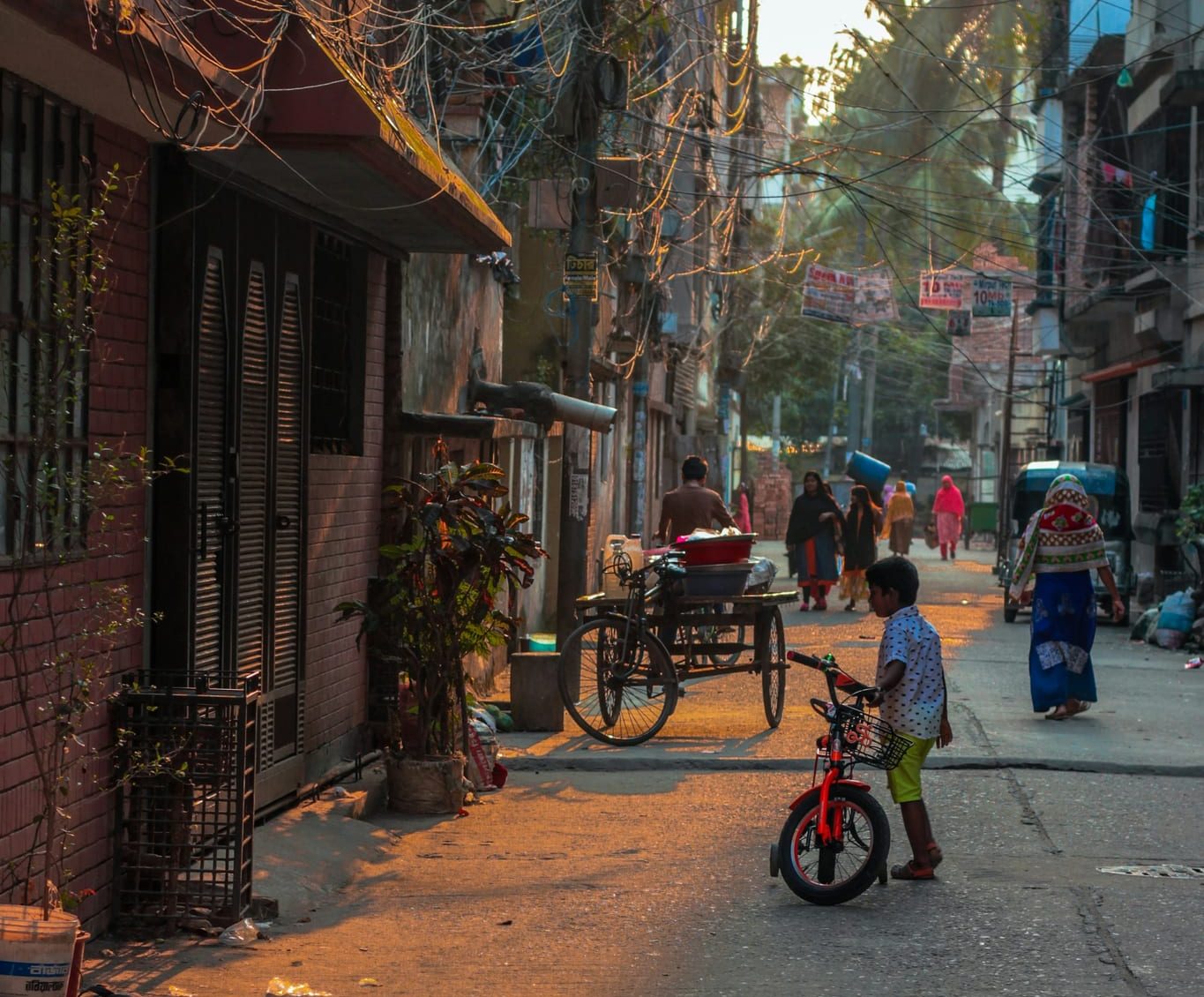
Despite global commitments under SDG 11.7 to provide universal access to safe, inclusive and accessible green and public spaces, Dhaka allocates just 0.9% of its land to open space. In our study, only 36% of children reported having a park within a 10–15 minute walk of their home. Access was particularly limited in unplanned areas, where children often rely on streets, rooftops or vacant plots for play.
This spatial inequality mirrors patterns observed in many cities across developing countries, where informal settlements and low-income neighbourhoods experience the greatest deficits in public amenities. Children in these areas face a double burden: high population density and the absence of safe spaces for recreation.
The Convention on the Rights of the Child (CRC), Article 31 affirms children’s right to rest, leisure, play and recreational activities appropriate to their age. Yet our findings show that even where parks exist, they often fail to meet this standard. Children described Dhaka’s parks as poorly equipped and inadequately maintained, lacking basic facilities such as toilets, drinking water, handwashing points, seating and waste management.
Play value was particularly limited for adolescents. Equipment and park design tended to give priority to younger children, while rules frequently restricted group sports and active play. This reflects a broader global trend: urban spaces are rarely designed with adolescents in mind, despite growing evidence that access to safe outdoor environments is essential for their physical and mental wellbeing.
Safety concerns emerged as one of the most significant barriers to park use. Nearly two-thirds of children reported feeling unsafe on the route to parks due to traffic, poor lighting, overcrowding and fear of anti-social behaviour. These concerns resonate with findings from other low- and middle-income cities, where unsafe mobility environments undermine children’s independent access to public space.
Crucially, the study highlights that perceived risk matters as much as actual incidents. Parents’ fears — shaped by broader urban insecurity — translate into restrictions on children’s movement, particularly for girls. This dynamic, observed globally, results in unequal access to public space and reinforces gendered patterns of exclusion.
Inclusive urban development is a central principle of both SDG 11 and the CRC, yet inclusivity remains a major gap in practice. Only 23% of children in the study felt that parks were accessible for children with disabilities, and fewer than one in four believed that girls feel welcome in these spaces.
Physical barriers, lack of inclusive play equipment and social norms combine to exclude large groups of children from spaces that are nominally public. These findings align with international evidence showing that disability-inclusive and gender-responsive urban design remains limited in many developing cities, despite formal policy commitments.
One of the clearest lessons from Dhaka is that governance and management are central to children’s experiences of public space. In unplanned areas, the absence of formal oversight contributes to deteriorating facilities and unchecked anti-social behaviour. In planned areas, parks are more regulated, but rules and security measures often prioritise order and asset protection over children’s rights to play.
This tension reflects a broader challenge faced by city authorities globally: balancing risk management with children’s participation and wellbeing. Notably, children’s voices are rarely included in decisions about how public spaces are designed, regulated or managed — despite CRC commitments to child participation.
While rooted in Dhaka, our findings point to transferable lessons for policymakers and development partners working toward child-responsive implementation of SDG 11. Urban open spaces need to be protected and appropriately developed for the benefit of children, especially in informal and low-income areas, before land pressures make recovery impossible.
The focus should be on functionality rather than infrastructure alone, ensuring that sanitation, lighting and maintenance make spaces genuinely usable. Design should explicitly account for inclusion, treating girls, adolescents and children with disabilities as primary users. Safety is best addressed through enabling measures such as lighting, supervision and social presence, rather than restrictive rules that limit play. Governance and accountability also need to be strengthened, combining municipal responsibility with community engagement and child participation.
Across developing countries, children remain largely invisible in urban policy debates dominated by housing, transport and economic growth. Yet access to safe, inclusive public space is a clear indicator of whether cities are fulfilling their commitments under SDG 11 and the CRC.
The Dhaka experience underscores a simple but powerful message: building cities for children does not require extraordinary solutions, but it does require political will, child-centred planning and recognition that play is not a luxury — it is a right. As cities continue to grow, ensuring that children can safely access and enjoy public spaces will be central to creating urban futures that are truly inclusive for all.