As I write, my eyes keep straying to the magnificent snow-capped peaks of the Andes out of the aeroplane window to my left. I am heading south, away from the Lithium Triangle, where I have spent a month exploring the world’s highest and driest desert. The Chilean Atacama is the home of the indigenous Lickanantay peoples, who have thrived in this hostile landscape since well before the Incas and then the Spanish came to dominate Chile. Nowadays, the biggest threat to the Lickanantay culture and way of life comes from the global mining corporations that dig up the Salar de Atacama, seeking lithium — white gold — to power the world’s electric vehicles (EVs) and solar batteries.
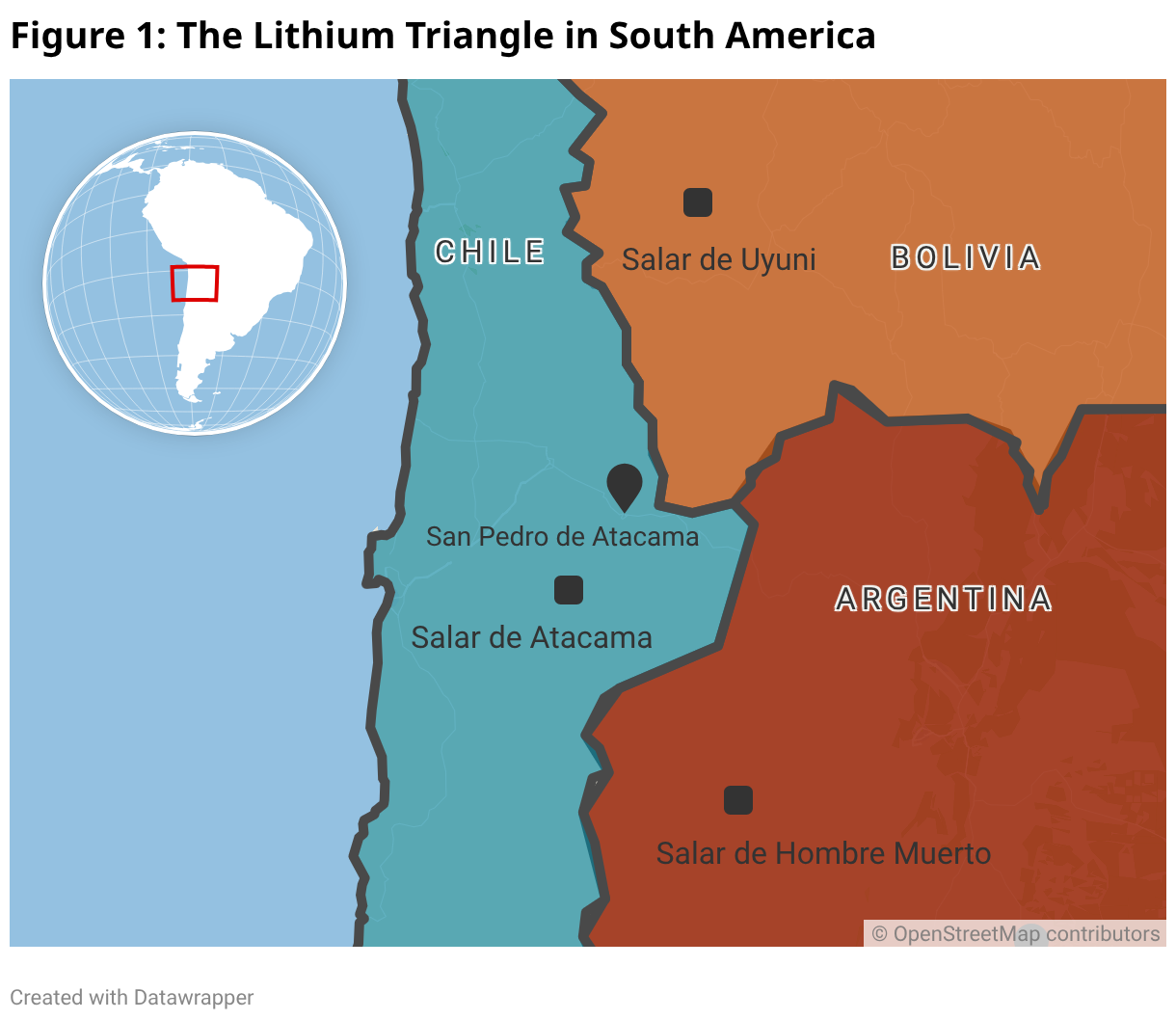
The Lithium Triangle of South America binds together the indigenous Lickanantay, Quechua, Colla/Kolla, Uru Chipaya and Aymara communities of the Atacama in northern Chile, the Salar de Uyuni in southern Bolivia, and the salt lakes of north-western Argentina. For the Lickanantay, longstanding traditions of respect for the spirits of the desert, and of all sentient beings who seek to survive in this place with little water, are challenged by bigger forces of demand and supply. The move to renewables, to support the transition to a global post-fossil fuel economy, is not a win-win option for everyone. EVs require batteries, which require lithium, an alkali metal of which 50% of the world’s known reserves lie in the Lithium Triangle. The growth of lithium mining here has occurred exponentially, as global demand for lithium has multiplied; 70% of Chile’s lithium goes to China, where as much as 87% of the world’s lithium battery production takes place.
The catch is that the Atacama Desert is not empty, nor devoid of life. There have been people in this part of Chile for thousands of years, living on and with the land in small communities (ayllu), farming and herding llamas and alpacas. Within these communities, most of which are formed around natural oases, resources are carefully and cooperatively managed. Human-built channels run between land parcels, and water is shared according to need, on a rotating cycle that follows the moon.
In Chile, lithium exploration dates back more than 40 years, but production has only really taken off since 2015. The dominant player is SQM, a multinational company that was initially a state-owned company, now privatised with different shareholders, including a Chinese corporation (Tianqi Lithium). Recently, it formed a partnership with Codelco, a Chilean copper company, to establish Nova Andino Litio, which plans to extract lithium in the Atacama salt flats until 2060. Another firm operating in the area is Albemarle, an American company which acquired Rockwood Lithium operations in Chile. In 2016, Albemarle negotiated a 30-year Impact Benefit Agreement (IBA) with Lickanantay communities to obtain their support for its ongoing operations. Similar agreements with the same communities have been entered into by SQM in recent years. The local indigenous communities are divided about them. Some of the affected Lickanantay people are totally opposed to mining, worrying about the environmental impacts, while others seek to engage constructively and increase the share of the benefits that come their way. However, principles of Free, Prior and Informed Consent (FPIC) have broken down within the IBA negotiations. Money put on the table by the mining companies at the start of the consultation process — their opening bid, if you like — inevitably manipulates communities’ will, questioning the “free” nature of the FPIC.
The Observatorio Ciudadano (translated as Citizen’s Watch), a Chilean NGO with offices in Temuco and Santiago, works in partnership with indigenous communities and local NGOs in all three countries of the Lithium Triangle, with the support of the Canadian International Development Research Centre (IDRC) and the International Federation for Human Rights (FIDH), to research mining impacts in the region and help affected communities to strategise for a more effective and united approach. While in San Pedro de Atacama, the heart of the region on the Chilean side, I was privileged to meet the Coordinator of the Observatorio’s Globalization and Human Rights Program, Jose Aylwin, a human rights, indigenous rights and land rights specialist, who also serves as a Vice President on the Board of FIDH. Jose has led the Observatorio’s major research, Lithium and Human Rights in Argentina, Bolivia and Chile, with a recent report published in Spanish and reported on in English by Mongabay. Our paths crossed while Jose was in San Pedro to launch this report locally at a workshop of the Consejo de Pueblos Atacameños, to which I was kindly invited as an observer by Oriana Mora Rodríguez of the Consejo. It was eye-opening to hear some of the questions asked about how they could hope to benefit from something that was so clearly of benefit to the rest of the world, but which required their land to be destroyed for mining, often without any hope of eventual land rehabilitation and restoration, and limited practical means of implementing IBAs.
I was struck by how similar the implications were to those from mining in the arid rangelands of Mongolia and Tanzania, where I have previously worked on land governance and landscape management with indigenous communities, through the Women’s Land Tenure Security Project (WOLTS). Later, I asked Jose how much his organisation and the indigenous communities in Chile had engaged with CSOs and NGOs in other parts of the world affected by mining? Indeed, they have, but it is still early days in the Lithium Triangle, and the picture is complicated by global climate change debates. This makes lithium mining seem less “bad” than extraction of fossil fuels, with corresponding pressure on those affected to act for the greater global good.
Places like San Pedro de Atacama face further environmental pressures from a growing tourist industry that was virtually non-existent 20 or so years ago. Tourists tramp through the desert, use up precious water resources in their long showers, and too many leave their rubbish behind, polluting the previously pristine landscape. Conversely, they create jobs.
It’s a complex place and a complex situation, which is why organisations like the Observatorio Ciudadano play such a vital role in helping local communities navigate these challenges, so that they can determine their own path and protect their heritage, culture and sacred sites. It’s also why organisations such as the Land Portal Foundation and the International Land Coalition (ILC), of which Observatorio Ciudadano is a member, play such vital roles in connecting people, sharing knowledge and facilitating debate on land governance issues like these across the globe.
As I leave this land of dust, clay, salt and sand, I take with me a newfound appreciation of the value of water, and of the ability of indigenous peoples to sustainably manage their environments in a manner that is not even within the comprehension of many people in the Minority World. I leave also with new friendships, and with the warmth of the Lickanantay welcome still glowing in my heart.
My deepest gratitude to Jose Aylwin and colleagues at Observatorio Ciudadano, Oriana Mora Rodríguez and all at the Consejo de Atacameños workshop in January 2026, and Sabine Pallas and Katheryn Sánchez Baquero of ILC for connecting me to Observatorio Ciudadano. Thank you also to Jose for reviewing this article before publication.