


Over three decades in the United Nations system, from village classrooms in Fiji to ministries in Africa and labour institutes across Asia, I have heard the same question: how do we build an economy strong enough to keep our people?
Across the Pacific, however, a quiet resignation has set in. Many now see the loss of teachers, nurses, tradespeople and young families as the inevitable fate of small island states, and rising remittances as an acceptable trade-off. Labour mobility is shifting from a safety valve to an unofficial development model. Global experience shows the danger. In Manila, Kathmandu, Kingston or Suva, I have never seen a country build lasting prosperity on the earnings of its absent citizens.
The Pacific is at a turning point. Remittances are climbing across Fiji, Tonga, Samoa, Vanuatu, Kiribati and Tuvalu, while domestic capacity is thinning just as fast: fewer teachers in classrooms, fewer nurses in clinics, fewer skilled workers in key sectors, fewer young people imagining a future at home. I see rising remittance dependence not as a trend, but as a structural warning. The real question is whether Pacific countries can retain enough people, skills and confidence to sustain viable economies.
I want to make a simple point: remittances help families, but they are not development. Without urgent action to rebuild domestic capacity, the Pacific risks sliding into a remittance-dependence trap that no country has ever escaped.
The Pacific now has some of the highest remittance-to-GDP ratios in the world (Table 1). In several countries, inflows rival or exceed tourism, agriculture, fisheries and even aid. Tonga and Samoa sit among the world’s top remittance-dependent economies. Fiji now receives over US$1.2 billion — around 11% of GDP. In many small island states, 20-50% of citizens live abroad.
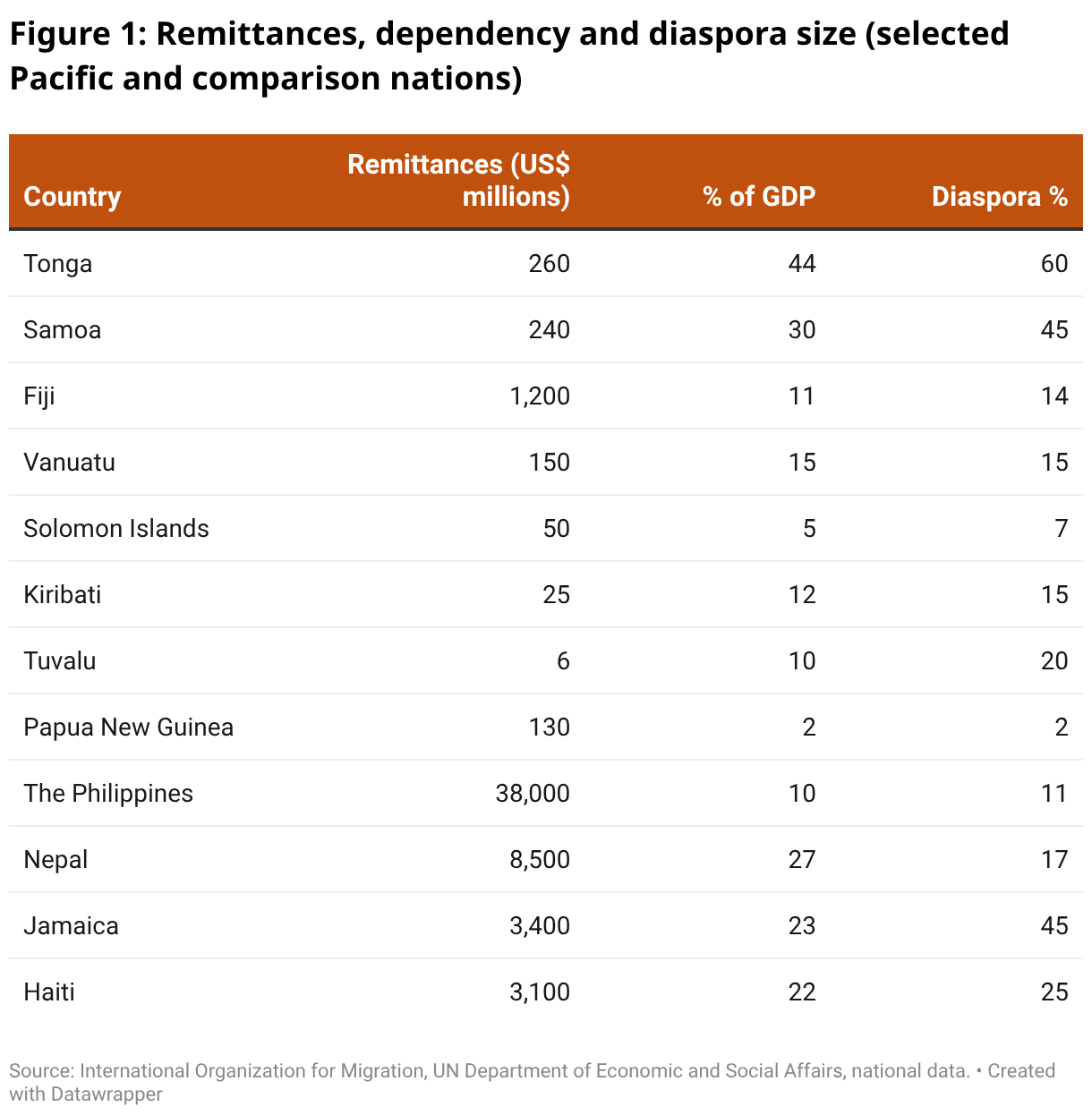
Remittances have become the region’s economic oxygen. Their value is undeniable. But so are their limits. High remittances consistently correlate with labour shortages, declining productive capacity, skills loss, rising dependency and continued outmigration.
Decades of research from the World Bank, the International Labour Organization, the Asian Development Bank and academic studies show the same conclusion: remittances offer consumption relief, not structural transformation. They support household income, education, and recovery after disasters, but they do not create industries, build institutions, expand the fiscal base, raise productivity, or generate broad-based employment. A dollar sent from Sydney or Auckland helps a family in Nadi or Apia, but it does not build a firm, a sector or a long-term job.
If remittances were a development strategy, Tonga would resemble Singapore and Nepal an Asian tiger. They do not. The global lesson is unmistakable: no country has ever moved from low-income to high-income status through remittances.
Fiji’s remittance boom is unfolding alongside something more worrying: a rapid erosion of domestic human capital. More than 114,000 people have left in six years, the equivalent of emptying a major town, while the economy continues to expand. This is not a crisis of patriotism; it is a crisis of capacity. Labour shortages now affect nearly every sector: education, health, construction, tourism, agriculture and the public service.
To cope, Fiji increasingly recruits workers from Bangladesh, the Philippines, India and Indonesia. They contribute significantly, but the risk is structural: locals leave; foreign workers keep the economy running. What Fiji lacks is not ideas, but a coherent labour-market strategy linking wages, migration, skills, tertiary education, private-sector demand and institutional reform.
As Adam Tooze argues in his 2025 Foreign Policy article The end of development that economic outcomes are ultimately political outcomes. People do not leave countries; they leave political economies where institutions feel opaque, opportunities feel limited, wages lag behind living costs, public services are stretched, meritocracy feels uncertain and the future feels narrower than elsewhere. Remittances can mask these pressures, reducing the political urgency for reform.
Small states cannot stop migration, but they can reshape the reasons people leave: make work pay with evidence-based wage reforms; promote meritocracy and institutions of fairness; institute national skills compacts; turn remittances into investment through diaspora bonds and matched savings schemes; create domestic jobs through sector strategies for agricultural modernisation, blue and green economy initiatives, ICT-enabled services and creative industries.
The real test of leadership is not whether people leave, but whether staying remains a dignified, rational and hopeful choice. Remittances keep households afloat, but only domestic opportunity keeps a country standing. When people lose confidence in their political economy, they migrate; when they believe in tomorrow, they invest in it. That belief, not GDP or inflows, is the real foundation of development.
The Pacific is now at that crossroads. We can treat rising remittances as success and the loss of workers as destiny. Or we can choose the harder path: rebuild institutions, reward merit, lift wages, invest in skills and expand real opportunities at home. Countries like Singapore and Mauritius did not develop by exporting people. They developed by giving people reasons to stay.
A future worth staying for is not a miracle. It is a choice, and it is still within reach.






What is the definition of diaspora here? If it’s the number of citizens who reside abroad, 15% for Vanuatu seems very unlikely. Even if you count non-Melanesians who have been naturalized, and even if you count those that may be doing seasonal work abroad at any given time (around 2% of the population I believe).
Dear Tihomir, Thank you for your question on the definition of diaspora. By “diaspora”, I was referring to the stock of people born in the country (or holding citizenship) who reside abroad on a medium- to long-term basis, drawing on UNDESA/IOM migrant stock estimates. It does not include short-term seasonal workers counted at a given moment, but rather accumulated migrant stocks over time.
In small countries like Vanuatu with a population of around 320,000, even relatively modest absolute numbers can produce between 8-15%. My argument in the blog does not rest on whether the figure is 8%, 1%3, or 15%. The structural point remains: in small island economies, outward migration stocks, especially of working-age and skilled populations, are proportionally far more consequential than in large countries.
This is a long response but given the subject matter, it is warranted.
A thought-provoking, even disturbing article by Dr. Naren Prasad that needs urgent attention.
Remittances are fairly prominent in the regional agenda, but the reporting is largely based on media releases, so mostly one-sided, with a positive, PR focus.
Dr. Prasad’s article reminds us of a well-established phenomenon known as the “resource curse.” One of its biggest victims was Nauru, which doesn’t have much to show for all its phosphate wealth except for a scarred and largely barren landscape. Besides overindulgence, copious waste and being ruthlessly exploited, Nauru did not invest its wealth for the future and all the money has long since evaporated.
Royalties and remittances may not be the same thing, but there are some undeniable parallels that we is a region would be foolish to ignore.
Taking lessons from the Nauru experience, are remittances another “curse” of abundance and consumption that some Pacific Island countries are at risk from? (Labour/skills like phosphate, is a (replenishable) resource, so perhaps falls in the ‘resource curse’ category in some respects at least).
This is the key question in Dr. Prasad’s article on the Pacific’s increasing dependency on remittances, which are climbing across Fiji, Tonga, Samoa, Vanuatu, Kiribati, and Tuvalu.
The remittances are worth tens of millions—in Fiji alone over US$1.2 billion, which is around 11 percent of the GDP.
Some might put remittances in the category of a “nice problem”.
But that is both simplistic and short-sighted.
As Dr. Prasad points out, domestic capacity is thinning, just as remittances are growing: “fewer teachers in classrooms, fewer nurses in clinics, fewer skilled workers in key sectors, fewer young people imagining a future at home”.
He makes what he describes as a simple point, but it is quite profound: “remittances help families, but they are not development”.
He adds that global experience shows the danger. “In Manila, Kathmandu, Kingston or Suva, I have never seen a country build lasting prosperity on the earnings of its absent citizens”.
According to Dr. Prasad, the key challenge in the Pacific remains the same: how do we build an economy strong enough to keep our people? But, he argues, that “a quiet resignation has set in”. Any such complacency should be worrying, if not alarming.
Dr. Prasad has sounded the warning very clearly, and it is vital that regional leaders take it seriously and make it a priority.
Remittances can be described as easy money, at least for the recipients, and if Dr. Prasad is to be believed, they could lulling us into a false sense of security and laziness.
Just as there is no such thing as a free lunch, there is no such thing as free money, and the Nauru experience is a stark reminder that history might repeat itself if such lessons are ignored.
Dear Shailendra, thank you for your kind words. And thank you for bringing up the “resource curse” element into this conversion. I would like to add the MIRAB model and aid dimension. The MIRAB model (Migration, Remittances, Aid, Bureaucracy) already recognised that small states often rely on external rents (Watters & Bertram 1985). What may be changing today is how those rents interact. Aid has become more fragmented, more conditional, often channelled through non-state actors, and less focused on building stronger, durable state capacity. The bureaucracy that aid sustains can become donor-responsive rather than citizen-responsive. At the same time, remittances sustain households directly. So we risk an equilibrium where aid keeps institutions/government appearing functional, remittances keep families afloat, and neither flow generates sufficient political pressure for structural and governance reform. One stabilises the state on paper; the other stabilises society in practice. But stability is not transformation. That is why our countries are stuck and people tend to leave.
This interaction between aid and remittances is rarely analysed together. Policy communities treat them separately, development cooperation on one side, labour mobility on the other, yet in small island contexts they operate simultaneously within the same political economy.
I think there is real scope to explore this further. If remittances help families but are not development, and aid helps governments function but not necessarily reform, what happens when both flows coexist at high levels? Do they complement reform, or unintentionally delay it?
This feels like an important next research conversation for the Pacific and beyond (I’m already thinking of doing a paper).
Thank you for pushing the debate in that direction.
Thank you so much, Naren. That was a wonderful piece of writing. You have presented an entirely different perspective on workers’ migration and remittance inflows.
Until now, I had viewed remittances only from one angle—their contribution to nation-building. Naturally, my thinking was shaped by the subcontinent’s context, where rapid population growth has created an abundant workforce. Migration and remittances have long been areas of interest for me, but your analysis has encouraged me to reflect on them from a new and broader perspective.
Once again, thank you for sharing such insightful thoughts.
Dear Khuram, Thank your kind words. In South Asia, where populations are large and labour supply abundant, migration and remittances have played a very different role. They have reduced poverty, supported families, and stabilised economies under pressure. My argument is not that remittances are “bad” or that migration is a failure. It is that context matters, especially size, scale, and institutional capacity. What works in Pakistan, India, Bangladesh, or the Philippines does not automatically translate to small island states with tiny labour markets and fragile public systems.
I am very grateful that you engaged with the piece in such an open way. These conversations are important precisely because they allow us to see the same phenomenon from different historical and demographic realities. Thank you again for reading it so carefully and for reflexion.
With respect, the simple point here is not correct and far too strong.
This is a comprehensive recent review of rigorous studies and paints a rather different picture, if we are trying to draw lessons from the global experience
https://voxdev.org/voxdevlit/international-migration/how-migration-reshapes-origin-areas
Dear Ryan. Thank you for pointing towards the VoxDev review paper, which is valuable. My reading shows that migration and remittances reduce poverty, improve schooling, and help households cope with shocks. I do not dispute that. But evidence-informed policymaking requires context, and that is where my reservation are with some of the conclusions drawn from global averages. Most of the strongest evidence comes from large countries like Bangladesh, Nepal, and the Philippines. In those contexts, labour markets are bigger, training systems are large, and institutions can absorb losses. In small island states like Fiji, Tonga, or Samoa, scale changes everything. Losing a few nurses or teachers is not marginal, it can destabilise an entire system. There is no mention of the scholarship of the small islands literature.
I speak not only as an economist, but as a migrant and a remittance sender. I know what remittances mean for families. They pay school fees. They rebuild homes. They buy imported goods. They ease hardship.
But I also know what I have seen. I have seen empty classrooms in remote Fiji. Health centres without permanent doctors. Government posts left vacant or filled in acting positions for years. Businesses desperate to hire locally but forced to import labour. Villages where the productive middle generation are reduced, leaving mostly the young and the elderly. Children encouraged to get just enough credentials to leave. These realities rarely show up in micro-level regression tables.
Migration is not bad. Remittances are not bad. But when scale is small and institutions are fragile, the political and institutional effects matter as much as the household gains. That dimension is largely missing from mainstream migration research. And for small island states, it is the dimension that may matter most.
Thank you for sharing this insightful piece. Your analysis highlights a tension that is often overlooked, while remittances provide vital support to households, they cannot substitute for the development of domestic capacity. I find your emphasis on creating opportunities at home especially compelling. It’s a reminder that sustainable development depends not just on financial inflows, but on building institutions, rewarding merit, and making it viable for citizens to stay and contribute. Your argument challenges policymakers to move beyond short-term relief and focus on the structural reforms necessary to retain human capital and foster long-term economic resilience.
Thank you again for bringing attention to this critical issue.
Thank you very much for your comment Charlton. I’m sure South Africa knows this tension well. Remittances across the region help households survive in Zimbabwe, Mozambique, Lesotho, Malawi among others, but they cannot replace functioning institutions, trusted governance, and domestic job creation. Financial inflows can stabilise families; only strong systems can sustain nations. You capture the core issue perfectly: development is about incentives. If talent is rewarded, institutions are fair, and opportunity is visible, people stay, or return. If not, migration becomes the rational choice. The challenge for policymakers, in Africa as in the Pacific and the Caribbean, is to resist the comfort of short-term relief and focus on long-term capacity.
“They developed by giving people reasons to stay.” I know Dr Prasad is well meaning: remittances are not ‘development’ – I agree; but ‘staying’ is not necessarily ‘development’ either. It would be a smarter strategy to encourage small state citizens to leave, drink the world, build networks and nurture ideas that they are NOT likely to nourish by staying put, and THEN come back, wiser, smarter, richer in social capital (if not in economic terms as well). I am all for the ‘right to stay’, but it has been proven that small island entrepreneurship is typically driven by those islanders who have dabbled with the world outside.
Professor Baldacchino, thank you for comment. I have long admired your work on small states, and I still consider your 1993 piece, “Bursting the Bubble: The Pseudo-Development Strategies of Microstates”, one of the sharpest analyses of the vulnerabilities of microstates. It shaped much of my own early thinking.
I agree entirely that “staying” is not development. Small states benefit enormously when their citizens “drink the world”, build networks, acquire skills and return with ideas, capital and confidence. Circulation, when it works, is powerful. My concern is about conditions. Encouraging outward mobility only works as a strategy if there are credible pathways to return, competitive domestic opportunities, and institutions & governance strong enough to retain talent. Return migration depends on confidence, confidence in governance, democratic stability, meritocracy, security and institutional fairness. If corruption grows, if appointments are politicised, if justice feels uneven, if insecurity increases, mobility becomes exit rather than circulation. This is precisely what is happening in my side of the world. And even worse, when the best and brightest (doctors, nurses, engineers, teachers, technical specialists) are welcomed with open arms abroad, the domestic system collapses. We end up training professionals who are quickly absorbed by larger economies, while our own bureaucracies struggle to retain high-level expertise. We then import labour from other developing countries to fill the gaps. This is the problem I see when our leaders celebrate remittance as development.
Thank you for your kind words on my 1993 paper: that was my second-ever paper in an international journal!
The parameters of Return Migration deserve a proper study.
Return Migration depends on confidence in homeland stability, security, justice as much as in opportunity. We can wax lyrical about the wonder of family ties, the ‘sense of home’, and ‘back to one’s roots’. But people are not just romantic: they are also transactional. Will the move back be worth it? Is the risk justified? What is there to go back to? Sure: there may be obligations to care for elderly parent/s; help in a family business; but even these are usually framed in wider considerations. So, briefly: it is smart to ‘send people away’, sendback remittances, but also hoping that they eventually come back, enriching the domestic labour pool with talent and innovation. The latter is not a foregone conclusion. Indeed, for every sender of remittances, there is a missed opportunity of a returning migrant.
Can UNRISD pilot such a study?
Professor Baldacchino, Thank you again for your engagement. I’m also glad that you are brining Malta and other countries in this conversation. I fully agree with you that return migration is conditional, and not emotional, people calculate risk. They ask: is there stability, justice, meritocracy, security? Is there something solid to return to? Without those foundations, the hope that migrants will come back enriched remains just that, a hope. For every returnee, there are many who settle permanently, especially when their skills are absorbed elsewhere. Remittances also declines over time.
This is where my concern increases. Encouraging people to “drink the world” is wise, but only if the home system is strong enough to receive them. Otherwise, small states risk going into abyss. When your most capable teachers, nurses, engineers, and administrators are welcomed with open arms in larger economies, the capacity loss is not easily replenished.
I am also concerned that much of the global migration–remittance literature generalises across contexts without sufficiently engaging the small-states scholarship, including MIRAB and, of course, your own work. Scale fundamentally changes the equation. What is manageable for Bangladesh or the Philippines can be disastrous for Tonga or Fiji. As you very well know, the political economy of microstates, the role of external rents, bureaucratic fragility, social cohesion, these are central issues.
On your suggestion of a study: I think it is an excellent idea. The parameters of return migration in small states deserve rigorous analysis, especially how governance quality, institutional trust, wages, and political stability shape return decisions. I would be very happy to help stimulate such a conversation, including with colleagues at UNRISD. Or with donors in Australia/NZ.
Dr Prasad – I will glady support an international, comprehensive study of how to stimulate return migration, with a small state focus. It should have a global reach, consider as many examples as posible from the Caribbean, Pacific, Indian, Mediterranean, West African and Middle East Regions. It should proceed with a standard template, including both quantitative statistics and qualitative arguments. ‘Best practices’ to be highlighted, where they exist.
If we are looking at an eventual publication, there is a ‘Small State Studies’ seies with an international publisher, of which I am a series editor.
I wonder if UNRISD can effectively lead such a study?
I agree that remittances on their own have limited development potential. State development policies, which offer excellent rationale for business growth and attract talent and capital back to the country of origin are needed for development purposes. Otherwise, remittances act as a short-term abeyance of poverty. On other occasions they may act as the incentive to start a small business or send someone to higher education, but for real economic development, more stakeholders need to be involved and an overall strategy for such development needs to be spelt out and acted upon. Thanks for this article.
Dear Rose Marie,
Thank you for this very excellent comment from Malta. Malta’s own migration history is actually instructive here. As you rightly pointed our elsewhere in your research that in the 1950s-1960s, large-scale emigration helped relieve unemployment pressures. But Malta did not rely on migration alone. Over time it invested deliberately in education, industrial policy, EU integration, financial services, and institutional reform. Migration became part of the story, and not the whole story. That is the key lesson for small states like those in the Pacific and the Caribbean: migration can buy time, but only strategy, governance, and diversification build prosperity. Remittances can support resilience, but development requires visionary leaders (in short supply these days).
I agree with the arguments in this article in the context of Fiji. When the population merely exceeds 900,000 people and 10% working abroad, importing labor to mitigate labor shortages and while the unemployment rate is around 4-5% which is not bad, that means that there are systematic issues in governance. Definitely Public administration reforms are needed to address these issues. In line with the Social investment theory, government should invest in education, healthcare and infrastructure, moreover reform fiscal policy stimulate private entrepreneurship, most importantly curb corruption. These measures may not immediately stop the labor migration but will mediate negative effects of labor outflows in long term.
Dear Jahongir,
Thank you. You’re absolutely spot on: in a country of just over 900,000 people, losing around 10% of the workforce while importing labour and still reporting low unemployment tells us something structural is happening. It is less about “numbers” and more about governance, politics, between skills and demand, wages and expectations, institutions and trust. Public administration reform is central. If recruitment is transparent, promotions are merit-based, fiscal policy supports enterprise, and corruption is firmly addressed, the signal to citizens changes. People begin to believe that effort will be rewarded at home. As you say, these reforms will not stop migration overnight, nor should that be the goal. Migration is age-old and often beneficial. But good governance and strategic investment can reduce the negative long-term effects of labour outflows and restore balance. And this is about rebuilding institutional confidence.
This is an excellent fact based article.
Dear Dhurba,
Thank you for reading this piece and your kind words.
Your article perfectly captures the crossroads the Pacific is currently facing. You are right to challenge the ‘quiet resignation’ that has set in regarding labor mobility. By framing remittances as a ‘structural warning’ rather than a success metric, you strip away the complacency that often masks domestic decline.
I am especially compelled by your suggestion to turn remittances into investment through diaspora bonds and matched savings. You have laid out a clear choice: we can either continue exporting our people or we can follow the path of Singapore and Mauritius by giving them reasons to stay. Thank you for reminding us that a future worth staying for is a choice, not a miracle.
Dear Mahendra, Thank you for your reflection on this piece. I’m glad the idea of remittances as a structural warning resonated, that was exactly the intention. I plan to write my future piece on policies that matter especially on diaspora bonds and matched savings.
Thank you.
The uncomfortable truth-that no country has built prosperity by exporting its people, needs to be said. In Pacific contexts, remittances are often celebrated as success even as institutions thin, public services weaken, and confidence in domestic futures erodes. Migration here is not just an economic calculation but a political and moral one: people are seeking systems that feel fair, predictable, and dignified, not simply higher wages. Rebuilding domestic capacity, fair wages, skills retention, and institutional trust is not anti-migration but pro-choice, because the real failure is not that people leave, but that staying is no longer imagined as viable.
Dear Farzana. Thank you for putting it so clearly, and for naming the uncomfortable truth. I completely agree: the real issue is not migration itself, but the quiet acceptance that exporting people can substitute for building institutions, services, and opportunity at home. You’re right that, in the Pacific, migration is as much a political and moral signal as an economic one. People are looking for countries that are fair, predictable, and dignified, places where effort leads somewhere. This is natural and understandable. Rebuilding domestic capacity, fair wages, skills retention, and institutional trust is not anti-migration at all. It is about restoring choice. The real failure is not that people leave, but that staying is no longer imagined as viable. Thank you for engaging so thoughtfully with the argument, this is exactly the conversation we need.
This is a pretty powerful & much needed intervention. I really like the way they’ve reframed remittances as the “oxygen of the economy” rather than just a tool for development. All across the Pacific, you see these huge inflows of remittances being celebrated – but nobody ever stops to think about how that hollows out domestic capacity, makes people feel like they’re not good enough & erodes the sense that we’re capable of doing things for ourselves. It’s worth highlighting that no country has ever made it to high-income status solely thanks to remittances – that’s just fact. What really spoke to me is the way they tie this all back to politics – people don’t just take off to find better paychecks, they’re also voting with their feet because other places look like they have better institutions, a more honest system & a better shot at a decent future. Building real opportunities, dignity & some genuine hope in what we can do for ourselves here is pretty much the only way we’re going to get out of this hole in the long run.
Dear Mypursu, Thank you for your excellent comment. I give credit to you for capturing the core argument far better than I can have summarise it myself. I fully agree that remittances are the oxygen of many Pacific economies (essential for survival) but oxygen alone cannot build muscle, institutions, or confidence. What worries me most is the fatalistic approach of our leaders who let this bleeding continue, and on the contrary celebrate the amount of money sent by the hardworking migrants. I completely agree that rebuilding opportunity, dignity, and hope at home is the durable way forward. But what we do with the remittance money sent home. Thank you again for engaging so seriously with the piece, this is precisely the kind of conversation the Pacific needs.
Excellent article. I am working on similar Tonga remittance trends and how remittances are spent in Tonga.
Dear Semi. Thank you very much for this kind comment. Your work seems interesting. Tonga is a particularly revealing case, given the scale of remittances relative to GDP and the size of the diaspora. I’d be very interested to read your findings, especially on how remittances are actually used at household level and what that means for domestic capacity over time. Please do share the work when it’s ready, this is exactly the kind of evidence we need to deepen the discussion.
Very intriguing analysis of impact of remittances on receiver nations. Unfortunately political attributes seem to contributing handsomely to migration of skilled human resources and the richer or major political/ economic power players in the gain from freely trained skilled work force that fill skill shortages in these developed nations. However, the ultimate buck stops at the leaders of nations who train people but fail to create conducive environments to satisfy the needs of the very people needed to build the nation. Sad, but fact of life. Unless there is a mutual desire to cultivate a sense of commitment with appropriately attractive socio-economic environment that is also politically conducive, the trend will continue and smaller nations will still suffer degradation.
Dear Ambika, Thank you for your comment. I agree with you. People do not leave only because of opportunities abroad, but because conditions at home do not meet their needs. Australia/NZ benefit from Pacific workers, but the real responsibility lies with our national leaders to create fair wages, good working conditions, security, protection and trustworthy institutions. Unless governments make staying a real and dignified option, migration will continue.
Naren, this is an excellent article. It gets down to the root of the issue and forces us to contemplate how do small island developing States such as ours, make it attractive for citizens to stay. How do we successfully create that enabling environment for true development? You have highlighted well some of the arguments that have come to the forefront here in Jamaica as your assessment of remittances is spot on and applicable to many of our countries which share similar experiences. Until we change our position or views on remittances, and see it for what it really is, we will continue to grapple with the social and economic consequences of dependency on remittances.
Dear Deidra, Thank you very much for this generous and thoughtful comment. I’m really glad the piece resonated in Jamaica and other parts of world, because so many of the dynamics we see in the Pacific mirror what you describe. You’re absolutely right: the central question is how small island states make staying a real, dignified option by creating environments where opportunity, fairness, and confidence in the future exist at home. Jamaica’s experience reinforces the point that remittances can ease hardship, but they cannot substitute for development. Until we are honest about that distinction, we risk managing symptoms rather than addressing causes. I appreciate you bringing the Caribbean perspective into this conversation. These shared experiences across regions are exactly what can help us rethink the development choices facing small states.