


Vanuatu’s prevalence of physical or sexual violence against women by husbands and partners has fallen by nine percentage points over the last 15 years — from 44% of ever-partnered women aged 15-49 in 2009 to 35% in 2024. This is a faster decrease than the global average, and is not surpassed by any other country in the Asia-Pacific region with comparable studies over two points in time.
This good news is a headline finding from Vanuatu’s Second National Survey on Women’s Lives and Family Relationships. The study was undertaken by the Vanuatu Women’s Centre (VWC) in 2024 in partnership with the Vanuatu Bureau of Statistics (VBoS) and was launched on 9 March 2026. It compares findings with the first Vanuatu national survey, which was undertaken in 2009.
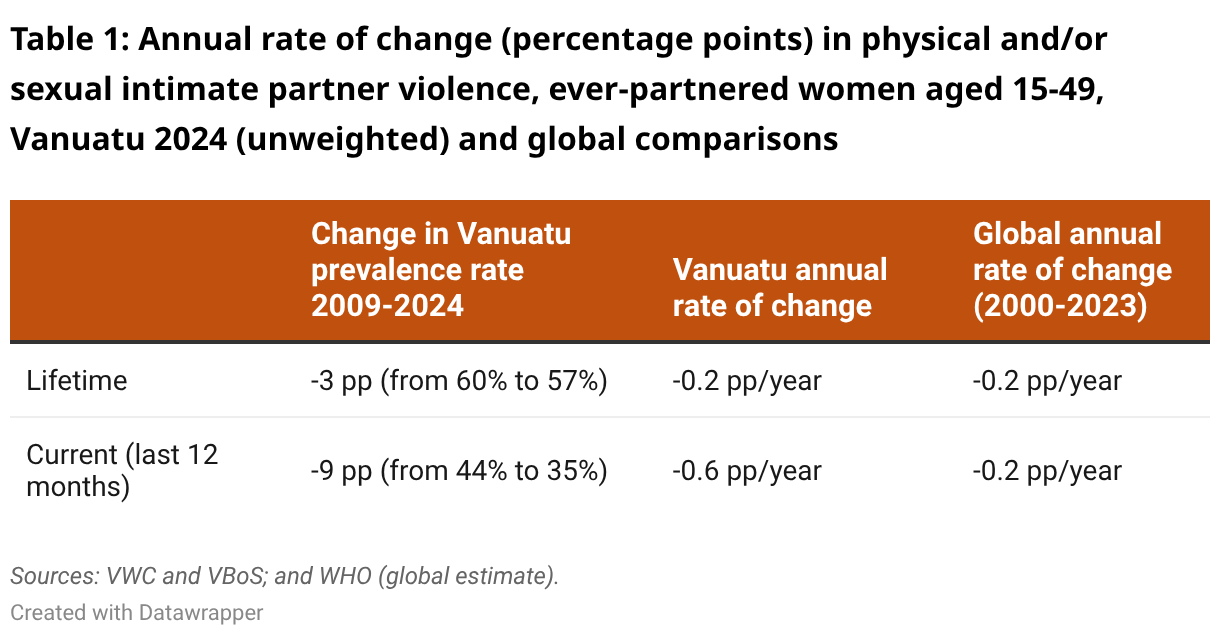
The global prevalence of physical and/or sexual partner violence has reduced by 0.2 percentage points annually, for both lifetime and current prevalence. For Vanuatu, the lifetime annual reduction in prevalence is also 0.2 percentage points. However, the pace of change for current prevalence (in the 12 months before each survey) is faster in Vanuatu at 0.6 percentage points annually.
Although Vanuatu’s reduction in the prevalence of intimate partner violence is undoubtedly still too slow at less than one percentage point per year, it is nevertheless a welcome finding, indicating that the prevention and response strategies of the Vanuatu Women’s Centre in collaboration with the Vanuatu Government, provincial governments, chiefs and other stakeholders are having an impact, as demonstrated in the research report.
Like other autonomous and locally led Pacific women’s organisations such as the Fiji Women’s Crisis Centre, VWC has consistently implemented — over more than 30 years — the strategies that various evidence-based reviews (for example, Htun and Weldon, the WHO, Garcia-Moreno et al. and a further WHO review) conclude are essential for reducing prevalence. These key strategies include: a survivor-centred and comprehensive approach to responding to women and girls subjected to violence; community mobilisation and group education with women and men to change harmful social norms; national legal advocacy to improve accountability coupled with client-based advocacy; and persistent long-term efforts in collaboration with other national and provincial Vanuatu agencies and community leaders to strengthen prevention and response efforts across the country at all institutional levels.
Inevitably, comparisons of prevalence rates between (and within) countries present methodological challenges. One of these challenges was addressed by the fact that the Australian Department of Foreign Affairs and Trade (DFAT) provided funding which enabled VWC to use the same methodology that was used in 2009. Both the 2009 and 2024 surveys used the World Health Organization (WHO) survey tool (adapted to the Vanuatu context), rather than a small module in a larger survey focused on a range of other social issues. This methodological choice significantly enhances the reliability and validity of comparative findings.
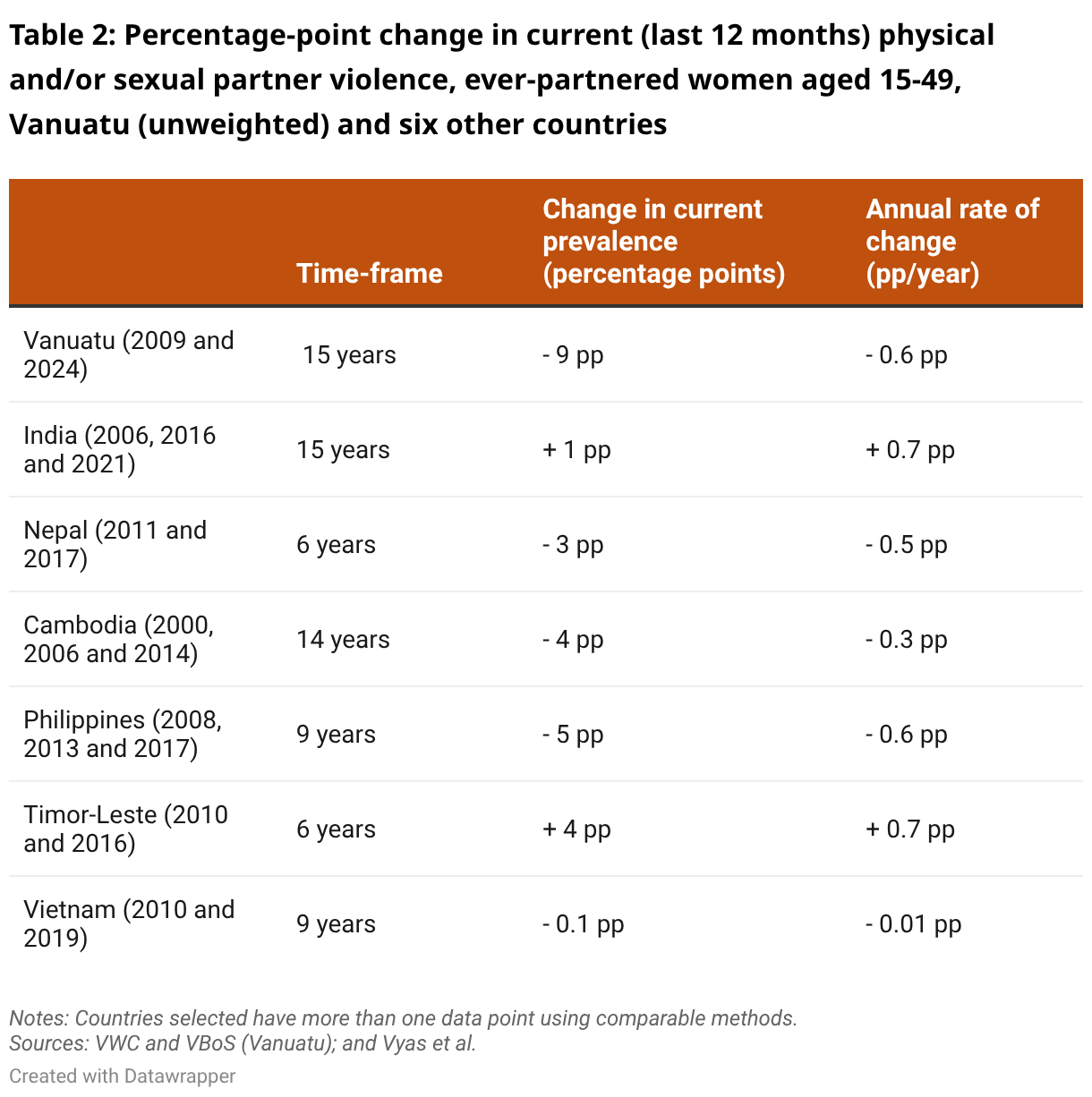
Another recent study compared changes in prevalence in several South and Southeast Asian countries where comparable methods of data collection were available across different points in time. Comparing the changes in Vanuatu since 2009 with the findings of this study provides further confidence in the conclusion that the pace of change in Vanuatu compares positively with other countries (Figure 2). However, it should be noted that Vanuatu and Melanesian countries in general have some of the highest prevalence rates in the world, and thus are starting from very high baselines compared to most countries, and that there are currently no other published studies across more than one data point for comparison within the Pacific region.
Despite the good progress made, data from the 2024 survey reveals a complex picture of progress, with emotional intimate partner violence (in the last 12 months) reducing by only three percentage points since 2009. The prevalence of coercive control remains extraordinarily high, with 59% of women currently facing this form of abuse from husbands or partners.
Data on non-partner violence, and particularly childhood and adult sexual abuse, are confronting. These abuses put women at significantly greater risk of living with violence in their adult intimate relationships, and underscore the challenges ahead: 21% of women have been sexually abused by non-partners in their lifetimes, including attempted rape and unwanted touching; and 30% of girls were sexually abused under the age of 15.
VWC pioneered the incorporation of several new areas of study into the 2024 survey: it was the first using the WHO methodology to incorporate questions into the survey tool on violence against women during disasters / emergencies, technology-facilitated abuse (by both partners and non-partners), and sexual harassment. It is also the only country survey (to our knowledge) to assess the extent to which intimate partner violence causes permanent disabilities among women. The incorporation of each of these issues into the survey tool came from the grassroots: they were informed by VWC’s day-to-day counselling, training, legal advocacy and prevention work across the nation.
Without ongoing core support from both DFAT and the New Zealand Ministry of Foreign Affairs and Trade, it would not have been possible to incorporate these new areas of research, to confidently compare prevalence rates over 15 years, or to achieve the good progress made to date.
Nevertheless, the findings require an urgent and renewed commitment to action by all stakeholders — to continue the investment in evidence-based strategies, and to accelerate and sustain the changes already made.




Congratilatoins tai Vola and your team. Very interesting data here. My human rights advocacy network members are already using this data for our advocay and GBV awareness rasing. Much appreciated. Keep doing what you do. Means alot!
This is an important finding, and any reduction in physical and/or sexual IPV should be recognised. But the headline risks overstating progress because the analysis leaves out several forms of violence that are central to women’s lived experience, including coercive control, emotional abuse, financial violence and technology-facilitated abuse.
When those forms of violence are included, the picture changes significantly. The 2024 survey shows that 86% of women have experienced at least one form of IPV in their lifetime, and 71% experienced abuse in the previous 12 months. On that broader and more complete measure, it is much harder to claim meaningful overall change.
So yes, there may be progress on some specific forms of violence, but the fuller data shows that intimate partner violence remains widespread, active and deeply entrenched. The headline should not minimise that reality.
A really incredible progress. Through the outcome, it seems the government, all organisations, and communities in Vanuatu are working really well together. With a great partnership between VWC and the national VbOS, the study was done nationally and really captured the progress. I would love to be connected with organisations who led the national legal advocacy to improve accountability coupled with client-based advocacy to learn and adapt some strategies that may work in Papua New Guinea. Great work and Thankyou Vanuatu 🙏
Amazing to see this research on violence against women & girls has shown significant & measurable reduction validating the strategies & amazing effort of all those involved.
Interesting data Vola, thanks for the article. Publicly available court data shows that applications for protection orders has increased by 18% with 1,167 filed in 2025. It would be good to understand whether access to the formal justice system has improved at the same pace as we previously estimated that approximately 98% of cases never reach the system and that rural women remain largely excluded from protection orders.
It is very concerning that the prevalence of sexual violence against children remains largely unchanged from earlier surveys. A review of 2023 Court decisions (criminal jurisdiction) shows 1/3 involved sexual offences, with nearly seven in 10 decisions involving sexual offences against children. It further indicated that courts continue to rely on flawed medical examinations, police/prosecution practice remains inconsistent; child protection remains severely under-resourced; and that almost half of the prison population were serving sentences for sexual offences, consistent since 2012. I hope that we can see greater investment in services for children in Vanuatu.
Keep up the good, important work Vola, Sharon, Juliet and team – the Vanuatu Women’s Centre has been tirelessly supporting women and children across the country, its network for Committees Against Violence Against Women and its Male Advocacy program a major part of its effectiveness. Reducing violence is slow, hard work as this article shows, but it remains fundamentally important if we are to build a healthy, safe society together. Tankyu tumas for all you do.
Congratulations to the team on achieving better outcomes for women and bringing positive growth to the people Vanuatu. This has been a long journey 🙏