


I am sure all readers of this blog will have been in meetings when someone will pipe up and say, “can’t we be more strategic?”. We all nod. Being “strategic” is like decentralisation: nobody can possibly disagree. However, it is rarely said what “being strategic” actually means. It is a sort of mantra. “My boss said it, so I will.”
I sense that in development we mean one of three things (or even all of them at the same time):
- Are we focusing on goals and higher-order thinking, rather than detailed operational issues?
- Are there ways of achieving a greater impact from our funding for this initiative?
- Are we addressing the root cause of the issue, rather than just its symptoms?
This brings me to public sector governance.
Most of Australia’s development budget is spent in partnership with other governments. Government-to-government assistance.
So, the question is: can we design such “public sector” governance support to become increasingly “strategic”?
Let’s start with breaking down how governments are structured. Starting on the ground floor so to speak, there are many individual government departments or agencies. Sometimes these may be stand-alone organisations, at arm’s length from government. An autonomous revenue authority would be one example.
Sitting “above” the individual agency (please bear with me) is the sector, such as education or health or transport. These “sectors” may have several individual departments or agencies under their jurisdiction. In education, there are the departments or agencies responsible for the curriculum, tertiary education, procurement of textbooks, teacher training, professional support, and so on. These departments and agencies collectively are often referred to as ministries.
“Above” the sector (the ministry) lie two responsibilities for the whole public service: managing the financial and human resources of the state. Ministries of finance are responsible for the money and public service ministries (sometimes commissions) are responsible for people. These two bodies set the rules and regulations for how money and people are managed for all line ministries.
So far, so clear. Now what do these ministries, departments and agencies (MDAs is the common abbreviation) do? They do three things: first, they deliver goods and/or services; second, they operate systems, procedures and processes that enable the delivery of those goods and services; and third, they draft and implement policies that govern the production and distribution of the goods and services that lie within their remit.
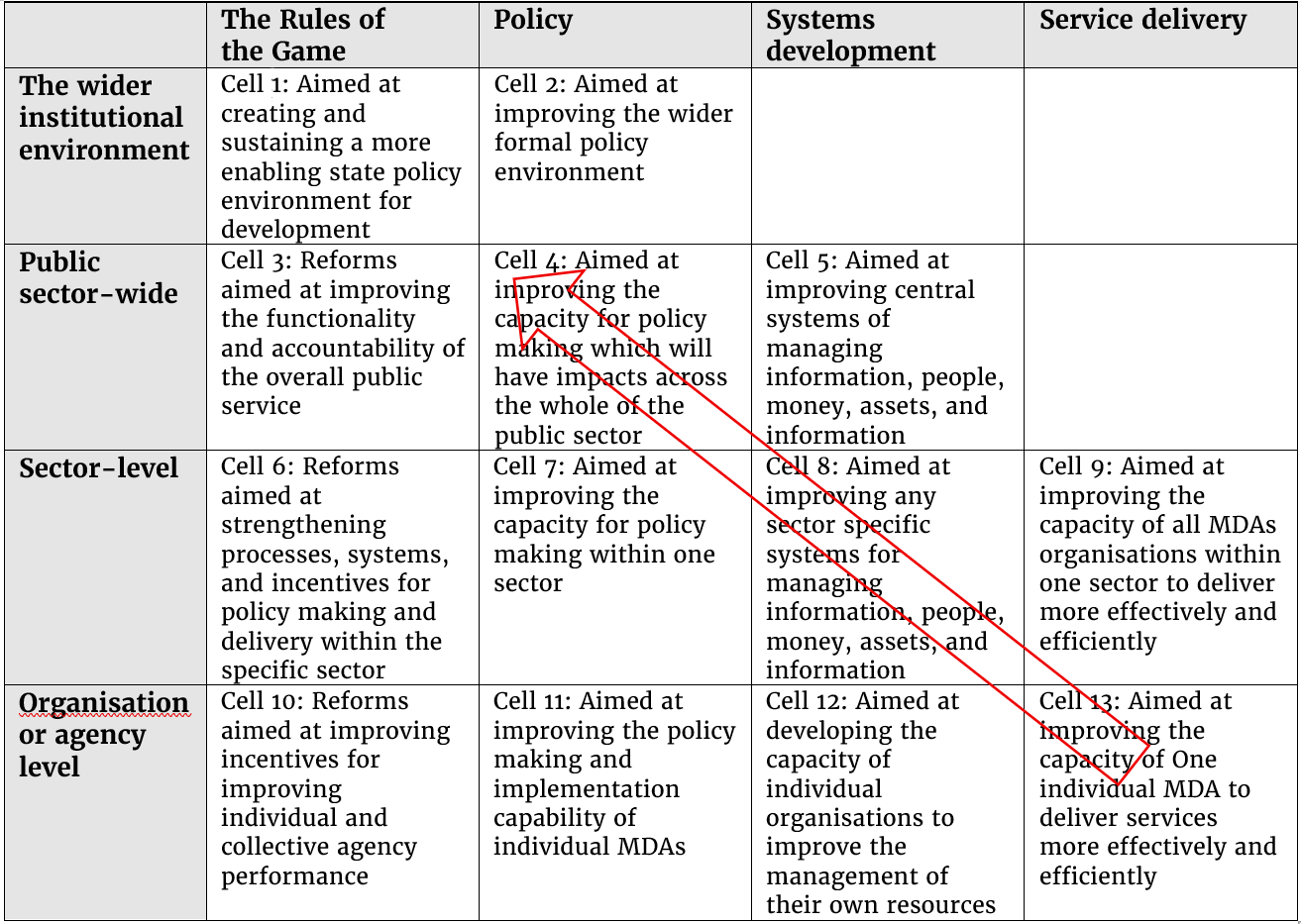
These two sets of observations are combined in the matrix below. But we know that the public sector does not exist in a vacuum. It sits in what is called the wider “institutional” environment. This refers to the formal and informal “rules of the game” which influence, if not determine, individual and collective behaviour. These are the incentives, the interests and the social norms and values that have become embedded and accepted in any polity. These “rules” may lie at cross-purposes with “conventional” thinking on how the public sector should operate: merit-based recruitment and promotion, competitive and transparent tendering, and a clear dividing line between the public and private spheres. The dominant pattern of norms and values found in Cell 1 below will affect what happens in all cells.
Table 1: Strategic public sector governance
Source: Graham Teskey.
What can this tell us about being strategic? If our objective is to help an individual MDA to deliver more and better goods and services, we can stop at Cell 13 and think no further. But if we do stop there, it is unlikely that we will achieve a lasting impact, or that we have addressed the root cause of poor organisational performance and functionality. We will have failed to be strategic in any of the three senses defined above.
From a public sector governance perspective, being more strategic requires us to track left and try and address system issues in the MDA (Cell 12). Even more strategically, we seek to revise and reform MDA policy (Cell 11).
However, the problem is that in seeking to promote such reforms within one agency, it is overwhelmingly likely that we will come up against bottlenecks. The individual MDA runs up against the established rules, regulations and ways of doing things at the sector or ministry level. So, in order to improve functionality and performance within the individual department or agency, we may well have to move into Cells 7, 8 and 9. We may need to consider what used to be called Sector Wide Approaches (SWAps).
Yet experience again tells us that sectors — ministries of health or education — face their own challenges and bottlenecks. Policies and regulations regarding appointing and paying teachers lie outside their control — usually with the public service ministry or equivalent. Similarly, the ministry of finance controls the cash. Sectors (ministries) can only reform themselves so far. At some point they run up against established public service-wide rules and regulations. So that shifts us up into Cells 4 and 5. What started out as a simple desire to, say, improve the delivery of basic education has suddenly morphed into a public service reform program.
The extent of the challenge faced at the sector and department level is largely determined by Cell 1: the wider institutional environment, the rules of the game. Cell 1 determines how challenging efforts in Cells 3, 6 and 10 are likely to be.
It follows that if we want to hit the three interpretations of “strategicness” noted above, we should follow the red arrow upwards and leftwards. The problem with that is the evidence tells us that the further we travel up this arrow, the harder the challenge will be. Rare are the examples of successful public service reform.
What does this mean for operations? Three things.
First, it is imperative that we understand what is going on in Cell 1. What are the rules of the game — the informal ones in particular. What are the interests and incentives that drive behaviour? Your political economy analysis must unearth these and draw out their real-world implications.
Second, you must be crystal clear regarding the problem you wish to address. For example, if staff attendance is poor at the department or agency level, then requiring staff to sign in and out may help temporarily, but if the real problem is low pay and the absence of a performance culture in the workplace, then it is unlikely to work for long. The problem lies beyond the reach of the department (and indeed the “sector”) itself.
Third, and following on directly from the first two, be clear-eyed about the objective of the investment. This requires an appreciation of both the nature of the problem and what “solutions” are technically appropriate and politically feasible. It may mean opting for second or even third best technical “solutions”.
Considering these three questions will indicate whereabouts on the arrow you are aiming to be. You should remember that it might not always be possible to be “more strategic” in the sense of the three dimensions outlined above. Sometimes there is nothing wrong in staying in Cell 13. It may be appropriate to respond to your colleague by saying, “no, in this instance we absolutely do not want to be more strategic.” If the benefits exceed the costs, who is to say that this is an inappropriate investment?







I liked a lot about this blog—particularly the critique of how “strategic” is often mis- and over-used, conferring unearned authority on whoever invokes it. The emphasis on identifying root causes (not just symptoms), and on designing responses that are politically and technically feasible—not just wishful thinking—also resonated (that temptation must be especially acute for short-term posted officers). And the “graveyard” of public service and governance reform programs is a sobering reminder of how hard being strategic and effective is in practice.
Graham’s principles translate directly to inclusive economic growth. A grounded understanding of political economy, gender and disability dynamics, and power structures within markets is non-negotiable. The real skill lies in navigating these constraints carefully—working within them, and occasionally around them—to catalyse durable change.
Paradoxically, the piece also reinforces the value of interventions that don’t always sound especially “strategic”. The debates in the 2000s around promoting growth and private sector development come to mind, when the dominant narrative was that aid should focus on creating that elusive “enabling environment,” rather than engaging directly with markets or firms. Experience has shown the limits of that approach: regulatory and legal reforms alone rarely shift outcomes, as entrenched interests adapt to preserve their position.
More recently, there’s been a shift in aid programming towards pragmatic partnerships with businesses, industry groups, and governments. These often start with a narrow, highly specific problem—hardly grand or “strategic” at first glance—but can generate tangible, scalable change that endures beyond project support. The most successful examples are, in fact, strategic in the ways Graham describes: locally grounded, realistic about constraints, but designed with a clear pathway to scale and sustained impact beyond program support—delivering strong value for money as a result.
In today’s reality, the word “Strategy” has been battered around so much that it has lost its meaning. When reading this article, one could easily detect, the concept of “Strategy” has been dialled down so many notches, it’s no longer what it really meant when dissecting it from State Power perspectives. At least that’s how it was unpacked for those who ventured into Post Graduate Studies of “Strategy” and the Art therein.
I agree. Having a strategy means (among other things) articulating a clear theory of change, identifying the problem and designing your program to address it. It does not mean the program should be focused at high levels of government. Part of the problem seems to be the word strategic which should have the same basic meaning as “strategy”. But it has come to be used as a synonym for acting at high levels of government. Bottom-up interventions can be just as “strategic”. We really should be starting with the problem not the level at which we want to operate.
Thanks Graham, I found your analysis of the matrix structure of public governance really useful. However i completely disagree with your claim that “…if we want to hit the three interpretations of “strategicness” noted above, we should follow the red arrow upwards and leftwards”. This conflates strategy with hierarchy which I think is damaging to development effectiveness.
If I could reframe the argument in terms of top-down and bottom up change. Both can be strategic or tactical. Either type of change can be attempted in both cells 1 and 13. In fact in the article you say that “The dominant pattern of norms and values found in Cell 1 below will affect what happens in all cells.” But cell one will not change by decree it requires effort applied in that cell.
Over focus on moving up the hierarchy means larger more complex programs, longer timeframes more entrenched and powerful stakeholders resulting in high cost and low sustainability. The result can be isomorphic mimicry, https://devpolicy.org/isomorphic-mimicry20110810/, where governments adopt the form of reform without the function because it is mandated from above. The development industries preference for moving in the direction of the arrow is driven by having identified counterparts, the prestige of strategic conversations, and a well-defined point of accountability. It is a problem masquerading as a theory of change.
In my view bottom up change working at the level at which services actually reach people, which often means in remote locations, will produce change that is real, sustainable and actually measurable. This does not mean “top down” is never the right approach it just isn’t the only approach.
Thanks Graham. And one might add that understanding and hopefully engaging with the ‘rules of the game’ takes time (years), and a willingness to engage at the political level. More often this is beyond the three to four year governance program timeframes, or the one to three year rotations of advisers through these programs, and of officials posted to development agencies. It also highlights the need to bring on board longer term local advisers who are better equipped to engage with and make use of these informal rules and incentives.