The United States has sanctioned Iran since the revolution of 1979. The most severe measures came in 2012, when the Obama administration and the European Union targeted Iran’s oil exports and its central bank, and again under the maximum-pressure policy of Donald Trump’s two administrations.
Sanctions are often evaluated based on how much government revenue they can cut, how much they damage the economy and whether they result in concessions or surrender. This is illustrated in the 15 October 2026 statement of US Treasury Secretary Scott Bessent on X about Iran sanctions: “The noose is tightening around Iran’s economy, and not even Iran’s so-called allies can save it. The Department of the Treasury will not relent until the Iranian regime’s coffers are empty and every remaining financial lifeline sustaining its war machine has been severed.”
The assumption behind these sanctions is that the economic pain they generate will weaken the government and increase the likelihood of achieving policy changes in the target regime.
However, these measures show only part of the picture. Sanctions are imposed on countries with existing systems of privilege, networks of dependence on the government, nepotism and favouritism. Existing institutions in target countries determine how the shock of sanctions is allocated and which segments of society gain new economic power and status from it.
Sanctions may be imposed on systems that are governed relatively well and transparently. China’s trade restrictions on Australian exports from 2020 provide an example. Australian exporters were able to redirect some products, especially coal and barley, to alternative markets. Other producers, particularly in the wine and lobster sectors, suffered substantial losses.
By contrast, in countries with higher levels of corruption, access to scarce resources after sanctions is more likely to depend on political connections, a pattern often described as crony capitalism: the allocation of business opportunities by political favour rather than by competition.
By disrupting normal import and export channels, trade sanctions can encourage smuggling, politically controlled firms and opaque financial intermediaries.
Iran, as one of the most sanctioned countries, provides ample examples of such intermediaries under sanctions, including the well-known case of Babak Zanjani and the so-called “trusties” who facilitate oil trade and other transactions on behalf of the Iranian government. Zanjani made a fortune helping the government sell oil around the restrictions, and was arrested in late 2013 over billions of dollars in oil revenue the state said he had withheld. This new segment of society can accumulate significant wealth over a short period, while the rest of society, including the middle class, loses status and bargaining power. These developments may reduce the opportunity costs of political violence and weaken trust in the political system.
Iran is not an exceptional case. Under the sanctions on Iraq after 1990, Saddam Hussein’s government controlled access to essential goods through rationing while finding ways to profit from restricted oil sales. Chang-Tai Hsieh and Enrico Moretti, in a 2006 article in the Quarterly Journal of Economics, estimate that the Iraqi regime collected about USD1.3 billion in bribes through the deliberate underpricing of oil under the UN Oil-for-Food Program.
A related pattern emerged in Syria during the civil war under Bashar al-Assad. International sanctions interacted with war, territorial fragmentation and pre-existing cronyism, helping create opportunities for politically connected intermediaries and war profiteers in the supply of goods and services. Zaki Mehchy and Haid Haid describe these networks in “Assessing control and power dynamics in Syria”, a 2020 Chatham House research paper written with Lina Khatib. A similar pattern can be observed in the case of the Maduro regime in Venezuela.
These cases show that countries with higher levels of corruption in the political system may be more vulnerable with respect to the risk of conflict when sanctions are imposed on them. Sanctions provide new chances for corruption, and measures aimed at weakening the government can instead empower a new wealthy class that has accumulated its wealth through the sanctions regime, rent-seeking and corruption.
Recent evidence from Iran shows how unequal these costs can be: poorer households suffered substantially larger welfare losses than richer households following the 2012 financial sanctions. We take the argument one step further by asking how the institutional environment, particularly corruption, can shape whether such economic pressure translates into domestic conflict.
In a study with Mohamad Alkurdi Albarawi, “Destabilizing the corrupt: economic sanctions and their conflict-inducing consequences”, published in the European Journal of Political Economy in 2026, we examined 122 countries over 1996–2020 using sanctions information from the Global Sanctions Database. We considered trade, financial, military and arms sanctions. Our main indicator of internal conflict was the number of conflict-related deaths, covering state-based fighting, non-state conflict and one-sided violence. We measured corruption using the V-Dem Political Corruption Index, with higher values indicating more corruption, and used its five-year lagged average to capture the preceding institutional environment.
We also controlled for country-specific characteristics, common year shocks and other economic and political factors related to internal conflict. We tried to reduce reverse causality by using lagged predictors of conflict, and omitted variable bias by controlling for relevant determinants of conflict.
One of our robust results is about trade sanctions. Trade sanctions are associated with higher conflict-related fatalities in countries with higher prior corruption, while the estimated association is negative or statistically insignificant at lower corruption levels. The relationship becomes positive and statistically significant when the V-Dem corruption index reaches approximately 0.6 on its 0–1 scale (Figure 1). Arms sanctions show a similar corruption-conditioned pattern, but there are greater concerns about conflict trends before their imposition. The evidence for financial and military sanctions is less consistent.
Figure 1: Estimated relationship between trade sanctions and conflict fatalities across levels of political corruption
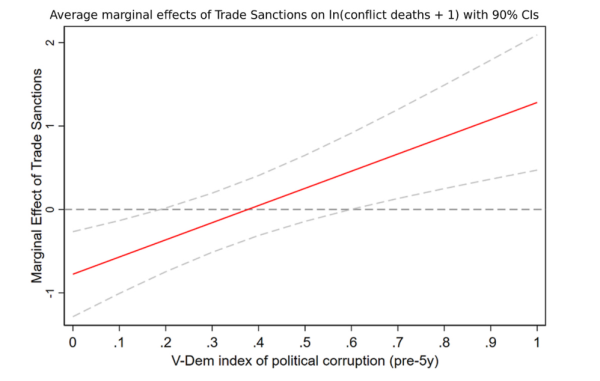
Source: Farzanegan and Alkurdi Albarawi (2026). Notes: The dashed lines show 90% confidence intervals.
One way this association can arise is through the middle class. In a 2025 article in the European Journal of Political Economy, Nader Habibi and I use a synthetic control method, which compares Iran with a constructed non-sanctioned equivalent, to show that sanctions reduced the size of Iran’s middle class. Corruption may amplify that effect. Pushing members of the middle class into lower-income groups may reduce the opportunity costs of engaging in larger conflicts, partly because the old and new poor make up a larger share of the vulnerable population and have a more convergent political agenda in challenging the ruling government than before sanctions.
The second part of this series sets out how economic pressure in a corrupt system can translate into conflict, and what follows for the design of sanctions.