In the first part of this series, we showed that trade sanctions are associated with more conflict-related deaths in countries where corruption was already high, and that one route runs through the middle class.
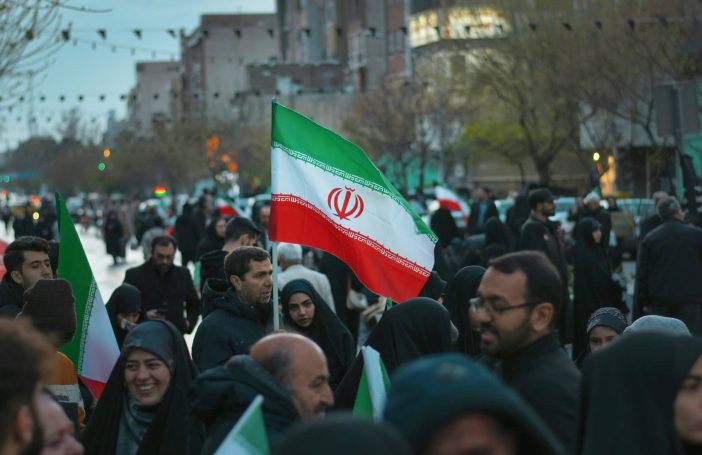
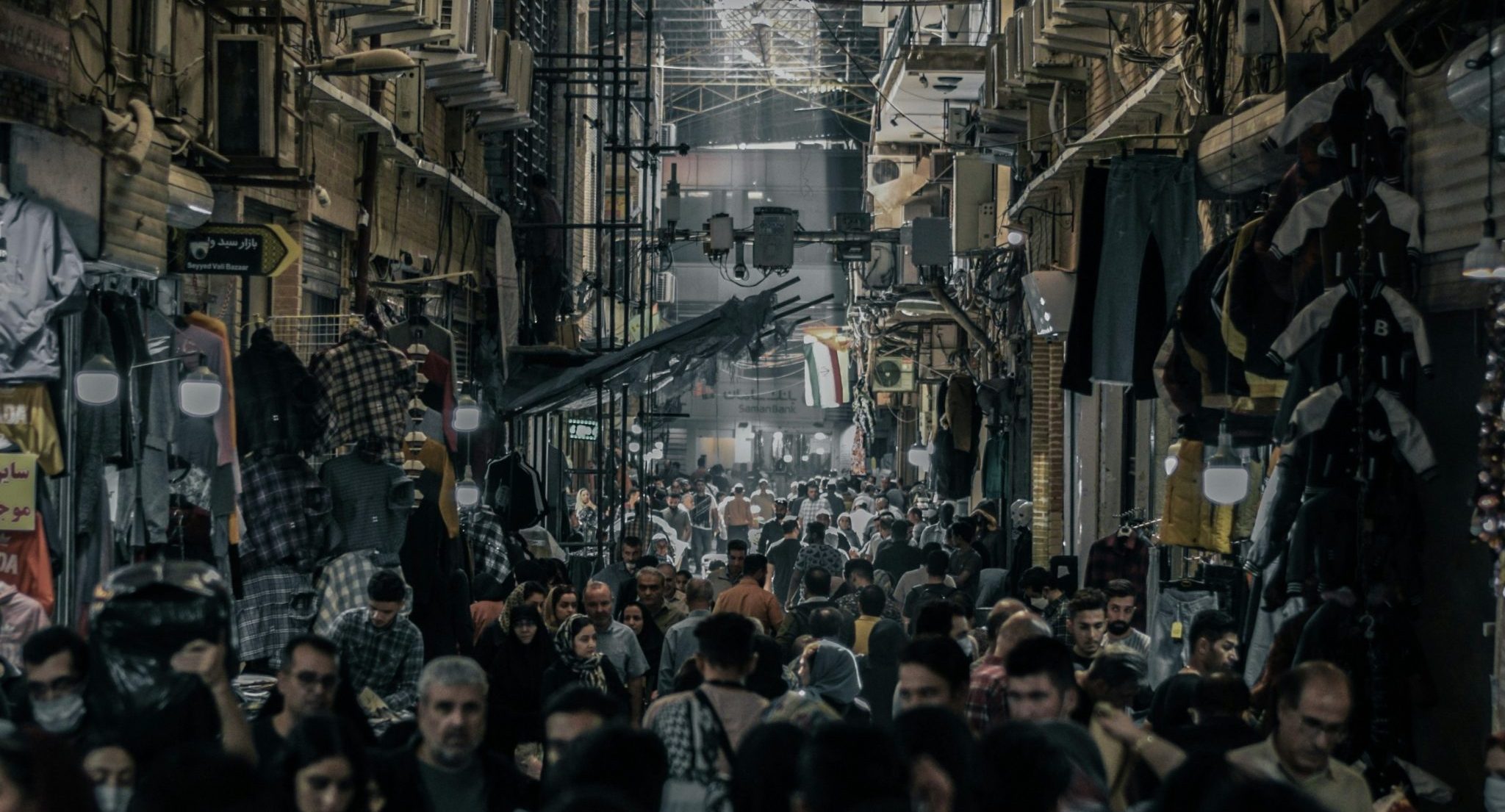
In the case of Iran, the middle class has realised that sanctions and corruption are eroding its social status. A look at the data collected from a sample of 11,252 people arrested during the large nationwide protests in Iran in December 2025–January 2026 shows that 65% belonged to the middle class and 32% to the lower socioeconomic class. Some 77% were under 30, 60% were self-employed or non-salaried workers and 93% had no previous criminal record.
This profile of arrested people (which is not necessarily representative of all protesters) shows a combination of economic inequality, perceived barriers to upward social mobility among young people and job insecurity, particularly among the self-employed. The important link is that sanctions can worsen economic opportunities, while corruption destroys trust in the political system and hope for a better future.
If politically connected actors capture new rents under sanctions while poorer households and the middle class carry disproportionate costs, inequality, mistrust and grievances may increase. Broader access to the internet and social media can make such inequalities more visible immediately and facilitate mobilisation. The risk of conflict is higher still where a large share of the population is young. In a 2017 article in the European Journal of Political Economy, Stefan Witthuhn and I found, using data for more than 100 countries over 1984–2012, that corruption reduces political stability mainly in countries with a large youth bulge.
A corrupt autocratic government may respond with greater repression, while opposition groups may mistake economic weakness for political weakness and make a miscalculation in their planning. As a result, violence may increase without necessarily producing regime change. Figure 1 sets out these steps.
Figure 1: Conceptual framework of study – corruption moderates the link between sanctions and conflicts
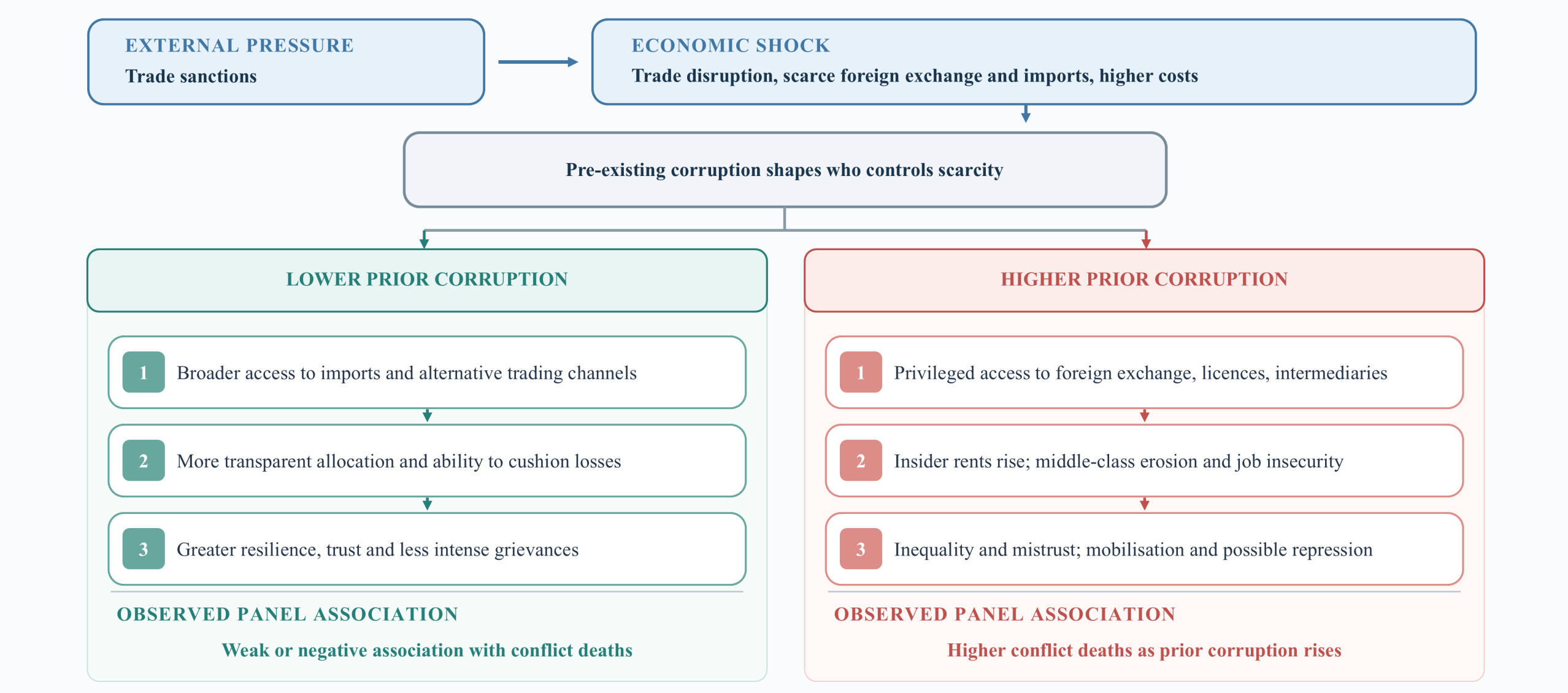
Source: Farzanegan and Alkurdi Albarawi (2026) Notes: Evidence: 122 countries, 1996-2026, strongest findings for trade sanctions, association positive and significant around V-Dem corruption >0.6.
These estimates do not imply that every trade sanction leads to violent conflict. Our panel data analysis identifies conditional associations, not the outcome of any particular case.
Nor does our study mean that sanctions never work. Economic pressure contributed to the political environment surrounding South Africa’s transition away from apartheid. Sanctions by the Obama government, in coordination with the EU and other parties, were a factor behind a move from Ahmadinejad’s radical politics to a pro-reform Rouhani government and ultimately led to the 2015 Iran nuclear agreement, the Joint Comprehensive Plan of Action (JCPOA), and partial sanctions lifting.
In both cases, other political and diplomatic factors also mattered. Our study does not measure whether sanctions achieve their stated objectives. Its contribution is to identify an additional risk: in highly corrupt target countries, economic pressure may entail greater distributional and conflict costs, whether or not it eventually secures a policy concession.
What are the lessons for sanctions planners? First, the senders of sanctions should assess the corruption and governance conditions of the target before choosing an instrument. In places where politically connected firms control import channels and access to foreign exchange, broad trade restrictions risk making those privileges more profitable. The capture of the state by these private interests shapes the government response to sanctions in ways that mainly enrich them at the cost of the broader population. Sanctions senders should consider more narrowly targeted measures, such as asset freezes, travel restrictions and focused financial measures against named individuals and entities, alongside efforts to limit the government revenue streams that sustain ruling networks.
Second, sanctions should be designed and monitored to restrict new opportunities for rent-seeking. This means tracing privileged intermediaries and diversion networks, checking who receives import licences and subsidised foreign exchange, and making sure that humanitarian exemptions work in practice. Essential goods such as food and medicines require functioning payment, shipping and insurance channels. Exemptions on paper are not enough if legitimate transactions cannot be completed due to over-compliance of the banking system.
In short, the amount of economic pain should not be the only relevant question for sanctions senders. They should ask who gains control over the restricted channels that remain after sanctions.
Our results also have implications for target countries which may receive sanctions for non-defendable reasons (for example, reactivation of sanctions on Iran by the Trump government in 2018 while Iran was implementing nuclear-related JCPOA commitments). They can increase their resilience to sanctions by controlling corruption and making the distribution of scarce resources more transparent. In Iran, greater economic resilience has long been promoted under the resistance economy doctrine. But such a strategy is less effective when public power is misused for private benefit and privileged networks and intermediaries continue to allocate economic opportunities and public resources.
Sanctions are often sold as a humane alternative to war. In economies with high levels of public corruption, sanctions can become part of a machinery that makes insiders richer and further weakens the middle class. The growing frustration of those who have fallen into poverty, together with that of those who were already poor, may destabilise the political system and increase the risk of internal violence. Before Washington asks how much economic pain it can impose, it should ask who will control that pain and what political order the resulting scarcity will create.