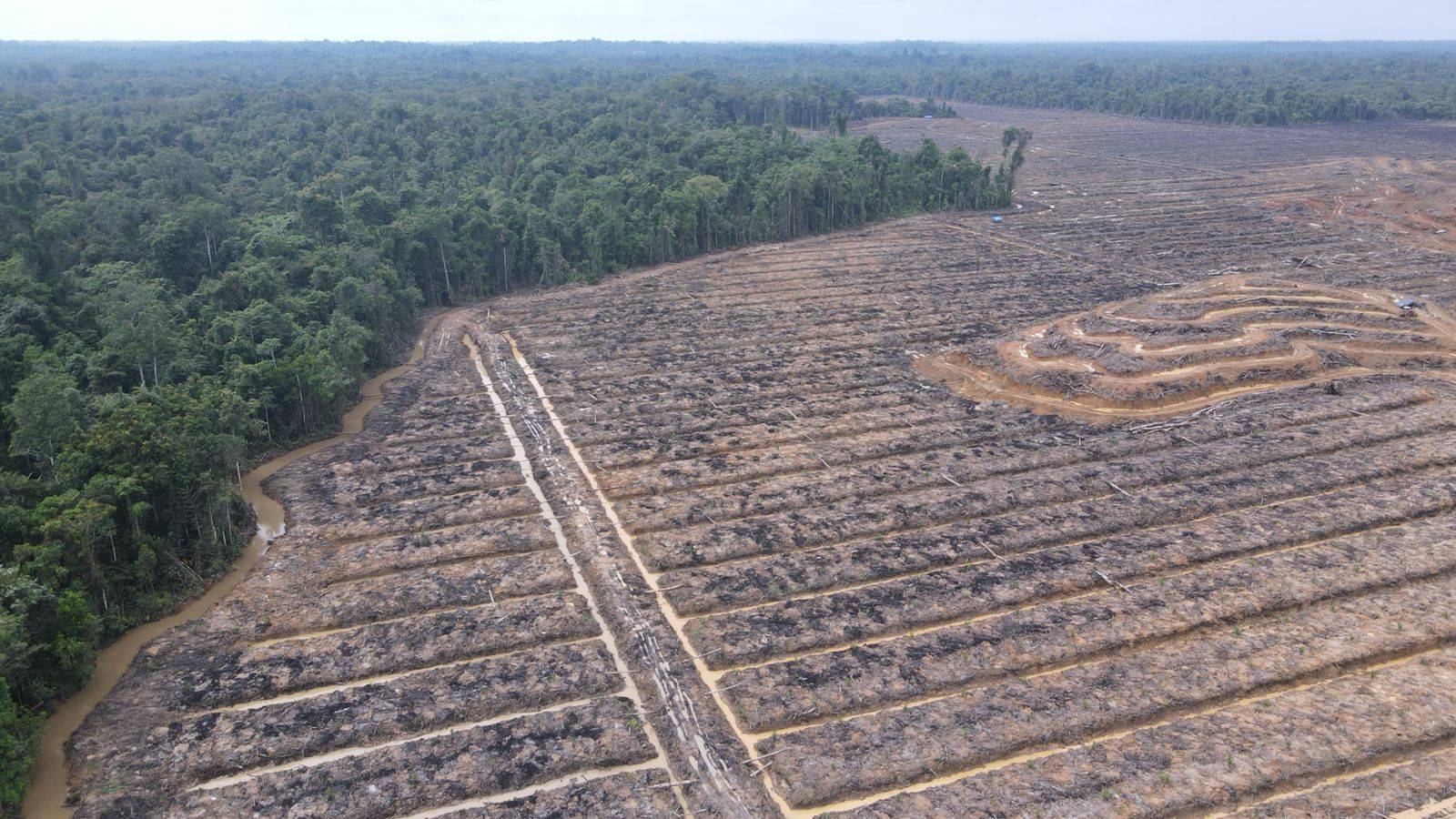
Indonesia’s flash floods in Sumatra are not merely natural disasters; they are also symptomatic of fiscal failure. While rescue teams battled torrents of mud, a quieter tragedy unfolded in the budget books. Disaster mitigation funding was systematically crowded out by competing political agendas. It signals a concerning reality that, within Indonesia’s current fiscal hierarchy, resilience appears expendable until a disaster hits.
The crisis extends far beyond emergency response budgets. As climate change accelerates, global norms dictate that nations should ramp up environmental spending to keep risks within acceptable limits. These funds are critical for reforestation and upgrading ecological defences before disaster strikes. Yet Indonesia is moving in reverse. The Ministry of Finance reveals a chilling fiscal paradox: 236 local governments slashed their environmental spending in 2025 compared to the previous year, widening Indonesia’s climate finance gap, which is estimated to reach US$145 billion through 2030. Worse still, even among districts that do allocate environmental budgets, spending bears almost no relationship to environmental quality, suggesting that the problem runs deeper than underfunding alone (see Figure 1).
Figure 1: Environmental spending vs environmental quality index across Indonesian districts, 2024
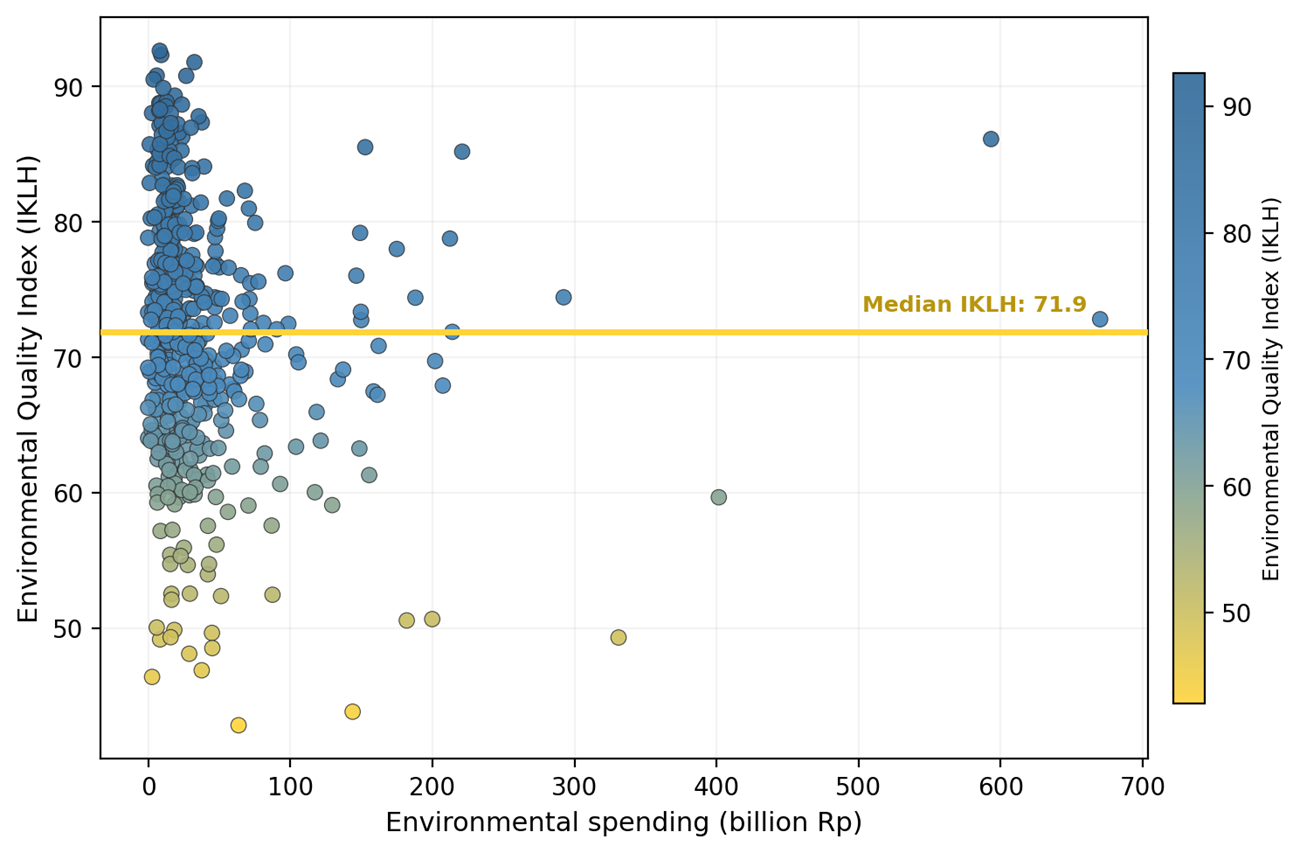
Source: Ministry of Finance.
The Ministry of Finance has attempted to steer local budgets toward environmental priorities using soft fiscal instruments. Under Law Number 1 of 2022 on Central and Regional Financial Relations, land cover indices are now factored into the formula for the General Allocation Fund — the main unconditional transfer from Jakarta to the regions — theoretically rewarding areas that preserve their forests. The law also refines Revenue Sharing Funds — transfers that redistribute natural resource royalties — by compensating areas suffering from the negative externalities of resource extraction in neighbouring regions. Furthermore, the Special Allocation Fund — a conditional grant for priority sectors — explicitly directs capital into environmental maintenance. Yet these mechanisms remain largely incentives rather than binding mandates, leaving execution at the mercy of local political will.
The liquidity trap becomes evident when examining international climate finance as an alternative. Most results-based instruments, such as those from the Green Climate Fund, operate on a reimbursement model where local governments must front costs and receive payments only after verified results are achieved. Cash-constrained regions cannot sustain multi-year environmental interventions while awaiting reimbursement cycles that span several months or even years.
This funding asymmetry collides with what might be called a conservation paradox, though the reality is more complex than a simple trade-off between forests and growth. The six Papua provinces, Indonesia’s easternmost frontier, maintain forest cover exceeding 80% and harbour globally significant carbon stores. Yet the region also records Indonesia’s highest poverty rate — around 26% — despite receiving billions in special autonomy transfers and hosting the massive Grasberg copper and gold mine, one of the world’s largest. Much of Papua’s forest cover persists not because of deliberate conservation policy but because of remoteness and limited infrastructure. At the same time, extraction is actively expanding: new permits for nickel mining, palm oil plantations and logging are encroaching on primary forest, with deforestation rates rising. The paradox, then, is not that Papua has chosen conservation over development, but that neither the revenues from extraction nor the fiscal transfers from Jakarta have translated into meaningful local welfare — while the pressure to open more forest only grows.
Meanwhile, Sumatra and Kalimantan converted vast forest tracts into oil palm, timber and coal extraction zones decades ago, fuelling rapid economic growth. Without deliberate fiscal intervention, conservation-rich regions will remain cash-starved, perpetuating a system where environmental stewardship is a burden only the poorest are expected to bear.
Given this reality, mandating environmental expenditure is not only justified but necessary. A binding floor would force local leaders to allocate environmental budgets at a specified minimum, with failure to meet targets triggering fiscal penalties in future transfers — mirroring the existing 20% education mandate. Fiscal space clearly exists. The Supreme Audit Institution of Indonesia identified trillions of rupiah lost to governmental inefficiency in its 2024 financial report. Beyond this, local budgets also suffer chronic bloat from inflated payroll costs that crowd out productive expenditures. Law 1/2022 already mandates capping personnel expenses at 30% of regional budgets over coming years. These efficiency measures alone could generate sufficient savings to fund mandatory environmental spending without burdening households or crowding out essential services. The solution requires no new revenue — only fiscal discipline and reallocation.
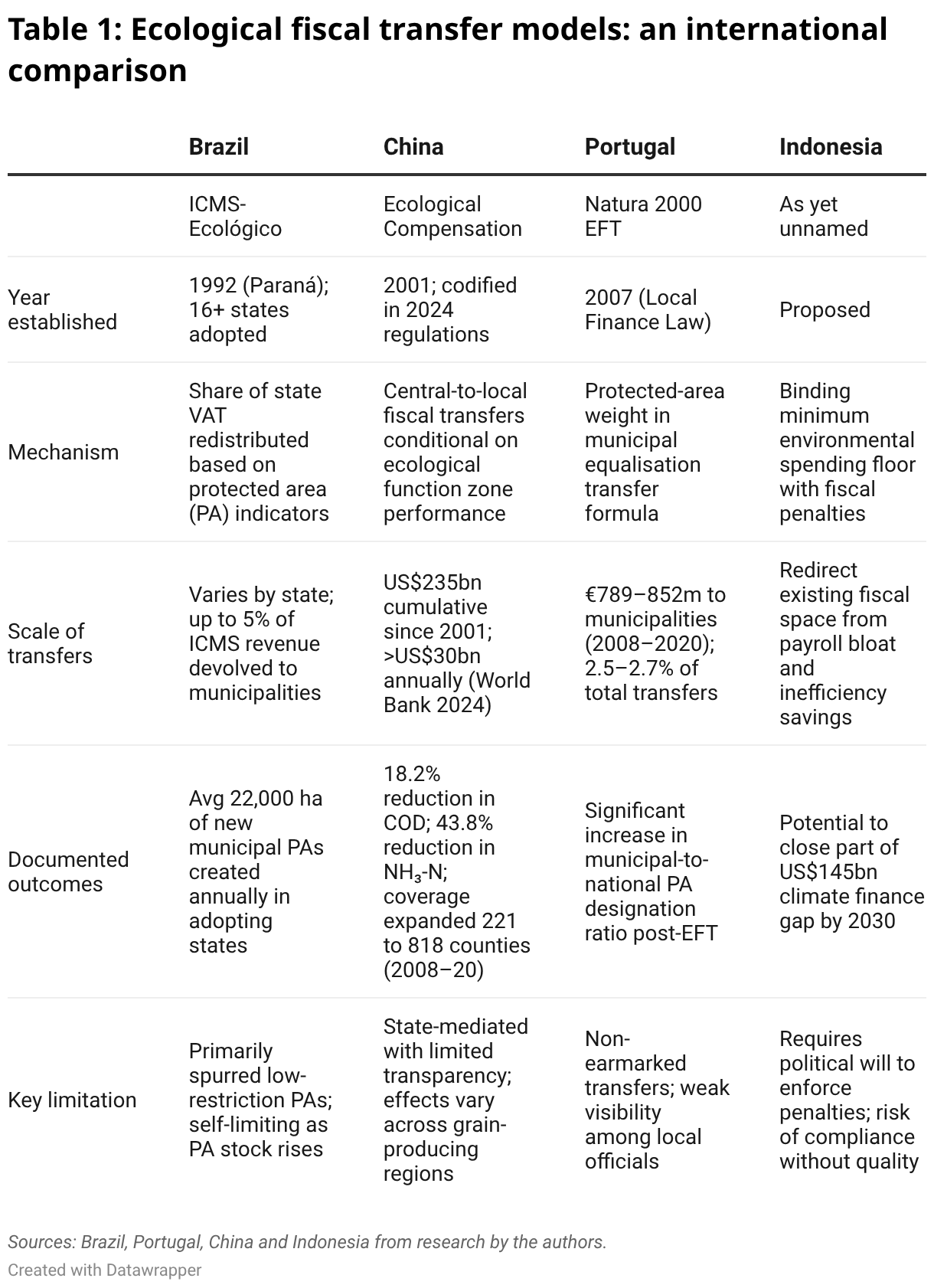
This design has international precedents. Brazil’s ICMS-Ecológico scheme earmarks a share of state VAT-derived transfers for conservation, and research has linked it to the creation of over one million hectares of new conservation units and measurable forest recovery. China’s ecological compensation program channels billions of yuan annually to upstream provinces, conditional on forest maintenance and water quality standards; in pilot basins, water quality has improved markedly. Portugal’s municipal transfer system incorporates Natura 2000 protected areas into its equalisation formulas, channelling additional funds to municipalities that host conservation land. These cases demonstrate that binding fiscal mandates can reshape budget allocations and generate measurable ecological outcomes. Table 1 summarises these models alongside the proposed Indonesian mechanism, highlighting both documented outcomes and inherent limitations that Indonesia’s design should address.
Mandating environmental spending at the subnational level would also strengthen Indonesia’s appeal to international climate finance. A critical barrier to accessing such funds has been concern over accountability and fund utilisation. Binding environmental spending mandates across central and local budgets would create institutional safeguards that transform investor risk assessments. The Supreme Audit Institution can conduct comprehensive audits covering both financial compliance and performance outcomes of climate expenditures. Equally important, local governments possess substantial discretionary funds that can be mobilised toward genuine climate resilience projects. When mandatory frameworks are in place, international investors gain assurance that their capital flows toward infrastructure and conservation rather than vanishing into opaque procurement cycles or politically motivated spending. This fiscal transparency could convert Indonesia from a climate finance risk into a credible investment destination, helping to close the US$145 billion gap in climate financing needed to meet 2030 targets.
Indonesia stands at a fiscal crossroads. Soft incentives have failed, international models show that mandatory spending works, and fiscal space exists. The choice is no longer whether Indonesia can afford a binding environmental spending floor, but whether it can afford not to have one. Delay transforms prevention into catastrophe and multiplies costs. Environmental spending is not compassion for nature but fiscal discipline for climate resilience. The time to mandate is now.