Australian aid
Australia will contribute US$2 million in “seed funding” to support the Republic of the Marshall Islands’ (RMI) newly established Resilience and Adaptation Trust Fund. It will also work with UNICEF to fund clean energy projects for RMI schools through the Australian Infrastructure Financing Facility for the Pacific (AIFFP).
Speaking at Senate Estimates hearings, DFAT officials said that they will engage with stakeholders on the final report of the OECD’s recent peer review of Australia’s aid program and that, while it does not accept all of its findings, “a lot of the reflections and recommendations in the report are things that we’re already considering and integrating into the program”.
The new leader of the opposition, Angus Taylor, has appointed Ted O’Brien as the Coalition’s Shadow Minister for Foreign Affairs and Senator Dave Sharma as its Shadow Assistant Minister International Development and the Indo-Pacific. Sharma is also the Shadow Assistant Minister for Citizenship and Multicultural Affairs.
A pre-budget submission compiled by the Australian Council for International Development (ACFID) shows that Australian aid spending as a share of the total federal budget under the Albanese Labor government (0.65% in 2025-26, est.) has now fallen below that of the Howard, Abbott, Turnbull and Morrison Coalition governments and is projected to decline further (figure below). ACFID’s membership is backing the campaign calling for aid spending to be restored to 1% of the federal budget.
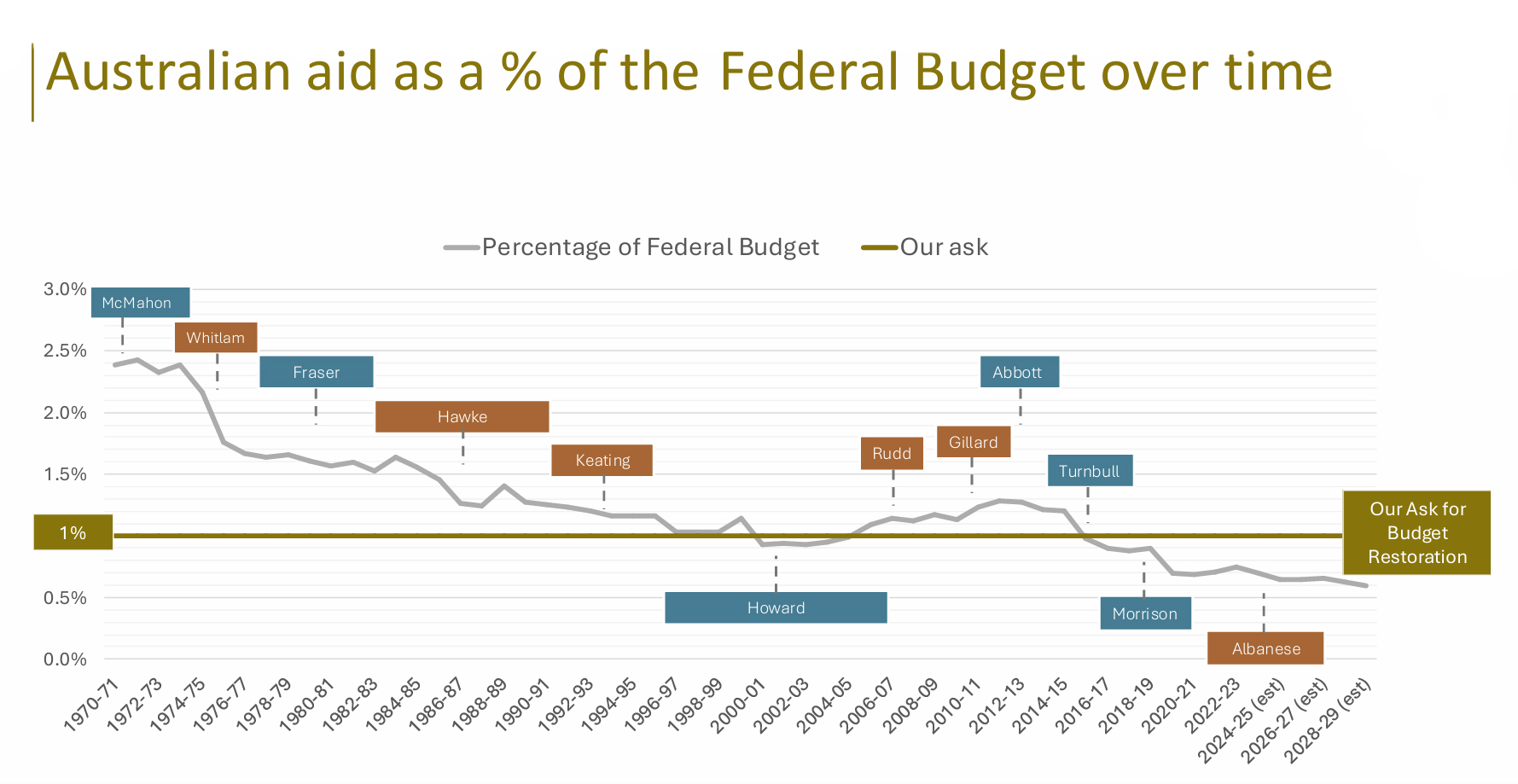
Chart: ACFID (Source: Development Policy Centre, Australian Aid Tracker)
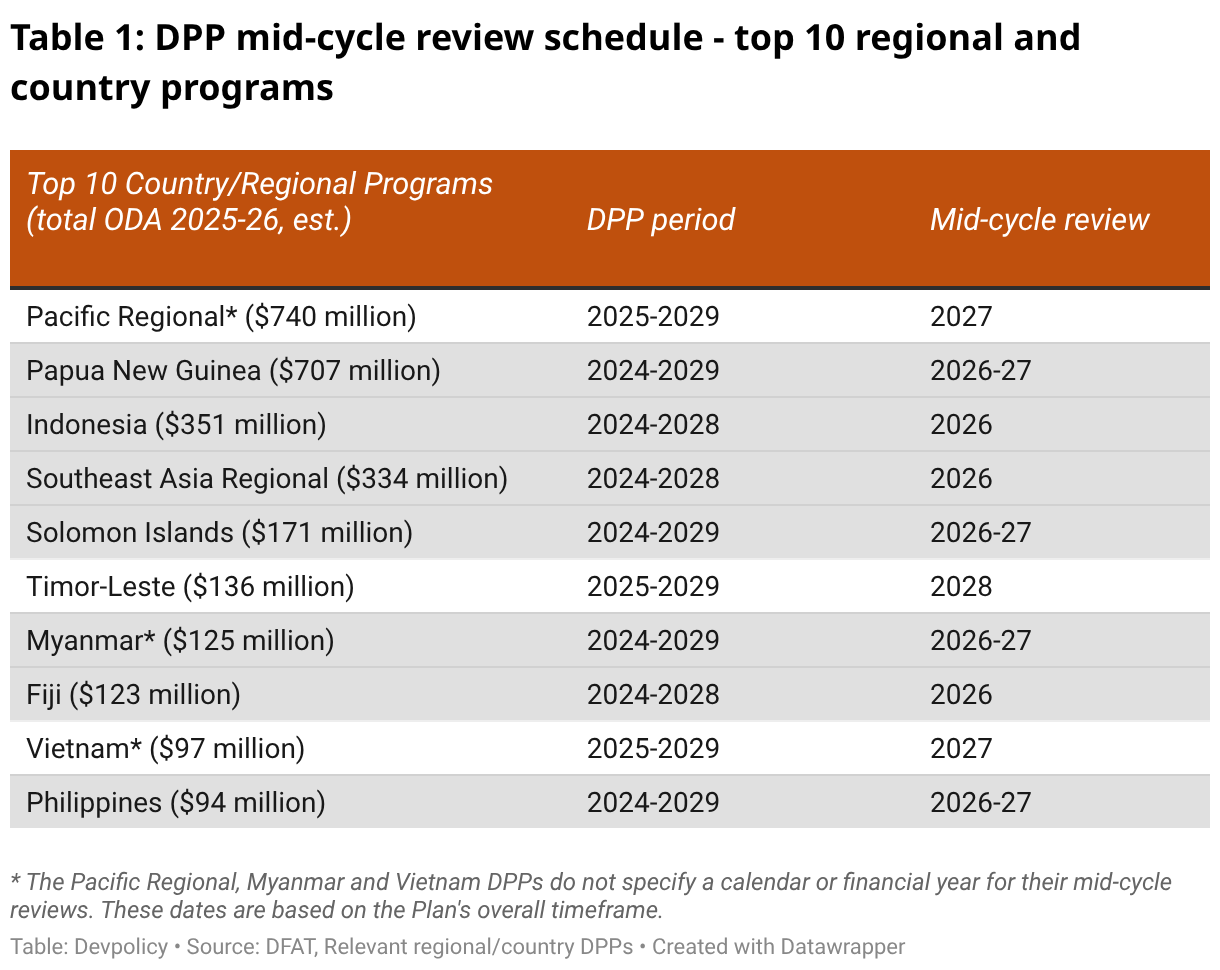
The mid-cycle reviews of the Development Partnership Plans (DPP) for seven of DFAT’s ten largest regional and country programs are scheduled for either this calendar year and/or in the coming financial year (Table 1). According to DFAT, the mid-cycle reviews will “capture, share and apply learning about progress” against the DPPs’ objectives.
DFAT has released the government’s second three-year report on progress under Australia’s “National Action Plan for Women, Peace and Security (WPS), 2021-2031”, highlighting its support for “expanded WPS efforts into emerging security domains”, inclusive humanitarian assistance and disaster preparedness, and women’s leadership in peacebuilding in the Pacific and Southeast Asia.
Regional and global aid
New Zealand has cancelled its participation in the Australia-US-Japan-New Zealand Papua New Guinea Rural Electrification Project, citing the worsening security situation in Enga province. The ambitious project aims to help PNG get 70% of households connected to electricity by 2030. It is not clear whether US participation in the project has been affected by the Trump administration’s aid cuts.
As Michael Kabuni and Grant Walton warned last year, PNG, along with Kuwait, has been “grey-listed” by the Financial Action Taskforce for its failure to meet international standards to combat money laundering and illicit finance. Among other consequences, the listing will mean more scrutiny on international aid transactions involving PNG banks and entities.
The US is reportedly pressuring countries not to back a draft resolution being proposed by Vanuatu seeking UN General Assembly members’ endorsement of last year’s advisory opinion on climate change by the International Court of Justice (ICJ). The ICJ opinion clarifies states’ international legal obligations in relation to combating climate change, including potential liability for financial reparations on the part of high-emission countries that have breached these obligations.
The Secretary-General of the UN, António Guterres, has warned that the organisation is facing “imminent financial collapse” and that its funding could run out as early as July as a result of unpaid assessed contributions, which total US$1.56 billion, and ongoing aid cuts affecting a range of UN agencies.
Speaking at the inaugural meeting of his “Board of Peace”, US President Donald Trump said that “we’re going to strengthen the United Nations … we’re going to help them money wise” and also that “the Board of Peace is going to be almost looking over the United Nations and making sure it is run properly”.
Trump announced that nine Board members have committed a total of US$7 billion to the reconstruction of Gaza and the US will commit another US$10 billion. The latter funds have yet to be appropriated through Congress and it is not clear how they will be managed. Trump also announced that Japan, which has not joined the Board, will host an “aid fundraiser” for Gaza that will be attended by South Korea, the Philippines, Singapore “and others”. The UN, World Bank and European Union estimate that the reconstruction of Gaza will cost an estimated US$70 billion.
A budget deal reached with Congress at the end of January restores around US$15 billion in previously proposed cuts to US funding for global health, multilateral and humanitarian programs and bilateral economic assistance in fiscal year 2026. According to analysis by the Center for Global Development, this will mean that — excluding the Biden administration’s supplementary funding to Ukraine and other crises — the US cuts to foreign aid between 2024 and 2026 (-23%) will now total less than those being pursued by the UK Labour government (-27%) over the same period. These estimates assume that the Trump administration spends these funds as directed by Congress.
Amidst these aid cuts, the UK will co-host an international conference on the future of global development cooperation in May.
A parliamentary inquiry into the UK aid cuts has called on the Starmer government to pause plans to cut staff in the Foreign, Commonwealth and Development Office that would result in a further deprioritisation of poverty reduction. Both Conservative and Labour MPs have also warned against possible moves to cut funding for the UK’s Independent Commission for Aid Impact.
The UK government has told the UN Security Council that the recent deregistration of dozens of international NGOs working in Gaza by Israel “risk[s] choking off essential access to people in desperate need and closing fragile health facilities …”. According to the Israeli government, to date 37 non-compliant international NGOs have failed to complete their registration to work in Gaza by refusing to submit complete lists of their Palestinian employees. Many international NGOs have objected to this requirement, citing the security risks to their staff, the strictness of their own vetting procedures and inconsistent application of the requirements.
Books, reports, articles and podcasts
A survey published by ODI Global finds that across all Small Island Developing States (SIDS), the Green Climate Fund (57%) is the most valued development partner overall, followed by China (37%). In the Pacific, Australia was found to be the most valued bilateral (and overall) development partner (85%), followed by Japan (60%), New Zealand (45%), China (25%) and the US (20%). The survey’s sample size is very small, with 40 government officials responding across all eligible SIDS and just 12 from 10 countries in the Pacific.
New research from the One Campaign shows “the great reversal” in China’s role in global development finance as Beijing has moved from a net provider of development finance inflows (+US$48 billion from 2015-19) in low- and middle-income countries to a net extractor in the form of debt servicing outflows (-US$24 billion from 2020-24) from these countries. By contrast, the multilateral development banks have become a more important source of development finance, accounting for 56% of net inflows in 2024, up from 28% a decade earlier.
The Centre for Development Finance Studies looks at the different models of Development Finance Institution (DFI) governance in the UK, France and Sweden. Their analysis finds that these differences “shape how effectively [DFI] policy priorities translate into investment decisions, how efficiently institutions can scale their operations, and how well they can adapt to shifting development challenges”.
The Abdul Latif Jameel Poverty Action Lab has released an “AI evidence playbook”, “a practical reference for policymakers, practitioners and donors investing in or developing AI-enabled programs.”