
Foreign companies play an important role in Papua New Guinea’s economy, contributing to investment, employment, trade and broader development. Changes in their presence and composition often provide useful indications of wider shifts in PNG’s socioeconomic development and are relevant to national economic planning.
However, because transparent and reliable company information is scarce, existing research has tended to focus on individual cases or on groups of companies from particular countries. In my research, I examine foreign companies in PNG using a more systematic, data-driven approach, to provide a clearer and more comprehensive picture of PNG’s foreign business landscape.
The analysis draws primarily on publicly available company registration records from PNG’s Investment Promotion Authority (IPA) up to October 2022. This predates a major update to the IPA website, after which shareholder information, which is needed to identify a company’s country of origin, was no longer available. The IPA records, together with other open-source data, reveal several notable shifts.
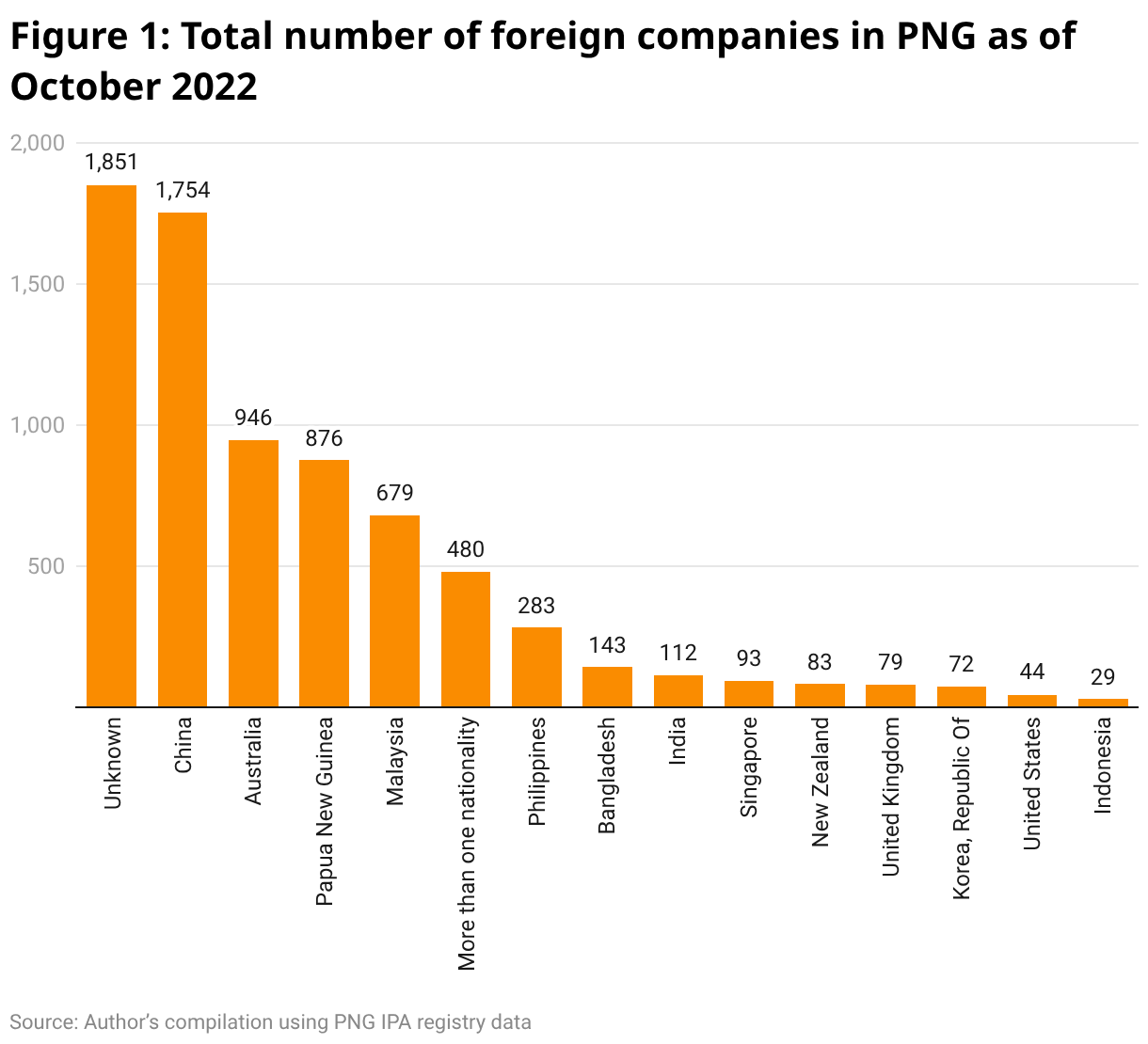
First, the number of foreign companies has expanded rapidly over the past decade. As at October 2022 there were 7,761 foreign companies with a valid entity status, that is, companies whose registration had not been cancelled. For quite a few of these companies, information on at least one key shareholder is missing. Of the 5,034 whose ownership can be established, 1,754 (35%) are Chinese, 946 (19%) Australian and 679 (13%) Malaysian.
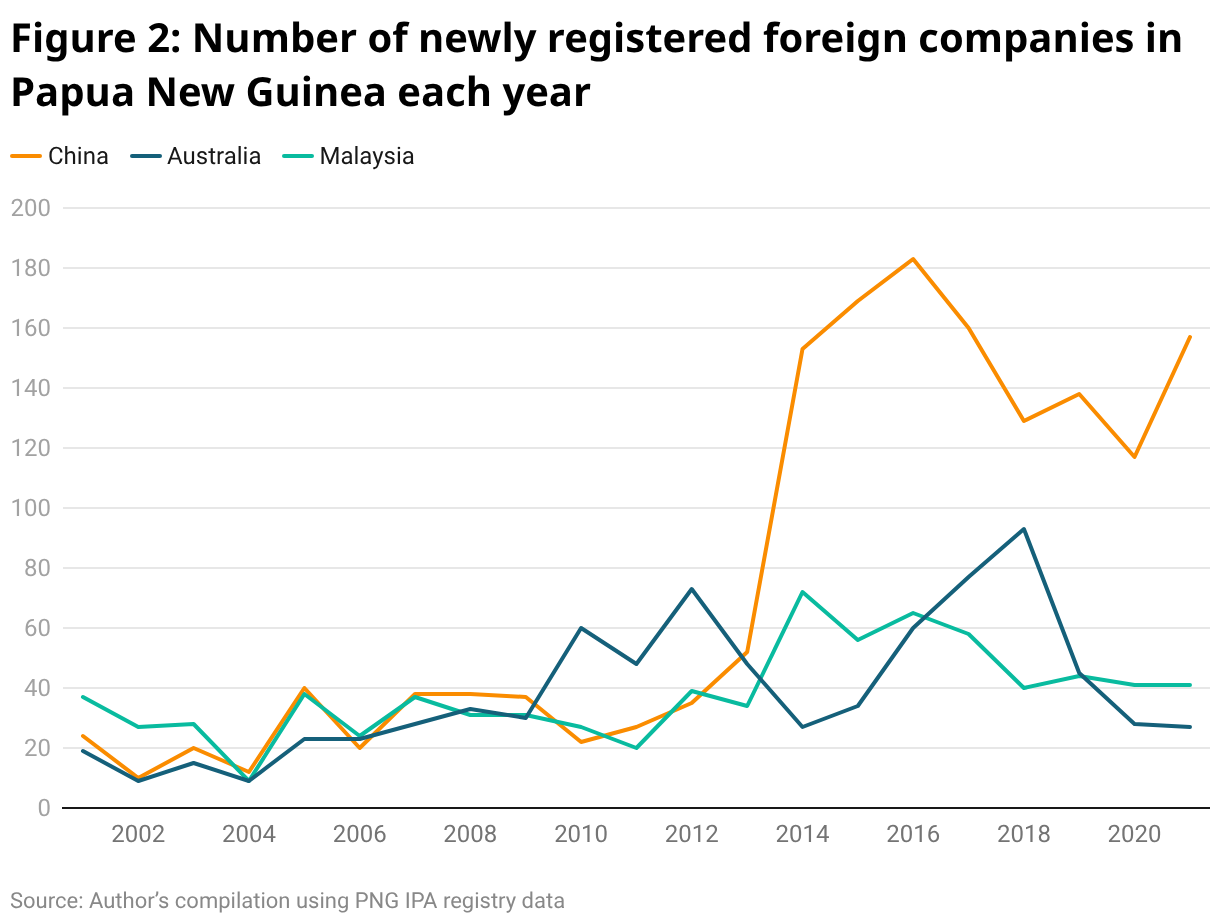
The dominance of Chinese companies is due to their growth over the 2010s. Before that decade, fewer than 50 Chinese, Australian and Malaysian companies were registered each year. But from 2014 to 2022 (the most recent year for which data are available), the annual average for Chinese firms rose to about 150.
Companies from different source countries occupy distinct niches within PNG’s economy. Chinese companies are heavily concentrated in retail, distribution and wholesale, which account for over half of Chinese companies’ reported business activities, as well as in construction, transportation and hospitality. Australian companies are more prominent in real estate, finance and professional services, and also have a stronger presence in the resource sector. Malaysian companies are the most widely distributed across sectors and have gradually diversified away from their traditional concentration in logging.
Foreign business activity is highly concentrated in the National Capital District, where nearly three-quarters of foreign companies report operating. Outside the capital, Chinese companies are often dominant, representing the largest source-country group in 19 of the 22 provinces and making up more than half of all foreign firms operating in six Highlands provinces. Australian companies are also widely present across PNG, but their share of foreign companies in most provinces is much smaller. Companies from other source countries, including Malaysian companies, tend to be concentrated in a smaller number of provinces.
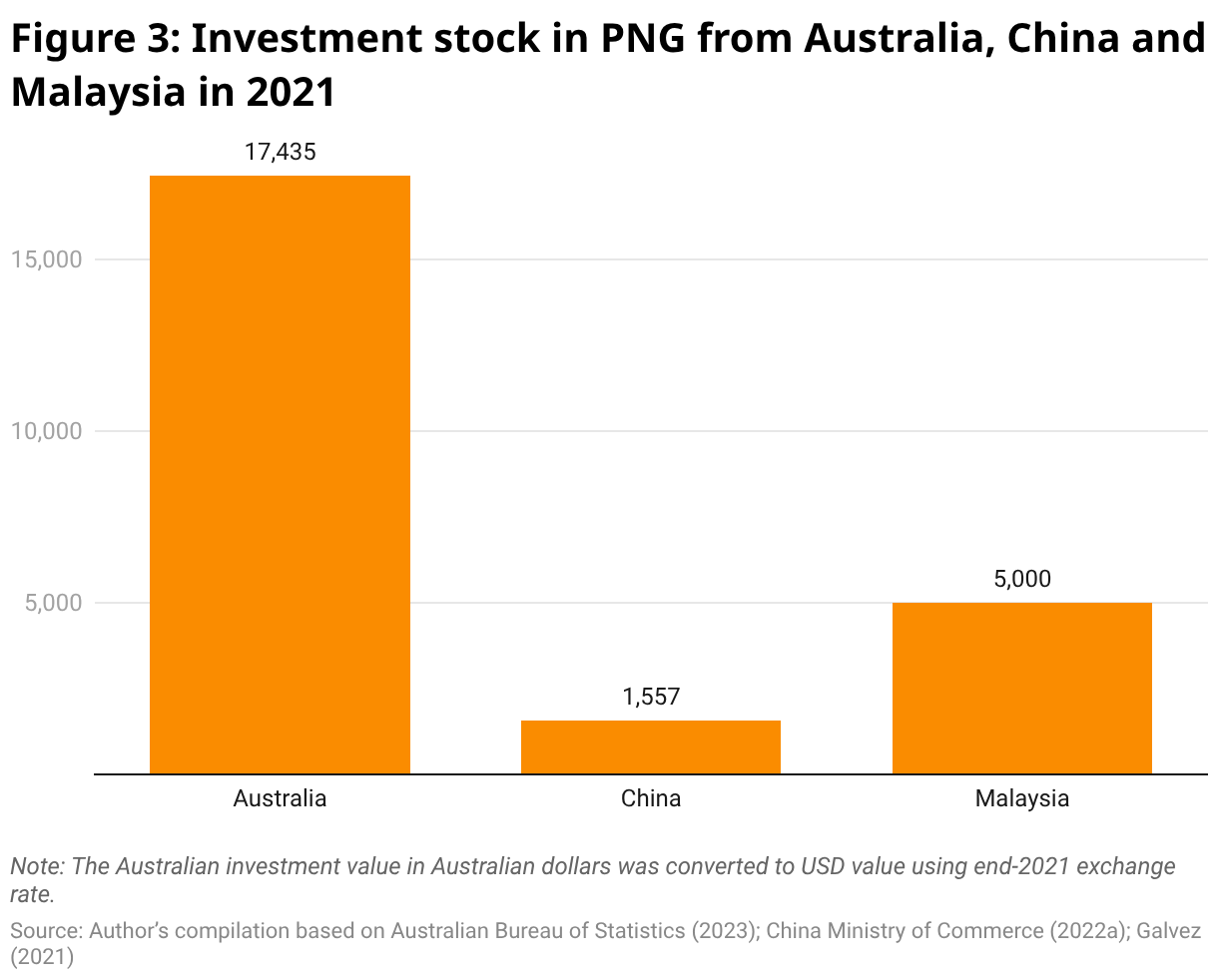
Chinese firms dominate numerically, but not in the scale of their investment. Measured by investment stock, Australia is still by far the largest source of foreign direct investment into PNG. China’s investment stock in PNG remains lower than that of Australia and Malaysia despite the much larger number of Chinese companies.
There are two main reasons for the gap between company numbers and investment stock. First, Chinese companies are more likely to be small or medium-sized enterprises (SMEs). Although this cannot be seen in the registry data, my wider research suggests that, while Chinese SMEs continue to expand in number, large Chinese enterprises have become more cautious in response to a perception of increased business risks in PNG. Second, a number of large Chinese enterprises are engaged mainly in project contracting rather than direct investment, and so commit relatively little capital in PNG.
In summary, the most significant shift shown by this newly constructed dataset is the rapid expansion of Chinese companies. Over the last decade, Chinese companies have surpassed Australian companies, historically the dominant players, in company numbers, and have established operations across all provinces. Their broad presence and focus on retail and distribution have made Chinese companies an increasingly important part of PNG’s domestic supply networks. By contrast, Australian and Malaysian companies have expanded more slowly in number and remain more geographically concentrated, but continue to play a prominent role in capital-intensive and resource-related industries.
Data note: To determine a company’s country of origin, this study adopts the following approach. First, the nationality of the largest shareholder is examined. If this shareholder holds more than 50% of total shares, the company is classified as originating from the same country as the shareholder. If no single shareholder holds a majority stake, the analysis proceeds to the two largest shareholders. If they are from different countries, the company is classified as having multiple nationalities. If they are from the same country, the company is attributed to that country if their combined shareholding exceeds 50%; otherwise, the third-largest shareholder is considered. This procedure continues until all companies are classified.
Download the full report.