Australian aid
With multiple protracted crises worsening across the Middle East as a result of the US-Israel-Iran war, members of the Australian Council For International Development’s Emergency Action Alliance have updated their public donation appeals for the region. Thousands of civilians have already been killed, and millions have been displaced in Iran and Lebanon (Figure 1). All three of the protagonists have now either committed or threatened to commit deliberate strikes on civilian infrastructure, acts which constitute a war crime. Globally, shocks to fuel, food and fertiliser prices and disruptions to supply chains are already placing further pressure on what remains of the international humanitarian system. Since the start of the conflict Australia has allocated $5 million in extra humanitarian assistance to Lebanon.
Figure 1: Internally displaced, border crossings and returns since start of the Iran war, as at 17 March
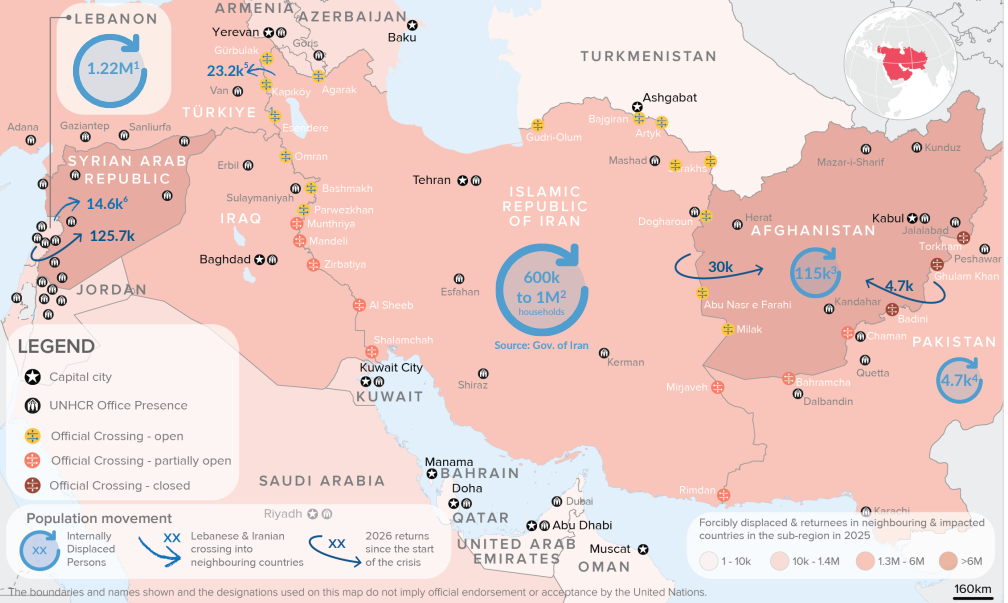
Source: UNHCR, Middle East Situation.
PNG’s government has approved the $170 million grant investment by the Australian Financing Facility for the Pacific (AIFFP) for the new “Pukpuk Treaty” submarine cable project. DFAT has said that the project will deliver lower internet prices, improved economic growth and increased education opportunities for PNG’s citizens. In January, the Albanese government announced an allocation of $550 million in grant capital for the AIFFP from within the existing Official Development Assistance (ODA) envelope. In nominal terms, this is equivalent to around five years’ worth of the annual 2.5% increases to the ODA budget that the Albanese government “locked in” under its May 2023 budget that are scheduled to commence from 2026-27.
There are now four parliamentary inquiries examining, either directly or indirectly, various elements of Australia’s international development assistance programs — three by the Joint Standing Committee (on conflict prevention, gender equality, Australia’s economic relations with Africa) and one by the Senate References Committee (on democracy and human rights in Myanmar). A group of crossbenchers from both chambers has criticised the Albanese government’s failure to respond to more than 100 completed parliamentary inquiries within the required timeframes.
In addition, the Joint Treaties Committee is examining Australia’s ratification of the treaty to establish the Pacific Resilience Facility (PRF). In February, DFAT officials told the committee that, to date, the PRF has raised just over one-third (US$173 million) of its initial capitalisation target of US$500 million and aims to raise the remainder this year through the COP-31 process. Once the Facility is operational, the interest on this capital will fund PRF projects, as well as the PRF Secretariat.
DFAT has released its ODA statistical summary for 2024-25. Sector reporting shows that governance (+22%) and economic infrastructure and services (+19%) saw the biggest year-on-year increases in spending, while health was the individual sector that saw the biggest decrease (-7%) (Figure 2).
Figure 2: Australian ODA by sector group, 2023-24 and 2024-25
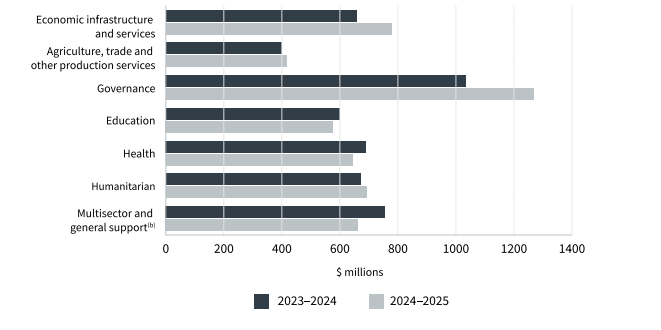
Source: DFAT, Australia’s Official Development Assistance: Statistical Summary, 2024-25, March 2026.
Regional and global aid
The US Millennium Challenge Corporation (MCC) and Fiji have signed a new grant agreement through which the Fiji government will develop a program for longer-term MCC support to address “binding constraints to economic growth”.
South Korea’s new five-year aid strategy aims to rationalise the number of individual projects and improve aid quality and transparency. The centre-left government in Seoul is pursuing a nominal cut of around 16% to development assistance funding in 2026, following a period of rapid expansion from 2019 to 2025.
Both Zimbabwe and Zambia have rejected proposed deals under the Trump administration’s new approach to bilateral health assistance, saying that Washington’s attempts to link this assistance to access to critical minerals (Zambia) and public health data (Zimbabwe) compromises their sovereignty. In the case of Zambia, the Trump administration is reportedly considering withholding funding for HIV treatments as leverage. In Kenya, the High Court has suspended a bilateral health deal with the US on the grounds that the deal may violate patient privacy and lacked adequate public consultation. The US has signed bilateral health deals with over a dozen other countries in sub-Saharan Africa under which Washington will shift its funding to government systems and reduce support over time as these countries increase domestic health spending.
As part of its ongoing effort to encourage shipping through the Strait of Hormuz under the threat of Iranian attacks, the Trump administration has directed the US Development Finance Corporation to offer up to US$20 billion in maritime reinsurance, including war insurance, to commercial vessels operating in the Persian Gulf. No companies have taken up this offer to date.
The early retirement of the World Food Programme’s (WFP) head, Cindy McCain, means that Trump will likely have the defining say in the appointment of the next leader of the agency — a role always filled by Americans since 1992. US funding for WFP was cut by US$2.6 billion in 2025 in the face of worsening food crises in Afghanistan, the Horn of Africa and the Middle East.
The European Parliament has criticised the EU’s “Global Gateway” initiative — which promises to mobilise €300 billion in infrastructure and other investments between 2021 and 2027 to compete with China in Africa and other regions — saying that the initiative’s “overly [European] Commission-driven, centralised, top-down structure has limited responsiveness to partner countries and private sector needs and weak ownership by local actors” and that “the selection of flagship projects does not yet follow transparent criteria”. The Global Gateway’s effectiveness and transparency have also been questioned in the OECD’s recent peer review of the EU’s development program.
The Labour chair of the UK’s parliamentary committee on international development, Sarah Champion, has taken aim at the Starmer government after the release of more detail on its planned aid cuts — which include cutting aid to Africa by half over the next three years and cutting UK climate and environment aid — saying, “These cuts do not aid our defence, they make the whole world more vulnerable”.
Books, reports, articles and podcasts
In a new article (open access) for the Australian Journal of International Affairs, the Development Policy Centre’s Cameron Hill examines what “development with depth” might look like when it comes to strengthening DFAT’s aid capability.
Analysis from the OECD shows that in 2023 the share of global ODA directed toward the core elements of the Multi-Dimensional Poverty Index (MPI) — health, education and living standards — declined to its lowest level since 2010 (28%) and that “contexts and regions with high rates of multi-dimensional poverty are increasingly being left behind” (Figure 3). In 2025, PNG had one of the highest MPI scores outside of sub-Saharan Africa, ranking 20th out of 105 developing countries.
Figure 3: ODA to the dimensions of the Multidimensional Poverty Index, 2010-23*
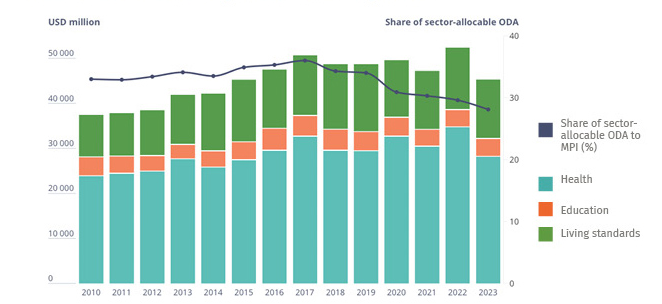
*Gross disbursements, constant prices 2023. Source: Multidimensional Poverty Peer Network, “Is Aid Reaching the Poorest? Using the Global MPI to reassess ODA priorities”, blog, 16 March 2026.
DFAT’s “Investing in Women” program and ANU researchers have published a new survey of attitudes, practices and behaviour when it comes to gender norms in Indonesia, the Philippines, Vietnam and Malaysia.
MIT Press has published a new, open access edited volume on the literature and evidence surrounding social protection programs in developing countries.
Eswar Prasad from Cornell University discusses his new book, The Doom Loop, which explores the increasingly negative feedback loops between global economics, domestic politics and geopolitics, on The Wire: China website.