

After a disastrous first couple of decades following independence in 1968, Nauru turned its economic fortunes around in the 2010s, with average annual per-person growth in national income of 4.9% between 2009 and 2024. In 2020, it was once again reclassified as a high-income country.
Nauru’s boom has been caused by a surge in foreign income. Its ratio of foreign income to GDP grew from around 30% in the late 2000s to more than 60% now. The major sources of foreign income have been Australia’s Regional Processing Centre (RPC), other aid and fishing licence revenue.
This influx of foreign income has transformed Nauru’s economy, as a comparison of the country’s two most recent censuses, in 2011 and 2021, confirms.
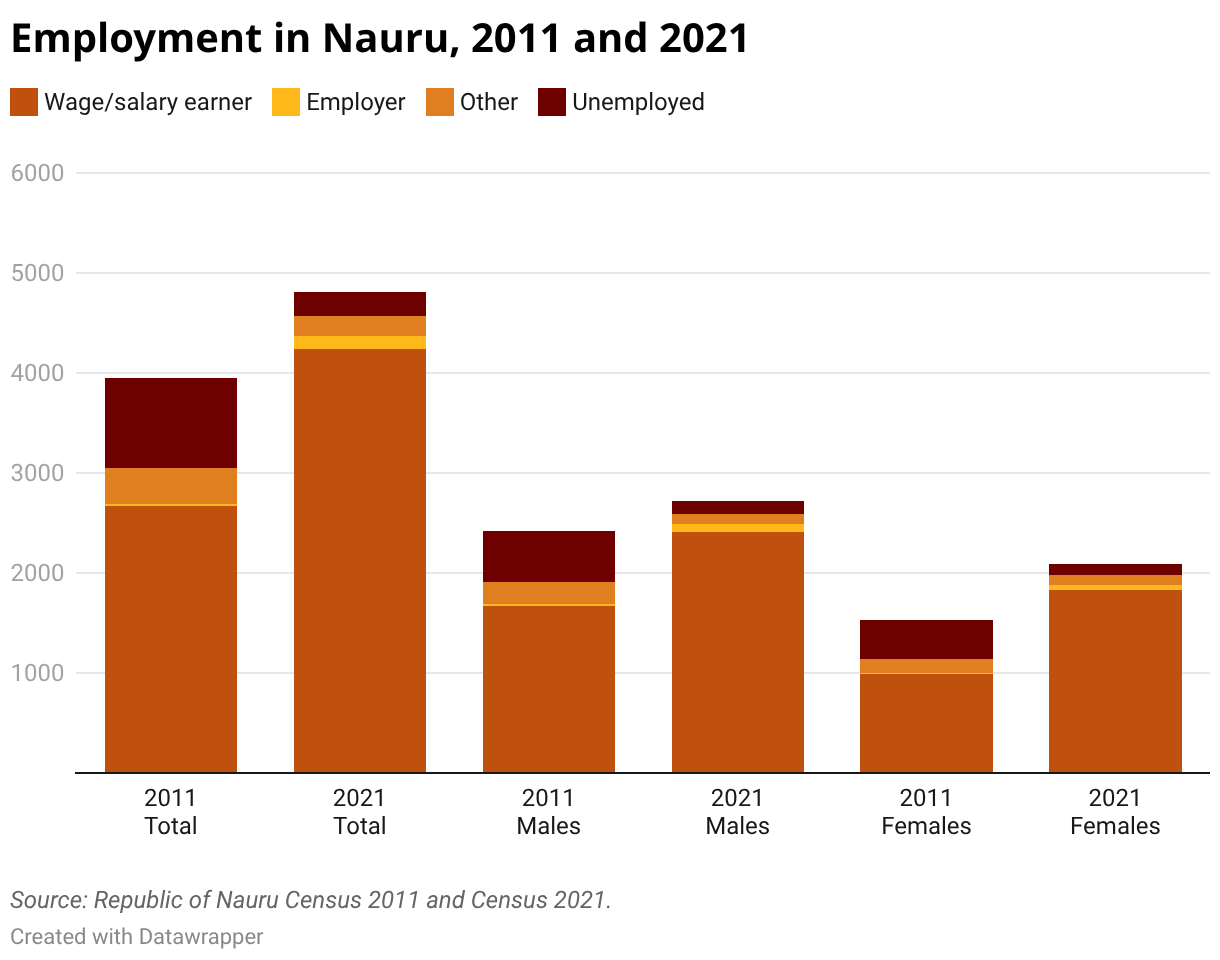
Between 2011 and 2021, the Nauru economy created 36% more jobs for men and, in a victory for gender equity, 74% more for women. The share of the population employed increased from 47% to 64%. Unemployment went down from 23% in 2011 to 5% in 2021. If any other boom worldwide has delivered similarly stunning results in such a short period, I am not aware of it.
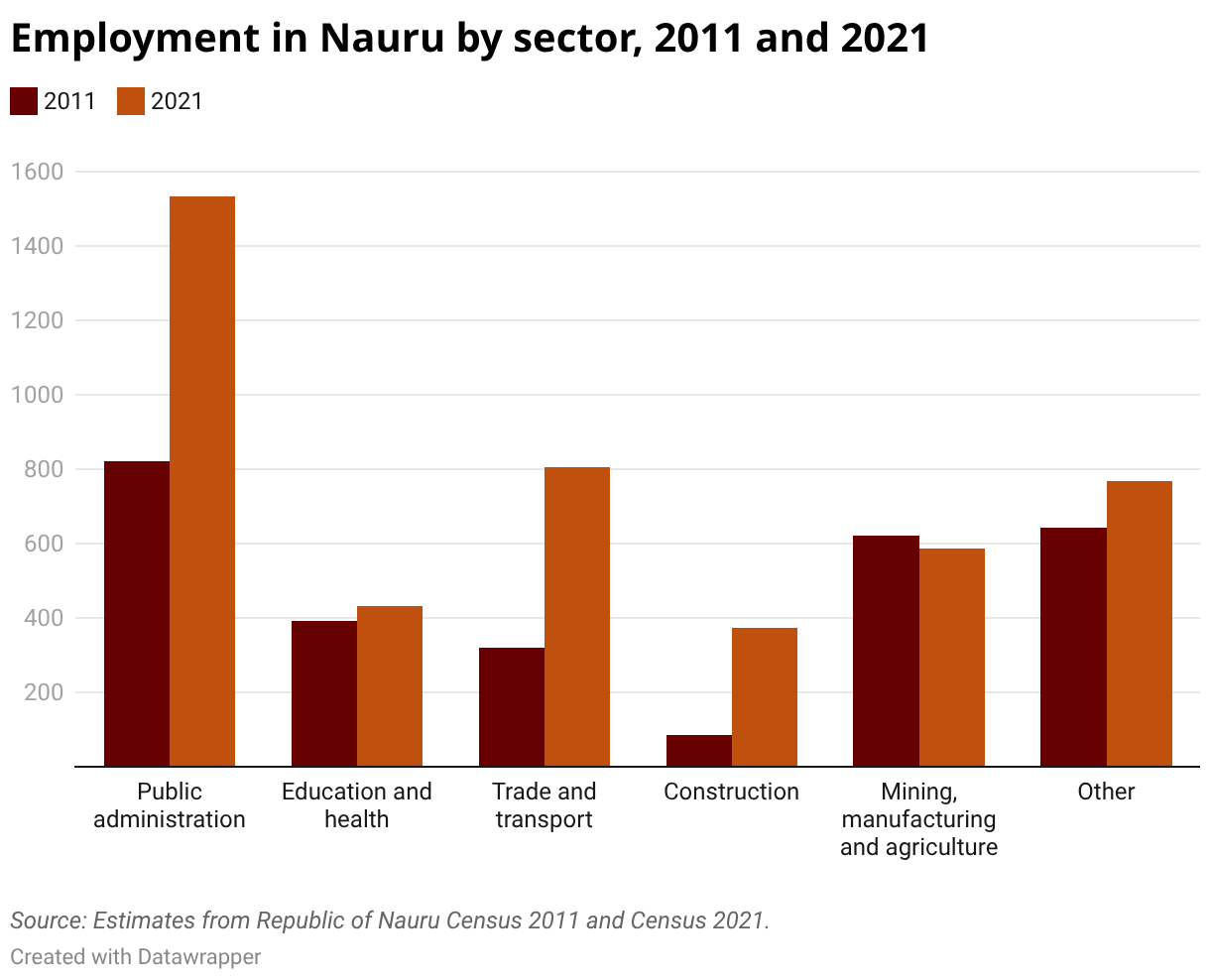
1,300 jobs were created over this period. The government used public sector employment to distribute its newfound foreign income among the population. The biggest job creator: public administration, where the number of jobs almost doubled. Unfortunately, there was hardly any increase in the number of education and health workers. But there were large increases in trade and transport, and in construction, responding to increased demand, as increased foreign income circulated through the economy.
Nauru’s labour market has clearly been booming. But what is even more remarkable is that, given this, the share of households primarily dependent on wage or salary income collapsed between 2011 and 2021, from 85% to 53%. What new sources of income became available to households? Rents and pensions. The share of households getting their income primarily from rental income increased from just 5% to 27%. The share of households getting their income primarily from pensions or retirement benefits increased from zero to 7%.
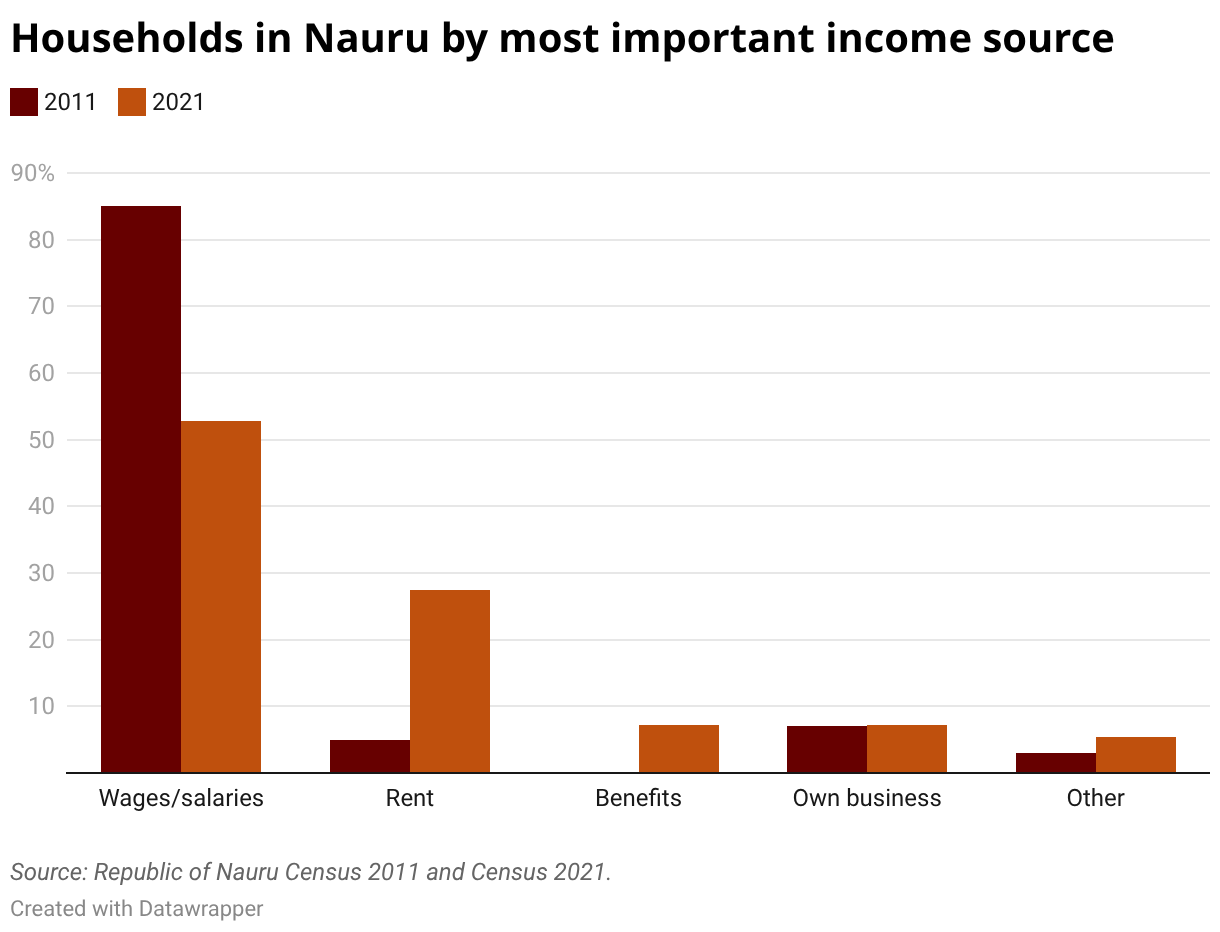
Clearly, the government, its bottom line boosted by its new access to foreign income, could now afford to pay benefits. But why has rent become so much more important to Nauruan households? Part of it must be coming from the growing number of foreign businesses operating in Nauru (from the many Chinese restaurants to Australia’s RPC). But this is also another way in which the government is sharing the wealth: in the 2020-21 budget, government land and house rental came to $14 million, a significant amount compared to a salary bill of $45 million.
While the 2021 census data is now a bit old, there is no sign of Nauru’s boom having ended. The most recent indicator we have is trips to Australia. In the 1990s, 200–300 Nauruans travelled to Australia every month on average. As times got tough, this fell to 100 in the 2010s. Then, due to the boom of the 2010s, the number of visitors to Australia grew to 500 a month before the pandemic shut borders. After the pandemic, the number of visits started to increase again, and reached 600–800 a month last year: that is more than 5% of the Nauruan population visiting Australia every month. Departures and arrivals are almost identical; this is not migration, these are visits. Travel for temporary employment is also extremely rare; rather, these trips are financed from disposable income.
Of course, there is no guarantee that Nauru’s boom will continue. But the country has learned from its past. Having bankrupted its first Sovereign Wealth Fund (SWF), financed with phosphate profits, Nauru has created a second, better-managed SWF, which has grown from 20% of the size of the economy in 2016 to 100% now.
The bigger threat to Nauru’s economic performance comes from its growing population. Nauru’s population was stagnant over the 2000s but grew at an annual rate of 1.6% between 2011 and 2021. The foreign rents that Nauru has been so successful in attracting are unlikely to continue to grow indefinitely. The country’s population growth means that these rents have to be divided between an ever-larger number of people.
Overall, Nauru has done extremely well to grow its economy and transform its economy for the benefit of its citizens. It has followed a heterodox strategy, ignoring much of the advice offered by mainstream economists. By trial and error, Nauru has come up with a mix of external revenue sources that, while controversial, does not, unlike its earlier experiments with offshore banking and passport sales, attract the opprobrium of major powers.
What Nauru needs now is a migration outlet to reduce population pressures and improve access to health and education. Despite its new-found wealth, Nauru actually has the lowest life expectancy of all the Pacific Island countries, which indicates the seriousness of the health challenges it is facing. A tiny country will always find it difficult to deliver quality health and education services, even a tiny rich country.
Now that Nauru has signed a security treaty with Australia similar to the Tuvalu Falepili treaty, it is well positioned to negotiate with Australia for the same migration concessions that Tuvalu extracted. This would mean that the hundreds of Nauruans who visit Australia every month would be able not only to shop and holiday in Australia, but also to benefit from Australia’s world-class education and health services. And some would migrate permanently, taking pressure off Nauru’s very limited island capacity and helping the country to sustain its remarkable economic boom.
Notes: The Republic of Nauru’s 2011 and 2021 censuses are available on the web. National income data is measured using Gross National Disposable Income (GNDI), deflated by the GDP deflator. SWF and budget data obtained from Nauru government documents.





When the people take hold of their future and their future generations and see the promise and the peril that is possible, they ALL must see that what they actually do each month, each week, each day, and each hour tells their future. Children should have classes in economics using their own country, their own homes and mostly their own lives as the electrifying example of the possibilities.
All views are very informative. In all of this talk of wealth a real concern is the authoritarian-type regime and accompaniment of a ministerial-heavy parliament. My greatest worry in all this overwhelming talk of wealth is the state of this land, development and customary ownership. We are people of the land. Rehabilitation of this land is in tandem with our physical, health and spiritual rehabilitation after a century of degradation and continuing degradation of our land and our dignity. It is now some 40 years since the call for rehabilitation and so far it is a dying call that those in successive power are skirting. With further delay is the real fear that by then (whenever), when we no longer exist, our children and their children etc will not know what their customary land is. While waiting for rehab to happen, and for the sake of our children that they are apprised of their true land legacy, that the country undertakes a land review/ consultation that informs and educates the children of today of their land rights. Keep your cash and I keep my land.
Dear Julie,
Greetings from Norfolk Island. I am so pleased to see that you are still fighting for the culture and the people of Nauru. After 40 years, I am saddened to see that it is still an uphill battle for you. Keep going Julie!. Rhonda
The first two decades of Nauru’s Independence were far from disastrous, although it must be said that Hammer DeRobert’s foray into the airline and shipping businesses put the country onto what turned out to be the top of a slippery slope and an eventual downhill slide exacerbated by the collapse of phosphate prices and the failure to adjust royalty payments from a fixed amount to a percentage of the FOB price.
Today things look rosy, but the question is: are they really? The country relies on revenues that are far from predicably reliable over coming years.
From the outside we tend to overlook the vulnerability of the country that has, since 2013, moved, perhaps inexorably, toward an authoritarian-type regime. The original constitutional structure of the country has been eroded by the creation of Deputy Ministers who, together with an expanded Cabinet control the Parliament to the extent that of the 18 members (excluding the Speaker) there is at present a government of fourteen, consisting of the President, eight Ministers and five Deputy Ministers – Parliament scarcely counts. With a national average salary of $24k, (which takes account of the large salaries paid to government and its employees), the salary of $90k for a Minister, $85k to a Deputy Minister, $75k for an ordinary member and the $110k of the President, pushes the average well above the true wage level of the average Nauruan. None of this would be possible without the larges of Australia and others providing funds to keep the country onside. I suggest that closer examination of the spread of the ‘wealth’ would find it done carefully done to maintain a power structure that looks after itself first. How things will pan put if David Adeang leaves power is another question
I suggest there is far more to Nauru than Australian money tells us – particularly when we really don’t know where it is all going.
Exactly remarkable, Dr Howes.
I was part of the educational reforms funded by DFAT and NZ Aid from 2006 to 2012. Building the education sector to get more of their students then into the employment sector.
14 years on and this impact is felt across the smallest republic in our world today.