The annual survey by Business Advantage PNG of the CEOs of 100 of Papua New Guinea’s largest firms is invaluable for the insights it provides. While little is published about how the CEOs are chosen and how many actually respond, the fact that this survey has been carried out since 2012 asking basically the same questions every year makes it the best mechanism we have for tracking business views in PNG.
For most of the last decade, a shortage of foreign exchange was the private sector’s top complaint. But the just-published 2026 PNG 100 CEO Survey shows that access to foreign exchange is now much less of a problem for business. This is a real achievement, but what is bothering firms now, and how has it changed over time?
We base our analysis on a comparison of business impediments between 2014 and 2026. 2014 is chosen as our base year because it is the first year in which foreign exchange shortages were included as a constraint. We compare only those criteria that appeared in both surveys. A small number of constraints that were only asked about in 2014 or in 2026 but not both had to be dropped.
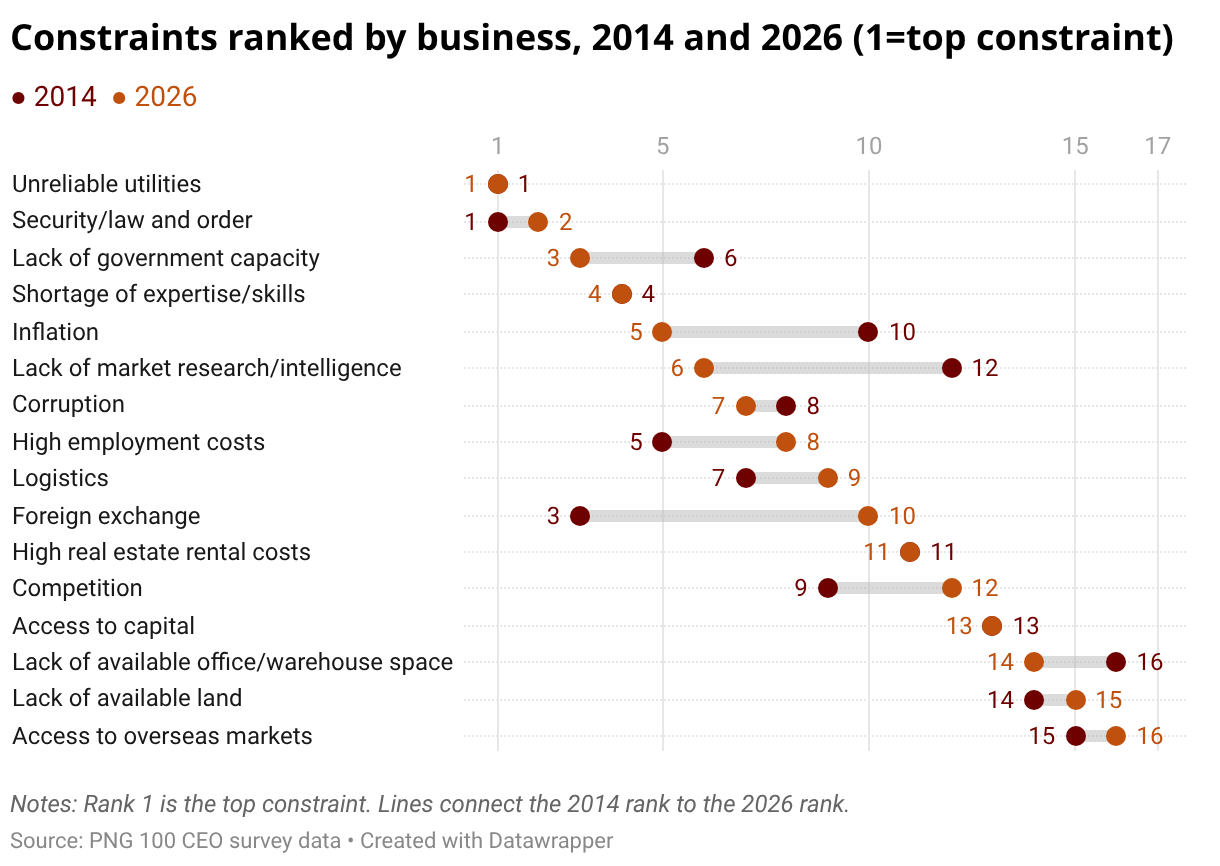
When ranking the 16 business impediments that appear in both the 2014 and the 2026 surveys, there is a lot of similarity over time. The overall correlation between the two sets of rankings is 0.78. Security was the equal first constraint in 2014 and is the second in 2026. Unreliable utilities was first in both years. Shortage of expertise is fourth in both years.
There are a few things firms are less worried about now. One of course is getting hold of foreign exchange: this has fallen from third to tenth place in the rankings. High employment costs have dropped from fifth to eighth place, competition from ninth to twelfth.
But three things have moved up in importance. Inflation has moved up from tenth to fifth, lack of market research from twelfth to sixth, and lack of government capacity from sixth to third.
In fact, the top three constraints are now all governance related: law and order, unreliable utilities and lack of government capacity. Improving law and order requires more jobs but also a more effective police force. A former police minister described PNG’s police force in 2020 to be “in complete disarray and riddled with corruption”. PNG’s state-owned electricity utility, PNG Power, has long been suffering from a governance crisis. Regarding government capacity, international indicators show PNG’s government effectiveness score declining over the 2010s and 2020s (See Figure 12.1 of Struggle, Reform, Boom and Bust: an Economic History of Papua New Guinea since Independence).
Poor governance is a tax on business.
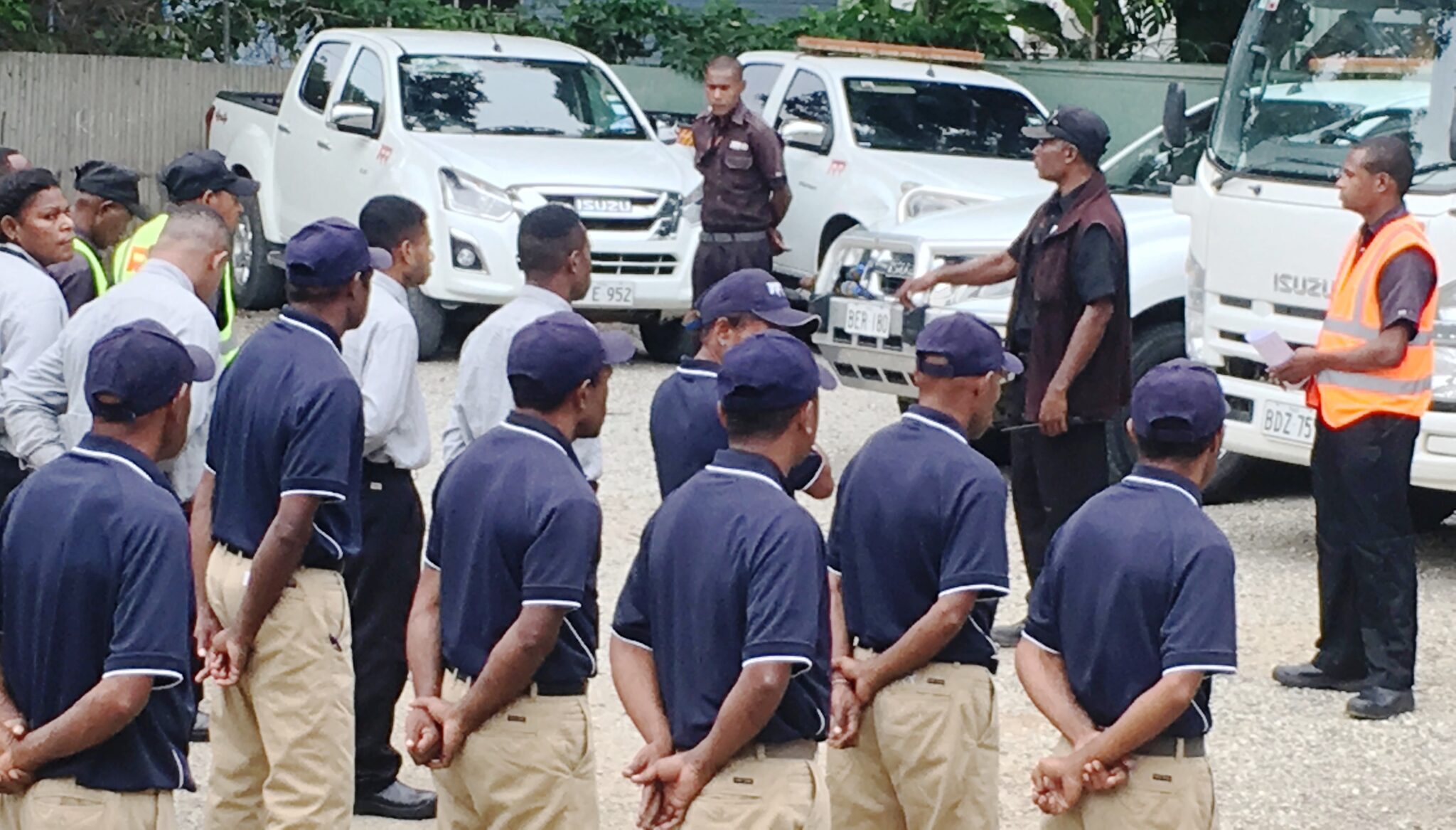
Business firms have to spend more on security when law and order are weak. A survey in 2014 showed that almost 80% of PNG’s businesses employ security guards. PNG’s security industry has now turned into the third largest employer in the country.
When power is unreliable, firms spend on expensive private generators. The head of the Lae Chamber of Commerce said last year that in Lae — the manufacturing hub of the country — businesses are “running 100% of the time on diesel generators tripling their operational cost”. And indeed a study of 8,483 firms across 25 African countries found that the cost of own-generation is three times higher than purchasing from the public grid. Coping is costly. A study of 243 firms in Uganda shows that poor public services result in firms investing in public capital themselves rather than making business investments. This means locking away employment opportunities that PNG desperately needs.
The impact of a lack of government capacity is harder to quantify. But, for example, government delays regarding the re-opening of the Porgera mine are estimated to have incurred care and maintenance costs of about K35 million every month. Most of the time though it is impossible to put a price tag on the inability of many departments and agencies to perform basic functions given persistent bureaucratic fragmentation and the absence of a strong development-oriented technocracy.
Poor governance is about much more than corruption, the usual focus of complaints about the PNG government. In fact, while corruption is also recognised by businesses as a problem, it comes in significantly lower (eighth in 2014, seventh in 2026) than the top three governance complaints of poor law and order, unreliable utilities, and a lack of government capacity.
Governance failures are hard to address. Foreign exchange shortages can be — and largely have been, at least for now — fixed by policy reforms, International Monetary Fund support and commodity price rises. But fixing the police, fixing PNG Power, fixing the bureaucracy — these are tasks many PNG governments have set themselves, but none has delivered.
There is clearly no easy solution. But a first step is to recognise that slow economic growth in PNG is, at its heart, a governance story.
The data over time from the Business Advantage surveys are available here.