


In the first article in this two-part series we explained why last year, 2024–25, Australia set a new record for issuing backpacker visas: the number, 321,000, was significantly above the previous record of 258,000 set in 2012–13.
We ended that article by speculating that it might have been the record inflow of backpackers that has finally spurred the government to implement reforms that have been debated for at least the last decade — since in 2016 the Fair Work Ombudsman found, after an inquiry into the employment of backpackers, that the scheme’s “work-for-visa” system is broken.
The 2026 budget flagged reforms to the Working Holiday Maker (WHM) visa program to “better control numbers, reduce barriers to work, provide a fairer allocation of WHM visas, and support Australia’s national interests” (p. 8). In this article we unpack what this could and should entail.
No details were given in the budget announcement beyond an expanded use of ballots. Ballots are already used to manage the massive excess demand for backpacker visas in China, India and Vietnam. One media source has suggested the use of ballots could be expanded to cover Indonesia, Chile, Argentina, Spain, Singapore and Israel.
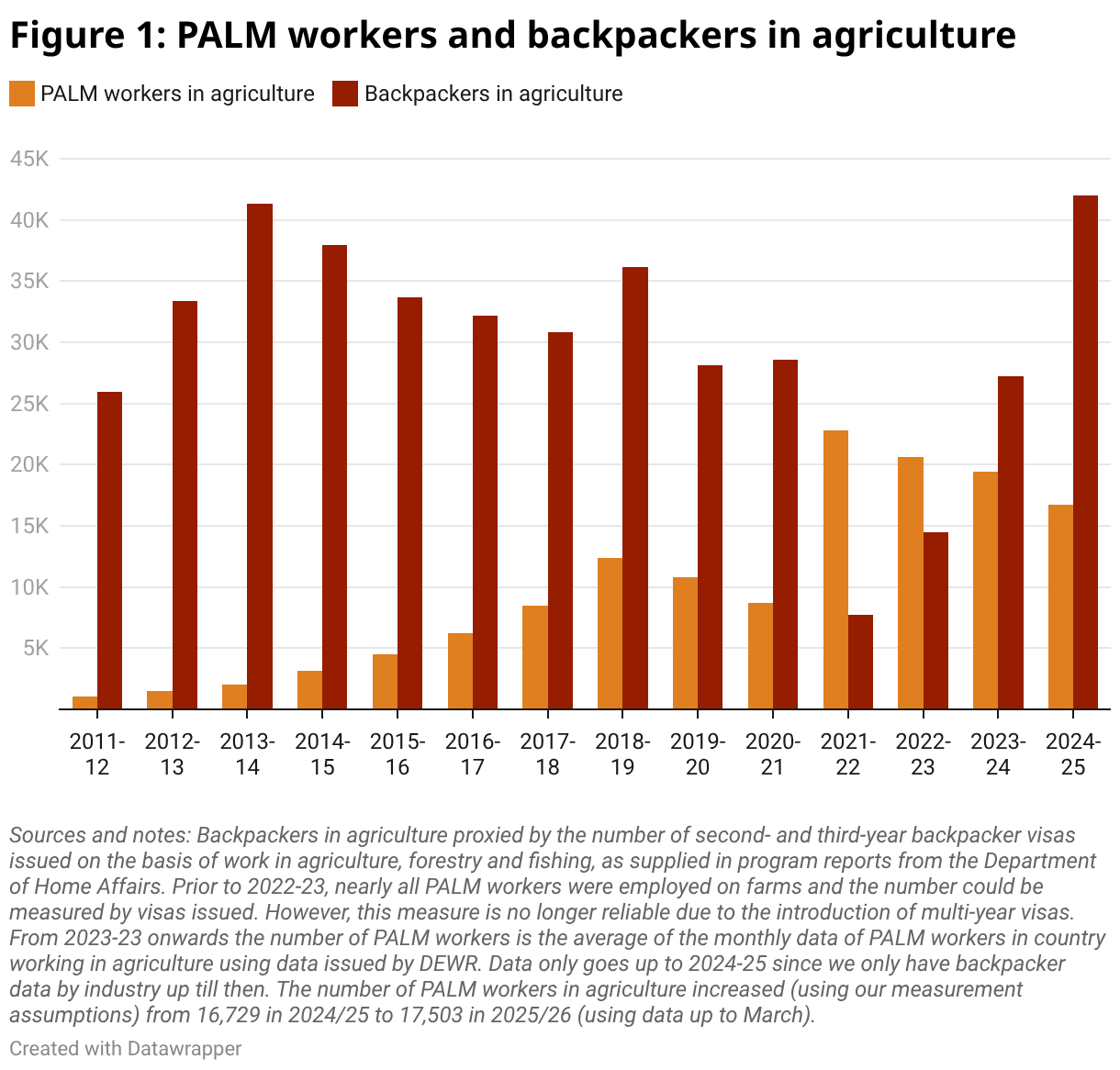
The reference to Australia’s national interests gives some further insight into the government’s thinking. Backpackers compete directly for jobs with Pacific Australia Labour Mobility (PALM) scheme workers. Most backpackers who work for a second- or third-year visa do so by working on a farm. PALM is a highly and increasingly tightly regulated scheme. By contrast, there is no regulation at all specific to the backpacker program. Not surprisingly, then, the PALM agricultural workforce, which had grown during the pandemic when the backpackers left, has shrunk now that they have returned: a decline from 22,445 PALM workers in agriculture as of June 2023 to 18,295 in March 2026.
This is against Australia’s national interests.
We can roughly compare the number of PALM workers to the number of backpackers in agriculture by taking the number of second- or third-year visa grants which have agriculture listed as their employer’s industry as a proxy for the latter. Outside of the pandemic, there have always been many more backpackers than Pacific workers in agriculture, but the ratio had been improving in favour of PALM workers before then. It is now significantly worsening again with the number of PALM workers in agriculture having fallen and the number of backpackers in agriculture reaching an all-time high.
What can the government do to protect opportunities for PALM workers, bearing in mind that several large Pacific countries want to send many more workers?
The reference to reducing barriers to work for backpackers gives a clue. Backpackers who want to get a second- or third-year visa (and are not from the United Kingdom) have to work in regional areas on a farm, in a mine or on a construction site. Since June 2021, in Northern Australia and postcodes that are considered remote and very remote, backpackers can also work in tourism and accommodation (full details regarding work requirements for later year visas are given here). This 2021 reform has already had a big impact. Last year, 28% of the non-UK backpackers granted a second- or third-year visa were approved on the basis of work in accommodation. It makes no sense to have such a complex set of work requirements. The government has several options, but not all of them are politically feasible.
Let’s deal with the braver, but probably too-hard reforms first.
One such reform would be to extend the treatment given to UK backpackers to backpackers of all nationalities, that is, effectively hand out three-year visas. That will not happen because, as the UK experiment shows us, it would generate a massive increase in backpacker numbers. This would be unacceptable in a context in which the government is aiming to reduce net overseas migration from 305,000 in 2024–25 to 245,000 in 2026–27 and to 225,000 by 2027–28.
A second “brave” reform would be to remove the requirement for regional work altogether, and just require that all non-UK backpackers undertake six months of work in their first year to get a second-year visa and three months of work in their second year to get a third-year visa. Most backpackers would rather be in the capital cities of Australia than in rural and remote areas. However, such a change could again be too radical for the government as it would attract more migrants to Australia, and more migrants looking for housing in our big cities.
A third option would be to recognise second- and third-year backpacker visas as work visas, and require any employer hiring such visa holders or accrediting first-year backpacker visas as having met their work requirements to register with government. They would have to pass “approved employer” tests, the same ones that PALM employers must pass. This would level the backpacker-PALM playing field, and greatly reduce backpacker exploitation. However, farmer groups are already complaining about the budget announcement of backpacker visa reform, and would be furious if such regulations were imposed on them.
If the above three are in the “too hard” basket, this leaves just two options which are probably politically feasible.
The first of these would be to remove the North Australia / very remote / remote / regional distinctions between work requirements, and simply have one set of work requirements for all backpackers, that is, that they undertake regional work. This would be logical, would reduce complexity, would make the backpacker program as a whole only marginally more attractive, and would serve the national interest by reducing competition between backpackers and PALM workers. Since agricultural workplaces are the most remote, they are the most susceptible to exploitation, so getting backpackers off farms and into hotels would also help reduce worker exploitation.
The second feasible reform would be to remove the exemption for agriculture from a condition that applies to other sectors, namely that a backpacker can only work for the same employer at the same location for six months. This exemption was given to agriculture in November 2018. In the same spirit of levelling the playing field for all regional employers, this exemption should go. That would help PALM and would reduce the number of backpackers staying on.
The backpacker work-for-visa scheme has long been broken. It is a pity that, despite this, the scheme has been allowed to boom for a second time, reaching record levels last year. The budget’s announcement of reforms to the backpacker work-for-visa scheme is not only welcome, but long overdue.
Read part 1.






Hi Stephen and Finn, absolutely agree on the need to reform the WHM schemes. As a first step I would suggest revoking the third year visa altogether (for all countries but the UK since, unfortunately Canberra’s hands are tied by the Morrison-Johnson free trade agreement). I do not believe the third year visa is part of any other bilateral agreement so it could be easily dispensed with. It was a Coalition-era initiative and if Labor wants to take credit for reducing Net Overseas Migration then scrapping the third visa option would make sense as a first step. If the definition of “specified work” to allow WHMs to qualify for a second visa is broadened to include any “regional work” as you propose, then I suggest this needs to be accompanied by a narrowing of the definition of “regional”. (Is Adelaide really “regional”?)