


According to the recent PNG National Census, the country’s population is around 10 million people. Four million are under the age of 18. Though the accuracy of the census figures is debatable, the ongoing concerns about a youth bulge are undeniable. PNG’s National Statistician John Igitoi described the growing youth population as “scary” and the birth rate is now seen as a threat to the country. Every year, PNG welcomes over 200,000 births. One in three of these births is unplanned.
The country’s National Demographic and Health Survey (DHS) tracks two key measures of fertility. The first is the Total Fertility Rate (TFR) and the second is the Wanted Fertility Rate (WFR). In PNG, the TFR is 4.2 children per woman, while the WFR is 3.0 children per woman. The difference between the TFR and the WFR is 1.2 extra children per woman, 40% higher than desired.
So how many “unplanned people” is that? When asked about their most recent birth, 17% of women indicated that it was unwanted (no more children desired) while 11% indicated that it was mistimed (wanted later but not now). Taken together, 28% of births were unplanned. With 230,000 births annually, that means something like 64,000 babies each year are born earlier than their mothers want, or are not wanted at all. Over a decade, that adds up to more than 600,000 people. That’s equivalent to nine times the population of Manus Province.
Why are there so many extra births?
First, access to family planning is limited. Only 37% of women have access to contraceptives. In rural areas, contraceptives are particularly scarce — less than 35% of women have access. Women who want to delay or stop childbearing often cannot.
The second reason is early marriage and teen pregnancies. For every 1,000 girls, 65 began childbearing before their 20th birthday. This is above the average of developing countries and the highest level in the region.
Third, there are education gaps. On average, women with higher education marry at age 23.5 years compared to 18.4 for those with elementary education only. A study of 6,406 women aged 23 to 30 years in Nepal, a developing country like PNG, found that completion of secondary schooling is the optimal level of education to delay women’s age at marriage and at first pregnancy. In PNG, however, most girls never make it to secondary school.
Fourth, there are cultural norms and demands related to the need for family labour to earn livelihoods. Children are seen as sources of labour and security in rural PNG. Hence, rural households tend to exhibit high fertility preferences.
Unplanned fertility is not evenly spread across the country. It varies sharply according to wealth, region and education. Poorer households want larger families but overshoot those targets (WFR: 3.6 vs TFR: 5) compared to wealthy households (WFR: 2.4 vs TFR: 3.4). The Highlands region has higher fertility preference but lower fertility outcome figures (WFR: 3.0 vs TFR: 3.8) compared to the Islands region (WFR: 2.8 vs TFR: 4.5). Women with little or no schooling prefer around three children, while those with higher education prefer around two.
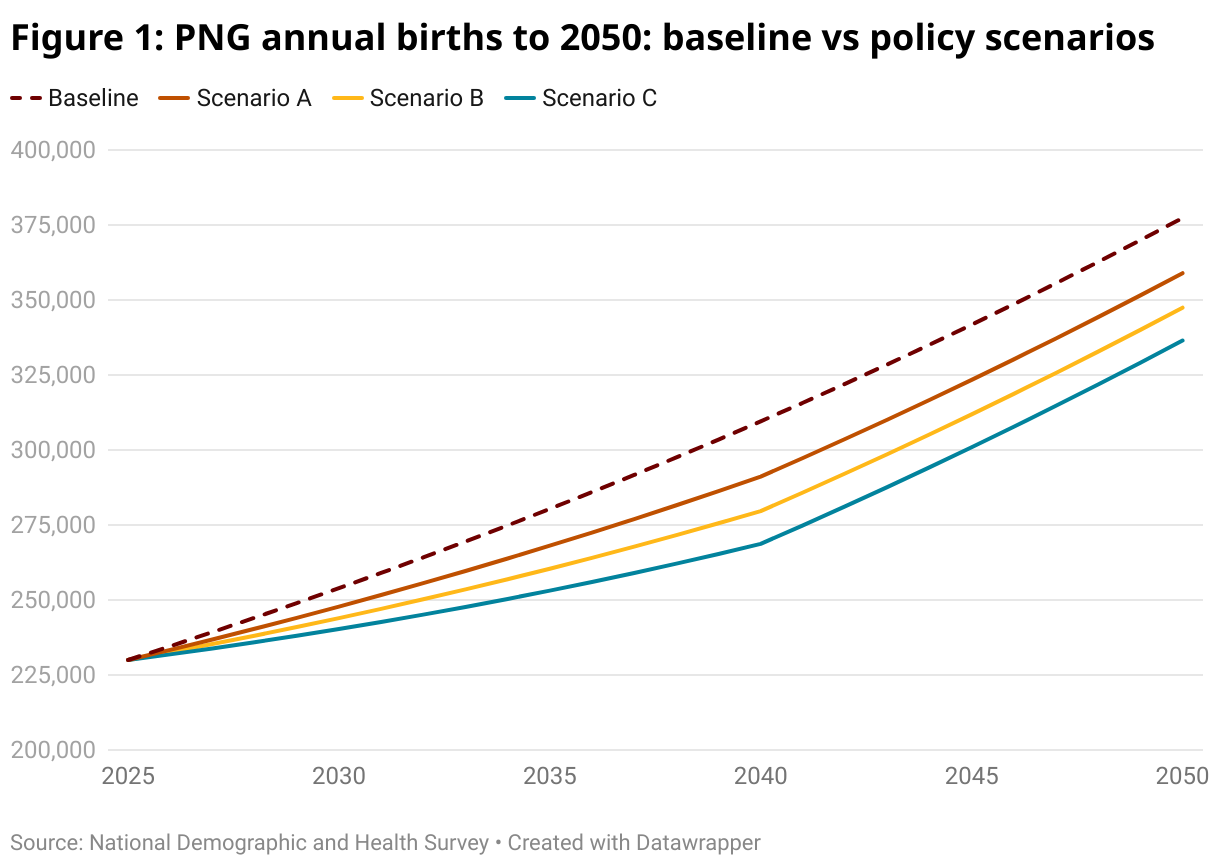
Without decisive policy intervention, annual births would reach over 370,000 by 2050 under a conservative 2% growth rate (Figure 1). Family planning on its own is not enough to alter this trajectory in a meaningful way. Scenario A models a reduction in unplanned births from the current 28% to 20% within 15 years, while Scenario B targets a deeper reduction to 15%. In both cases, the downward pressure on total births is still relatively modest. By contrast, Scenario C, which combines family planning with investments in education and later marriage, shows a strong impact. Annual births are contained below 350,000 until midway through the century.
Academics have warned that PNG’s current booming population is a “ticking time bomb” and that the country’s population might exceed 15 million people by 2030 and 18 million by 2040 — figures far beyond the level that current infrastructure, health systems and labour markets could absorb.
But, in fact, the impacts are already here. The country is currently facing overcrowded hospitals with about one doctor per 40,000 patients and overcrowded schools with about one teacher per 60 students. There is a law and order crisis where one police officer serves 1,845 citizens and there are overpopulated urban centres where job creation struggles to keep up with graduating students. Population growth is clearly out of control. Unplanned births add fuel to that fire.
For population growth to be placed on more sustainable path, the birth rate should truly reflect the optimal choices of households given their constraints. When families decide when to have children, these children are more likely to have a proper education, enjoy better health and grow up in households with less poverty. And, not least, this would reduce additional pressures on the environment — and the economy too. Perhaps then we could allow the National Statistician to avoid the word “scary” and stop commentators framing new births as “a threat” to the country.
To sum up, PNG is already struggling to take care of its population. Yet, every year it adds over 60,000 unplanned citizens to that population. The DHS clearly shows that women want fewer children than they are having now. Not helping them to close this gap would be a missed opportunity.
This article was first published by Lanesia Knots.


As in other countries, men need to play their part in birth control. Vasectomies if they’ve had the desired number of children or the use of condoms. But sadly, men are resistant, and corruption at the top means that the country’s resources are squandered. The figures for doctors and teachers per head of population are sadly reduced from when I was last there!