Bojonegoro, a farming district on the Bengawan Solo river in East Java, sits on the Cepu Block, one of Indonesia’s most productive oil fields. Local legislators estimate that the district supplies about a quarter of national crude output. Between 2019 and 2024 it received more than Rp12.4 trillion (about USD750 million) in oil and gas revenue-sharing transfers, and in 2023 its Rp7.47 trillion budget was, on Bojonegoro Institute’s reading of the published budget figures, the second largest of any regency in Indonesia.
Three channels transmit oil wealth to Bojonegoro, and none of them reports who receives what. Nobody in the district government, the district enterprise or the operating company can show, from published data, whether the poorest women in Bojonegoro have gained anything from the oil.
The money has not reduced poverty at the pace it arrived. In March 2025, 11.49% of Bojonegoro’s population, some 144,900 people, lived below the poverty line, down from 11.69% a year earlier and still well above the national rate of 8.47%. An undergraduate thesis at the University of Jember covering 2017–2024 found no significant effect of the district’s oil and gas revenue share on its poverty rate. That’s one student study rather than hard evidence, but no official evaluation has tested the question either.
The first channel is the revenue-sharing transfer (dana bagi hasil, or DBH) from the national budget. The second is the 10% participating interest in the Cepu Block reserved for regional governments, in which Bojonegoro’s share is held through the district enterprise PT Asri Dharma Sejahtera. The third is the operator’s direct contribution to communities and the local economy, through community development programs and the local hiring and contracting required by a 2011 district regulation on local content. All three are now under strain, and none was designed to track who within the district benefits.
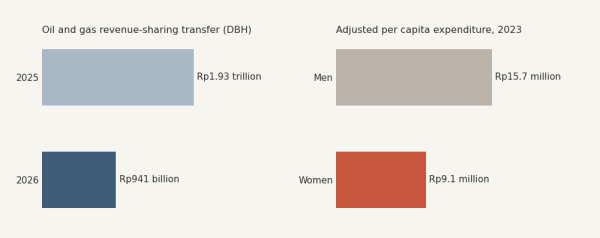
The transfer channel depends on Jakarta, and in Indonesia’s current turn towards recentralisation that is a weakness. As Ronny Sasmita has argued on this blog, regions hold political autonomy without fiscal substance, and more than 80% of them rely on central transfers for most of their budgets. The 2026 national budget calculated natural resource revenue shares at only 50% of the amount set by the 2022 law on central–regional fiscal relations. Bojonegoro’s oil and gas DBH fell from Rp1.93 trillion in 2025 to Rp941 billion (about USD57 million). A share written into law was halved through an annual budget decision. The district’s new education endowment, meant to turn oil revenue into long-term human capital, was cut from Rp500 billion to Rp200 billion before it was capitalised.
The ownership channel leaks. Under a 2009 shareholder agreement, the district enterprise’s private partner receives 75% of the dividends from Bojonegoro’s participating interest and the district 25%. Of the USD37.6 million in dividends for 2022, the district received USD9.4 million. A hearing in the district parliament in August 2026 ended without agreement on renegotiation. The accounts of the enterprise are not published, so residents cannot see what the remaining quarter was spent on.
The company channel is growing in importance as transfers shrink. ExxonMobil Cepu Limited reports more than 200,000 direct beneficiaries of its community development programs across four districts. These programs are approved by the national upstream regulator, SKK Migas, and presented to district agencies for coordination. After its transfers were cut by about Rp370 billion, neighbouring Blora asked whether company community funds could be recorded as district revenue. Company programs can fill gaps, but their published results are counts of people reached rather than evidence of who benefits, and they answer to the company and a central regulator, not to local voters.
What the government does publish suggests where the gaps are likely to be, even though none of it is tied to oil spending. In 2023, women’s adjusted per capita expenditure in Bojonegoro was Rp9.06 million, against Rp15.74 million for men, or about 58% of men’s level. Women averaged 6.96 years of schooling against 8.04 years for men. Bojonegoro Institute’s analysis of the national social registry found women, and especially older women and women with disabilities, over-represented in the poorest tenth of the population. Whether oil-funded programs have reached that group is not recorded anywhere. The chart below shows the fall in revenue-sharing transfers between 2025 and 2026 alongside the gap in adjusted per capita expenditure between women and men.
Figure 1: Bojonegoro oil revenue halved in 2026 and women spend 58% of what men do
Source: Author’s chart from published government data: KPPN Bojonegoro via suarabanyuurip.com; Bojonegoro Regency Government citing BPS (2024).
Gender mainstreaming is not a new obligation. It has been required of all levels of government since 2000, and Bojonegoro passed its own regional regulation on gender mainstreaming in 2025. In practice, a 2025 assessment by Bojonegoro Institute found that most agencies prepare gender budget statements for only one or two sub-activities, often when they are needed for the national gender award rather than during budget preparation. Community participation rarely goes beyond consultation. In the 2023 award round, Bojonegoro was placed in the lowest award category, while neighbouring oil producers Tuban and Blora were placed a tier higher. The award measures administrative compliance: the district is judged on whether it files the paperwork, not on whether the spending changed anything.
The problem lies in how benefit sharing is designed, not in Bojonegoro alone. In Papua New Guinea, the PNG LNG project had shipped more than 200 cargoes before any royalties reached landowners, because the government had not determined who the beneficiaries were. Most landowners were still waiting in 2019, and contributors to that debate on this blog argued that the process also denied the rights of local women. In Western Australia, the Auditor General found in 2014 that Royalties for Regions was delivering infrastructure and services without evidence that projects achieved their intended outcomes. Earmarking revenue for a place does not by itself share benefits within it.
Three changes would let Bojonegoro answer the question it cannot answer now. First, every program financed from oil, including the endowment and company community programs, should report beneficiaries by sex, age, disability and welfare decile. The endowment’s implementing regulation already requires reports every semester, so adding disaggregated data would cost little. Second, the district should publish the participating interest accounts, and any larger share won through the current renegotiation should be ring-fenced for services the poorest households use, with the same reporting attached. Third, women’s groups, organisations of people with disabilities and village representatives need a formal role in setting priorities for oil-funded spending, whether public or corporate.
Production at Banyu Urip, the block’s main field, peaked in 2021 and is now declining, and around 41% of Bojonegoro’s poor, on Bojonegoro Institute’s analysis, work in agriculture. If the transition away from oil is planned without asking who will carry its costs, the women already at the bottom of the distribution are likely to carry them again.
Australia’s International Gender Equality Strategy lists locally led approaches to women’s leadership among its five priorities and Indonesia’s districts are where such approaches succeed or stall. The practical lesson for Australian programs working with subnational governments in Indonesia is that support for gender equality is worth little unless it also builds the reporting that shows where resource money lands. The question for producing regions is no longer whether they receive a share of resource wealth, but whether anyone can show that the share reaches the poorest women before the oil runs out.