


In part 1 and part 2 in this series, the author set out the census evidence on Pacific migration and reflected on what Tuvaluans have built in Australia. In this final part, he turns to Kiribati’s own government.
In the first two articles in this series, I talked about Tuvalu’s migration success and argued that Australia should be fairer to Kiribati. But Kiribati must also do its part. Before I finish, I want to speak directly to my own government — this administration and every administration that follows.
If there is one national issue that should rise above political parties, it is migration.
Kiribati needs to embrace both outward and inward migration as a long-term national development strategy, and no Pacific nation has more reason to than we do. More than half of our population now lives on South Tarawa, one of the most densely populated atolls in the world, and our housing pressures, youth unemployment, infrastructure challenges, freshwater limitations, sanitation issues and increasing climate risks are all intensified by this concentration of people.
Migration should not be seen as an admission of defeat, but as an investment.
When I-Kiribati leave to study, work or settle overseas, they do not stop being I-Kiribati. They become part of a global I-Kiribati community, acquiring new skills, professional networks, languages, business ideas and life experiences. Many return home, others support their families through remittances and others create opportunities for the next generation. This is not brain drain; it is brain circulation.
We have already seen this within our own political leadership. Several members of parliament have lived, studied or worked overseas before returning home to serve our country, and we welcomed them through the ballot box because we recognised the value of the experiences they gained abroad. We should extend that same philosophy to all I-Kiribati.
I therefore encourage the current and every future government to make secure, permanent migration pathways one of our highest foreign policy priorities. Seasonal worker programs are valuable, but they should not be the end goal. We should pursue greater numbers under Australia’s PEV and New Zealand’s Pacific Access Category (PAC), and we should also pursue permanent mobility arrangements similar to Tuvalu’s Falepili Union. Whatever happened politically in 2024 that led to Kiribati only joining the PEV in its second year is now behind us, and looking forward we should participate wherever opportunities exist for our people.
Some people will disagree with me because they fear “brain drain” and for other personal or philosophical reasons. I understand those concerns, but for pragmatic purposes I encourage policymakers to ask ordinary I-Kiribati families what they want: go to the villages, visit the outer islands, conduct a nationwide survey or include these questions in the census. Listen before deciding on behalf of everyone.
I believe the answers would be very consistent. Just look at the number of I-Kiribati who applied for the PEV last year: 10,145, or roughly 100 applications for every visa available — a level of oversubscription that dwarfs even the long-standing pressure on the New Zealand PAC.
Most parents want better educational opportunities for their children, access to quality healthcare, secure employment and choices for their children that they themselves never had. That does not mean they love Kiribati any less; it means they love their children.
There is also an important lesson from Tuvalu. Whatever one’s views on the geopolitics surrounding Australia, China and Taiwan, one thing is difficult to ignore: Tuvalu has consistently pursued international relationships that produced tangible opportunities for its citizens. Whether one interprets the Falepili Union primarily as a climate agreement, a strategic security agreement or a combination of both, the outcome is undeniable — hundreds of Tuvaluans now have a pathway to permanent residency in Australia each year. That is good leadership.
Small island states cannot afford to ignore geopolitics. We do not choose the game, but we do choose how we play it. Our responsibility is not to take sides out of ideology alone, but to secure the greatest long-term benefit for the people we represent. My interest is not in whether China, Taiwan or Australia wins, but in whether I-Kiribati families win. That is the question that should guide every diplomatic decision we make.
Migration is no longer simply a climate issue. It is at once an education, labour, health, economic, housing and population policy, and above all a human and economic development policy.
If Australia and New Zealand are serious about fair or equity-based climate mobility, and not just geopolitical chess, they must look at the per-capita census data and ask honestly: why does Tuvalu receive, as noted in the first article in this series, 12 times more New Zealand PAC slots per capita than Kiribati? Why did Tuvalu receive a bilateral permanent residency treaty with Australia when Kiribati, which pioneered the entire global conversation on climate migration, has nothing comparable?
I am not asking anyone to treat Tuvalu differently. I am asking Australia and New Zealand to be consistent, and I am asking our own government to fight for that consistency — loudly and persistently.
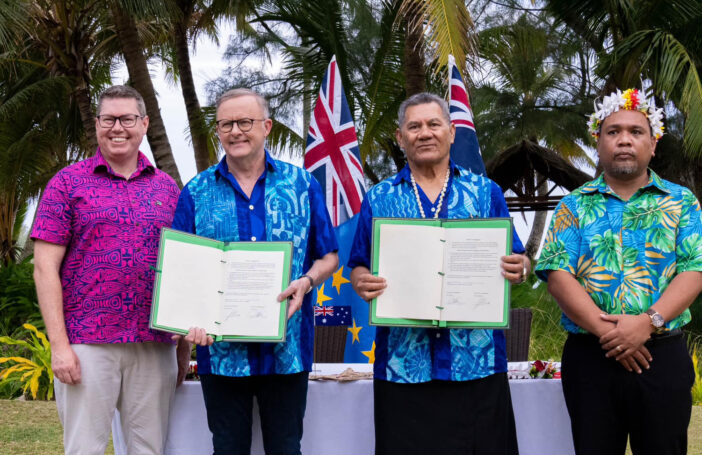
And while we wait, the gap keeps widening. In March 2026, Tuvalu’s Prime Minister Feleti Teo met with New Zealand Prime Minister Christopher Luxon in Auckland and they signed a Statement of Partnership — a formal stepping stone towards a full treaty to be concluded by 2028, the 50th anniversary of Tuvalu’s independence. Prime Minister Teo has publicly stated his ambition to have this framework in place by that milestone, and New Zealand has already pledged an additional NZ$20 million to Tuvalu’s flood resilience work. The goal is a treaty that mirrors and complements the Falepili Union, a bilateral architecture that would give Tuvaluans two separate treaty-level migration agreements with two of the world’s most desirable destinations.
Prime Minister Teo is showing exactly the kind of principled, long-range, people-first leadership that I think we can learn from, building the future for his people with urgency and vision. But if Tuvalu secures that 2028 treaty with New Zealand while Kiribati remains without a single bilateral migration agreement, not with Australia and not with New Zealand, then it will be a profound failure on our part as leaders, and our people will pay the price for it for a generation.
Let us approach migration strategically, so that Kiribati can also build a global diaspora that will return home with the ideas, capital, skills and international experience needed to strengthen our nation for generations to come.
This concludes the three-part series. Read part 1 and part 2.






Mauri Dr Amota,
Thanks for these 3 articles on migration, particularly Kiribati and Tuvalu migration to Australia and New Zealand. Whilst I agree with much of the evidence you present I find differences in context and conclusions.
But first i feel as if I should introduce myself. I live in Ambo, was born in Abaokoro, consider myself to be Tabiteuean but have no Kiribati blood, an I-matang n I-Tabiteuea! My parents were British colonial officials which gave me the privilege of being born in Kiribati and I have now, aged 73, been accepted as a Kiribati citizen. As a child I also lived in the Solomon Islands but have spent most of my life in England where I am a long standing member of the I-Kiribati community. I have spent 20+ years in Kiribati, have lived on Tabiteuea, Onotoa, Butaritari, Betio, Bairiki and the last 10 years in Ambo. I have also stayed with Kiribati families in Australia, NZ, Fiji, Germany, Netherlands and Sweden. I believe my background has given me some understanding of Kiribati but my different life experience often gives me different perspectives which can be useful sometimes in discussion.
With regard to migration it does seem that Kiribati has not got the advantages of many other island peoples, particularly Tuvalu. Kiribati population has grown 4 fold in my lifetime from 30,000 in 1952 to 138,000 now and is unique I think in the Pacific in this regard. It has no migration pathway to a metropolitan state as the COFA countries do with the US and Cook Islands, Nuie, Samoa, Tonga do with NZ and now Tuvalu with Australia. Personally I see this as a positive- there is not the depopulation that is happening in the Cook Islands or the brain drain although I am concerned when I see teachers and nurses, both in short supply in Kiribati, leaving to do age care and fruit picking in Ausralia and NZ . Its great for the people going, more money, experience etc, but it’s not necessarily great for Kiribati.
I think there are a few reasons for this which are positive. Kiribati has done comparatively well financially and stability wise since Independence. Its massive EEZ has given it both more money to invest in social welfare programmes improving the lives of people but also a growing sovereign wealth fund for future investment. Kiribati constitution has also provided stability – only 5 presidents in almost 50 years compared to many many more Prime Ministers in Tuvalu over the same period.
I would really love to see a Marine Science campus of USP located in Kiribati so that over the coming years there is a growing number of I-Kiribati with a good scientific as well as traditional knowledge of our environment, we know how to conserve and farm our ocean and lagoons, te bun. te nuovo, te komera, te koikoi, te waro, te newe etc.
I would also like to see us assembling the data around sea level rise and climate change. The media narrative is not the whole story. Atolls around the world are mainly increasing in land area(see Paul Kench et al studies which have shown accretion of 30% on South Tarawa, and even accretion on Funafuti). My lived experience confirms these findings. We need to be assembling data and studying our environment so we are the experts on atolls, not people who’ve hardly ever spent much time on them. Is overwashing more or less frequent, is it more extensive?We need to measure levels of the water lens, the temperature and acidity of the sea, the health of our corals and much more.
Renewable energy and desalination technology offer us the possibility of making our islands more sustainable despite climate change.
In response to your story about the strength and organisation of the Tuvalu community in Australia as evidenced by their own church and pastor I would point out that Tuvalu is almost exclusively LMS Protestant which means religious and cultural identity are the same, whereas the Kiribati diaspora is denominationally divided, Catholics, Protestants, LDS, SDA. Jehovas Witnesses et al, making it more difficult to come together in that way. Despite this the Kiribati diaspora seems to come together well. I have been a member of the British version, the Kiribati Tungaru Association (KTA) for over 30 years and I see similar communities in Australia, NZ and the USA posting Independence celebrations and dances in their countries (or states).
I offer these comments up for debate, te maroro, and I hope you will consider them as such. I very much enjoyed reading your various articles and look forward to more. I hope that I have the pleasure of meeting you one day, maybe when you next come to Tarawa if you have the time and inclination.